Mali (processor)
Series of graphics processing units produced by ARM Holdings
title: "Mali (processor)" type: doc version: 1 created: 2026-02-28 author: "Wikipedia contributors" status: active scope: public tags: ["arm-architecture", "graphics-processing-units", "graphics-chips"] description: "Series of graphics processing units produced by ARM Holdings" topic_path: "arts" source: "https://en.wikipedia.org/wiki/Mali_(processor)" license: "CC BY-SA 4.0" wikipedia_page_id: 0 wikipedia_revision_id: 0
::summary Series of graphics processing units produced by ARM Holdings ::
::data[format=table title="Infobox graphics processing unit"]
| Field | Value |
|---|---|
| name | Mali |
| image | File:ARMCortexA57A53.jpg |
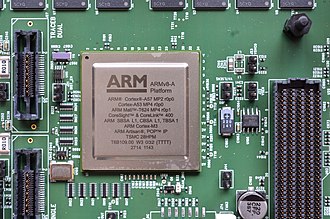
| caption | ARM Cortex A57 A53 big.LITTLE SoC with a Mali-T624 GPU |
| created | 2005 |
| architecture | |
| model | See Variants |
| numcores | 1 to 32 cores |
| fab | 4 to 40 nm |
| d3dversion | 9 to 12 |
| openclversion | 1.1 to 3.0 |
| openglversion | 2.0 to 3.0 |
| vulkanapi | 1.0 to 1.3 |
| :: |
| name = Mali | image = File:ARMCortexA57A53.jpg | img_w = | caption = ARM Cortex A57 A53 big.LITTLE SoC with a Mali-T624 GPU | date = | created = 2005 | architecture = | model = See Variants | cores-nothread = | numcores = 1 to 32 cores | process = | fab = 4 to 40 nm | d3dversion = 9 to 12 | openclversion = 1.1 to 3.0 | openglversion = 2.0 to 3.0 | mantleapi = | vulkanapi = 1.0 to 1.3 The Mali and Immortalis series of graphics processing units (GPUs) and multimedia processors are semiconductor intellectual property cores produced by Arm Holdings for licensing in various ASIC designs by Arm partners.
Mali GPUs were developed by Falanx Microsystems A/S, which was a spin-off of a research project from the Norwegian University of Science and Technology. Arm Holdings acquired Falanx Microsystems A/S on June 23, 2006 and renamed the company to Arm Norway.
It was originally named Malaik, but the team shortened the name to Mali, Serbo-Croatian for "small", which was thought to be fitting for a mobile GPU.
On June 28, 2022, Arm announced their Immortalis series of GPUs with hardware-based Ray Tracing support.
Graphics processors
Utgard
In 2005, Falanx announced their Utgard GPU Architecture, the Mali-200 GPU. Arm followed up with the Mali-300, Mali-400, Mali-450, and Mali-470. Utgard was a non-unified GPU (discrete pixel and vertex shaders). ::data[format=table title="class="nowrap" |Comparison of Mali Utgard graphics processing units"] | Model | Launch date | Type | EUs/Shader core count | Core clock rate | L2 cache size | Fillrate | GFLOPS (per core) | OpenGL ES | M△/s | GT/s | (GP/s) | Mali-55/110 | Mali-200 | Mali-300 | Mali-400 MP | Mali-450 MP | Mali-470 MP | |---|---|---|---|---|---|---|---|---|---|---|---|---|---|---|---|---|---| | 2005 | date=March 2022}} | 1 | | | 2.8 | | 0.1 | | 1.1 | | | | | | | | | | 2007 | Programmable pipeline | 1 | | | 5 | | 0.2 | | 2.0 | | | | | | | | | | 2010 | 1 | 500 | 8 KiB | 55 | | 0.5 | 5 | | | | | | | | | | | | 2008 | 1–4 | 200–600 | 8–256 KiB | 55 | | 0.5 | 1.2–5.4 | | | | | | | | | | | | 2012 | 1–8 | 300–750 | 8–512 KiB | 142 | | 2.6 | 4.5–11.9 | | | | | | | | | | | | 2015 | 1–4 | 250–650 | 8–256 KiB | 71 | | 0.65 | 8–20.8 | | | | | | | | | | | ::
Midgard
1st generation
On November 10, 2010, Arm announced their Midgard 1st gen GPU Architecture, including the Mali-T604 and later the Mali-T658 GPU in 2011. Midgard uses a Hierarchical Tiling system.
2nd generation
On August 6, 2012, Arm announced their Midgard 2nd gen GPU Architecture, including the Mali-T678 GPU. Midgard 2nd gen introduced Forward Pixel Kill.
3rd generation
On October 29, 2013, Arm announced their Midgard 3rd gen GPU Architecture, including the Mali-T760 GPU.
4th generation
On October 27, 2014, Arm announced their Midgard 4th gen GPU Architecture, including the Mali-T860, Mali-T830, Mali-T820. Their flagship Mali-T880 GPU was announced on February 3, 2015. New microarchitectural features include:
- Up to 16 cores for the Mali-T880, with 256KB – 2MB L2 cache
Bifrost
1st generation
On May 27, 2016, Arm announced their Bifrost GPU Architecture, including the Mali-G71 GPU. New microarchitectural features include:
- Unified shaders with quad vectorization
- Scalar ISA
- Clauses execution
- Full cache coherency
- Up to 32 cores for the Mali-G71, with 128KB – 2MB L2 cache
- Arm claims the Mali-G71 has 40% more performance density and 20% better energy efficiency than the Mali-T880
2nd generation
On May 29, 2017, Arm announced their Bifrost 2nd gen GPU Architecture, including the Mali-G72 GPU. New microarchitectural features include:
- Arithmetic optimizations and increased caches
- Up to 32 cores for the Mali-G72, with 128KB – 2MB L2 cache
- Arm claims the Mali-G72 has 20% more performance density and 25% better energy efficiency than the Mali-G71
3rd generation
On May 31, 2018, Arm announced their Bifrost 3rd gen GPU Architecture, including the Mali-G76 GPU. New microarchitectural features include:
- 8 execution lanes per engine (up from 4). Doubled pixel and texel throughput
- Up to 20 cores for the Mali-G76, with 512KB – 4MB L2 cache
- Arm claims the Mali-G76 has 30% more performance density and 30% better energy efficiency than the Mali-G72
Valhall
1st generation
On May 27, 2019, Arm announced their Valhall GPU Architecture, including the Mali-G77 GPU, and in October Mali-G57 GPUs. New microarchitectural features include:
- New superscalar engine
- Simplified scalar ISA
- New dynamic scheduling
- Up to 16 cores for the Mali-G77, with 512KB – 2MB L2 cache
- Arm claims the Mali-G77 has 30% more performance density and 30% better energy efficiency than the Mali-G76
2nd generation
On May 26, 2020, Arm announced their Valhall 2nd Gen GPU Architecture, including the Mali-G78. New microarchitectural features include:
- Asynchronous clock domains
- New FMA units and increase Tiler throughput
- Up to 24 cores for the Mali-G78, with 512KB – 2MB L2 cache
- Arm Frame Buffer Compression (AFBC)
- Arm claims the Mali-G78 has 15% more performance density and 10% better energy efficiency than the Mali-G77
3rd generation
On May 25, 2021, Arm announced their Valhall 3rd Gen GPU Architecture (as part of TCS21), including the Mali-G710, Mali-G510, and Mali-G310 GPUs. New microarchitectural features include:
- Larger shader cores (2x compared to Valhall 2nd Gen)
- New GPU frontend, Command Stream Frontend (CSF) replaces the Job Manager
- Up to 16 cores for the Mali-G710, with 512KB – 2MB L2 cache
- Arm claims the Mali-G710 has 20% more performance density and 20% better energy efficiency than the Mali-G78
4th generation
On June 28, 2022, Arm announced their Valhall 4th Gen GPU Architecture (as part of TCS22), including the Immortalis-G715, Mali-G715, and Mali-G615 GPUs. New microarchitectural features include:
- Ray Tracing support (hardware-based)
- Variable Rate Shading
- New Execution Engine, with doubled the FMA block, Matrix Multiply instruction support, and PPA improvements
- Arm Fixed Rate Compression (AFRC)
- Arm claims the Immortalis-G715 has 15% more performance & 15% better energy efficiency than the Mali-G710
5th generation
On May 29, 2023, Arm announced their 5th Gen Arm GPU Architecture (as part of TCS23), including the Immortalis-G720, Mali-G720 and Mali-G620 GPUs. New microarchitectural features include:
- Deferred vertex shading (DVS) pipeline
- Arm claims the Immortalis-G720 has 15% more performance and uses up to 40% less memory bandwidth than the Immortalis-G715
Technical details
Like other embedded IP cores for 3D rendering acceleration, the Mali GPU does not include display controllers driving monitors, in contrast to common desktop video cards. Instead, the Mali ARM core is a pure 3D engine that renders graphics into memory and passes the rendered image over to another core to handle display.
ARM does, however, license display controller SIP cores independently of the Mali 3D accelerator SIP block, e.g. Mali DP500, DP550 and DP650.
ARM also supplies tools to help in authoring OpenGL ES shaders named Mali GPU Shader Development Studio and Mali GPU User Interface Engine.
Display controllers such as the ARM HDLCD display controller are available separately.
Variants
The Mali core grew out of the cores previously produced by Falanx and currently constitute: ::data[format=table] | Model | Microarchi- tecture | Type | Launch date | EUs/Shader core count | Shading Units (per core) | Total Shaders | Fab (nm) | Die size (mm2) | Core clock rate (MHz) | L2 cache size (KiB) | Fillrate | GFLOPS (per core) | GFLOPS (total) | API (version) | M△/s | GT/s | (GP/s) | Vulkan | OpenGL ES | OpenCL | Model | Microarchi- tecture | Type | Launch date | EUs/Shader core count | Shading Units (per core) | Total Shaders | Fab | Die size (mm2) | Core clock rate (MHz) | Max L2 cache size (KiB) | Fillrate (per core) | FP32 GFLOPS (per core) | GFLOPS (total) | Vulkan | Open GL/ES | Open CL | |---|---|---|---|---|---|---|---|---|---|---|---|---|---|---|---|---|---|---|---|---|---|---|---|---|---|---|---|---|---|---|---|---|---|---|---|---|---| | url=http://www.khronos.org/assets/uploads/developers/library/2012-pan-pacific-road-show/OpenGL-and-OpenGL-ES-Taiwan_Feb-2012.pdf |publisher=Khronos Group |title=OpenGL and OpenGL ES |date=2012 |first1=Alan |last1=Tsai |url-status=live |archive-url=https://web.archive.org/web/20230427064842/https://www.khronos.org/assets/uploads/developers/library/2012-pan-pacific-road-show/OpenGL-and-OpenGL-ES-Taiwan_Feb-2012.pdf |archive-date= Apr 27, 2023 }} | Midgard 1st gen | Unified shader model + | Nov 2010 | 1–4 | 8 | 8–32 | 32 28 | | 533 | 32–256 | 133 | 0.6 @ 600 MHz | 9.6 @ 600 MHz | 9.6–38.4 @ 600 MHz | rowspan="7" | 3.1 | 1.1 Full Profile | | | | | | | | | | | | | | | | | | | | | | Mali-T658 | Nov 2011 | 1–8 | 16 | 16–128 | | | | | | | | 19.2 @ 600 MHz | 19.2–153.6 @ 600 MHz | | | | | | | | | | | | | | | | | | | | | | | | | | | Mali-T622 | Midgard 2nd gen | Jun 2013 | 1–2 | 4 | 4–8 | 32 28 | | 533 | | | | | 4.8 @ 600 MHz | 4.8–9.6 @ 600 MHz | | | | | | | | | | | | | | | | | | | | | | | | | | Mali-T624 | Aug 2012 | 1–4 | 8 | 8–32 | | 533–600 | | | | | 9.6 @ 600 MHz | 9.6–38.4 @ 600 MHz | | | | | | | | | | | | | | | | | | | | | | | | | | | | Mali-T628 | 1–8 | 16 | 16–128 | | 533–695 | | | | | 19.2 @ 600 MHz | 19.2–153.6 @ 600 MHz | | | | | | | | | | | | | | | | | | | | | | | | | | | | | Mali-T678 | 1–8 | | | 28 | | | | | | | | | | | | | | | | | | | | | | | | | | | | | | | | | | | Mali-T720 | Midgard 3rd gen | Oct 2013 | 1–8 | 10 | 10–80 | 28 14 10 | | 400–700 | 600 (MP8@ 600 MHz) | 0.6 @ 600 MHz | 12 @ 600 MHz | 12–96 @ 600 MHz | | | | | | | | | | | | | | | | | | | | | | | | | | | Mali-T760 | 1–16 | 14 | 14–224 | 28 20 14 | 1.75 mm2 per shader core at 14 nm | 600–772 | 256–2048 | 1300 | 16.8 @ 600 MHz | 16.8–268.8 @ 600 MHz | 1.0 | 3.2 | 1.2 Full Profile | | | | | | | | | | | | | | | | | | | | | | | | | | Mali-T820 | Midgard 4th gen | Q4 2015 | 1–4 | 8 | 8–32 | 28 | | 600 | 32–256 | 400 | 9.6 @ 600 MHz | 9.6–38.4 @ 600 MHz | | | | | | | | | | | | | | | | | | | | | | | | | | | Mali-T830 | 16 | 16–64 | 28 16 14 | | 600–950 | 400 | 19.2 @ 600 MHz | 19.2–76.8 @ 600 MHz | | | | | | | | | | | | | | | | | | | | | | | | | | | | | | | Mali-T860 | 1–16 | 14 | 14–224 | | 350–700 | 256–2048 | 1300 | 16.8 @ 600 MHz | 16.8–268.8 @ 600 MHz | | | | | | | | | | | | | | | | | | | | | | | | | | | | | | Mali-T880 | Q2 2016 | 1–16 | 21 | 21–351 | 20 16 14 | | 650–1000 | 1700 | 25.2 @ 600 MHz | 25.2–403.2 @ 600 MHz | | | | | | | | | | | | | | | | | | | | | | | | | | | | | Mali-G31 | Bifrost 1st gen | Unified shader model + Unified memory + | Q1 2018 | 1–6 | 4 or 8 | 4–48 | 28 12 | | 650 | 32–512 | | 0.5 @ 1000 MHz | 8–16 @ 1000 MHz | 48–576 @ 1000 MHz | 1.2 | 2.0 Full Profile | | | | | | | | | | | | | | | | | | | | | | | Mali-G51 | Q4 2016 | 1–6 | 8 or 12 | 8–72 | 28 16 14 12 10 | | 1000 | | 16–24 @ 1000 MHz | 16–144 @ 1000 MHz | 1.0 | | | | | | | | | | | | | | | | | | | | | | | | | | | | Mali-G71 | Q2 2016 | 1–32 | 12 | 12–384 | 16 14 10 | | 546–1037 | 128–2048 | 1850 | 1 @ 1000 MHz | 24 @ 1000 MHz | 24–768 @ 1000 MHz | | | | | | | | | | | | | | | | | | | | | | | | | | | Mali-G52 | Bifrost 2nd gen | Q1 2018 | 1–6 | 16 or 24 | 16–144 | 16 12 8 7 | | 850 | 32-512 | | 2 @ 1000 MHz | 32–48 @ 1000 MHz | 32–288 @ 1000 MHz | 2.1 Full Profile | | | | | | | | | | | | | | | | | | | | | | | | | Mali-G72 | Q2 2017 | 1–32 | 12 | 12–384 | 16 12 10 | 1.36 mm2 per shader core at 10 nm | 572–1050 | 128–2048 | | 1 @ 1000 MHz | 24 @ 1000 MHz | 24–768 @ 1000 MHz | 2.0 Full Profile | | | | | | | | | | | | | | | | | | | | | | | | | | Mali-G76 | Bifrost 3rd gen | Q2 2018 | 4–20 | 24 | 96–480 | 12 8 7 | | 600–800 | 512–4096 | | 2 @ 1000 MHz | 2 @ 1000 MHz | 48 @ 1000 MHz | 192–960 @ 1000 MHz | 1.1 | 2.1 Full Profile | | | | | | | | | | | | | | | | | | | | | | | Mali-G57 | Valhall 1st gen | Superscalar engine + Unified memory + | Q2 2019 | 1–6 | 32 | 32–192 | 12 7 6 | ? | 950 | 64–512 | ? | 4 @ 1000 MHz | 64 @ 1000 MHz | 64–384 @ 1000 MHz | | | | | | | | | | | | | | | | | | | | | | | | | Mali-G77 | 7–16 | 224–512 | 7 6 | ? | 695–850 | 512–2048 | ? | 448–1024 @ 1000 MHz | | | | | | | | | | | | | | | | | | | | | | | | | | | | | | | Mali-G68 | Valhall 2nd gen | Q2 2020 | 1–6 | 32–192 | 6 5 3 | | | | 64–384 @ 1000 MHz | 1.2 | 3.0 Full Profile | | | | | | | | | | | | | | | | | | | | | | | | | | | | Mali-G78 | 7–24 | 224–768 | 5 | | 759-848 | | 448–1536 @ 1000 MHz | | | | | | | | | | | | | | | | | | | | | | | | | | | | | | | | Mali-G310 | Valhall 3rd gen | Q2 2021 | 1 | 16 or 32 or 64 | 16–64 | 6 5 4 | | | 256–1024 | | 2, 4 or 8 @ 1000 MHz | 2 or 4 @ 1000 MHz | 32–128 @ 1000 MHz | | | | | | | | | | | | | | | | | | | | | | | | | | Mali-G510 | 2–6 | 48 or 64 | 96–384 | | | | 4 or 8 @ 1000 MHz | 4 @ 1000 MHz | 96–128 @ 1000 MHz | 192–768 @ 1000 MHz | | | | | | | | | | | | | | | | | | | | | | | | | | | | | Mali-G610 | 1–6 | 64 | 64–384 | | | 512–2048 | | 8 @ 1000 MHz | 128 @ 1000 MHz | 128–768 @ 1000 MHz | | | | | | | | | | | | | | | | | | | | | | | | | | | | | Mali-G710 | 7–16 | 448–1024 | | 650,850 900 | 2648 | 896–2048 @ 1000 MHz | | | | | | | | | | | | | | | | | | | | | | | | | | | | | | | | | Mali-G615 | Valhall 4th gen | Q2 2022 | 1–6 | 128 | 128–768 | 4 | | | | 256 @ 1000 MHz | 256–1536 @ 1000 MHz | 1.3 | | | | | | | | | | | | | | | | | | | | | | | | | | | Mali-G715 | 7–9 | 896–1152 | | | | 1792–2304 @ 1000 MHz | | | | | | | | | | | | | | | | | | | | | | | | | | | | | | | | | Immortalis-G715 | 10–16 | 1280–2048 | | | | 2560–4096 @ 1000 MHz | | | | | | | | | | | | | | | | | | | | | | | | | | | | | | | | | Mali-G620 | 5th Gen | Deferred Vertex Shading (DVS) | Q2 2023 | 1–5 | 128–640 | | | 256–1024 | | 256–1280 @ 1000 MHz | | | | | | | | | | | | | | | | | | | | | | | | | | | | | Mali-G720 | 6–9 | 768–1152 | | | 512–2048 | | 1536–2304 @ 1000 MHz | | | | | | | | | | | | | | | | | | | | | | | | | | | | | | | | Immortalis-G720 | Q4 2023 | 10–16 | 1280–2048 | | | | 2560–4096 @ 1000 MHz | | | | | | | | | | | | | | | | | | | | | | | | | | | | | | | | Mali-G625 | Q2 2024 | 1–5 | 128–640 | 4 3 | | | 256–1024 | | 256–1280 @ 1000 MHz | | | | | | | | | | | | | | | | | | | | | | | | | | | | | | Mali-G725 | 6–9 | 768–1152 | | | 512–4096 | | 1536–2304 @ 1000 MHz | | | | | | | | | | | | | | | | | | | | | | | | | | | | | | | | Immortalis-G925 | 10–24 | 1280–3072 | | | | 2560–6144 @ 1000 MHz | | | | | | | | | | | | | | | | | | | | | | | | | | | | | | | | | Mali G1-Pro | Q3 2025 | 1–5 | 128–640 | 3 | | | 512–2048 | | 256–1280 @ 1000 MHz | 1.4 | | | | | | | | | | | | | | | | | | | | | | | | | | | | | Mali G1-Premium | 6–9 | 768–1152 | | | 512–4096 | | 1536–2304 @ 1000 MHz | | | | | | | | | | | | | | | | | | | | | | | | | | | | | | | | Mali G1-Ultra | 10–24 | 1280–3072 | | | | 2560–6144 @ 1000 MHz | | | | | | | | | | | | | | | | | | | | | | | | | | | | | | | | ::
Some microarchitectures (or just some chips?) support cache coherency for the L2 cache with the CPU.
Adaptive Scalable Texture Compression (ASTC) is supported by Mali-T620, T720/T760, T820/T830/T860/T880 and Mali-G series.
Implementations
The Mali GPU variants can be found in the following systems on chips (SoCs):
::data[format=table]
| Vendor | SoC name | Mali version |
|---|---|---|
| Allwinner | Allwinner A1X (A10, A10s, A13) | Mali-400 MP @ 300 MHz |
| A20, A23, A33, A64, H2, H3, H64, R8, R16, R40, R18 | Mali-400 MP2 @ 350/350/350/600/600/?/?/?/?/?/? MHz | |
| H5 | Mali-450 MP4 | |
| H6 | Mali-T720 MP2 | |
| H313, H616, H618 | Mali-G31 MP2 | |
| Amlogic | 8726-M series (8726-M1, 8726-M3, 8726-M6, 8726-MX) | date=2012-02-08 |
| 8726-M8 series (M801, M802, S801, S802, S812) | Mali-450 MP6 @ 600 MHz | |
| 8726-M8B series (M805, S805) | Mali-450 MP2 @ 500 MHz | |
| S905, S905X/D/L | Mali-450 MP3 @ 750 MHz | |
| S905X2, S905X3, S905Y2, S905D2, S905X4 | Mali-G31 MP2 | |
| S905X5 | Mali-G310 @ 1 GHz | |
| S912 | Mali-T820 MP3 @ 600 MHz | |
| S922X, A311D | Mali-G52 MP4 | |
| T966 | Mali-T830 MP2 @ 650 MHz | |
| ARM | Morello | Mali-G76 |
| Asus | Tinkerboard, Tinkerboard S | Mali-T760 |
| Baikal Electronics | Baikal-M | Mali-T628 MP8 |
| CSR | Quatro 5300 Series | Mali-400 MP |
| ELVEES Multicore | 1892VM14Ya | Mali-300 |
| InfoTM | iMAP×15 | Mali-400 |
| iMAP×820 | Mali-400 MP2 | |
| iMAP×912 | Mali-400 MP2 | |
| Tensor | Mali-G78 MP20 @ 848(996) MHz | |
| Tensor G2 | Mali-G710 MP7 @ 848(996) MHz | |
| Tensor G3 | Mali-G715 MP7 @ 890(900) MHz | |
| Tensor G4 | Mali-G715 MP7 @ 940 MHz | |
| HiSilicon | Kirin 620 | Mali-450 MP4 @ 533 MHz |
| Kirin 650/655/658/659 | Mali-T830 MP2 @ 900 MHz | |
| Kirin 710 | Mali-G51 MP4 @ 1000 MHz | |
| Kirin 810 | Mali-G52 MP6 @ 820 MHz | |
| Kirin 820 | Mali-G57 MP6 @??? MHz | |
| Kirin 910/910T | Mali-450 MP4 @ 533/700 MHz | |
| Kirin 920/925/928 | Mali-T628 MP4 @ 600/600/? MHz | |
| Kirin 930/935 | Mali-T628 MP4 @ 600/680 MHz | |
| Kirin 950/955 | Mali-T880 MP4 @ 900 MHz | |
| Kirin 960 | Mali-G71 MP8 @ 1037 MHz | |
| Kirin 970 | Mali-G72 MP12 @ 746 MHz | |
| Kirin 980 | Mali-G76 MP10 @ 720 MHz | |
| Kirin 985 | Mali-G77 MP8 @??? MHz | |
| Kirin 990/990 5G | Mali-G76 MP16 @ 600 MHz | |
| Kirin 9000 5G/Kirin 9000E 5G | Mali-G78 MP24/22 @ 759 MHz | |
| Hi3798cv200 | Mali-T720 @ 450/600 MHz | |
| Leadcore | LC1810, LC1811, LC1813, LC1913 | Mali-400 |
| LC1860, LC1860C, LC1960 | Mali-T628 MP2 @ 600 MHz | |
| MediaTek | MSD6683 | Mali-470 MP3 |
| MT5595, MT5890 | Mali-T624 MP3 | |
| MT5596, MT5891 | Mali-T860 MP2 | |
| MT6571, MT6572, MT6572M | Mali-400 MP1 @ ?/500/400 MHz | |
| MT6580 | Mali-400 MP1 @ 500 MHz | |
| MT6582/MT6582M | Mali-400 MP2 @ 500/416 MHz | |
| MT6588, MT6591, MT6592, MT6592M, MT8127 | Mali-450 MP4 @ 600/700/600/600 MHz | |
| MT6735, MT6735M, MT6735P | Mali-T720 MP2 @ 600/500/400 MHz | |
| MT6737, MT6737T | Mali-T720 MP2 @ 550/600 MHz | |
| MT8735 | Mali-T720 MP2 @ 450 MHz | |
| MT6753 | Mali-T720 MP3 @ 700 MHz | |
| MT6732, MT6732M, MT6752, MT6752M | Mali-T760 MP2 @ 500/500/700/700 MHz | |
| MT6750 | Mali-T860 MP2 @ 520 MHz | |
| MT6755 (Helio P10/P15/P18) | Mali-T860 MP2 @ 700/650/800 MHz | |
| MT6757 (Helio P20, P25) | Mali-T880 MP2 @ 900 MHz/1.0 GHz | |
| MT6797 (Helio X20/X23/X25/X27) | Mali-T880 MP4 @ 780/850/875 MHz | |
| MT6763T (Helio P23), MT6758 (Helio P30) | Mali-G71 MP2 @ 770/950 MHz | |
| MT6771 (Helio P60, P70) | Mali-G72 MP3 @ 800/900 MHz | |
| MT6768 (Helio P65), MT6769 (Helio G70/G80/G85/G88) | Mali-G52 MC2 @ 820/950/1000 MHz | |
| Helio G91 | Mali-G52 MC2 @ 1 GHz | |
| MT6785 (Helio G90/G90T/G95) | Mali-G76 MC4 @ 720/800/900 MHz | |
| MT6781 (Helio G96, G99) | Mali-G57 MC2 @ 950/1000 MHz | |
| MT6833 (Dimensity 700, 810, 6020) | Mali-G57 MC2 @ 950/1068/950 MHz | |
| MT6853 (Dimensity 720, 800U) | Mali-G57 MC3 @ 850 MHz | |
| MT6873 (Dimensity 800) | Mali-G57 MC4 @ 650 MHz | |
| MT6875 (Dimensity 820), MT6883Z (Dimensity 1000C) | Mali-G57 MC5 @ 900 MHz | |
| MT6877/MT6877T (Dimensity 900/920/1080/7050) | Mali-G68 MC4 @ 900 MHz | |
| MT6885Z (Dimensity 1000L) | Mali-G77 MC7 @ 695 MHz | |
| MT6889 (Dimensity 1000/1000+) | Mali-G77 MC9 @ 850 MHz | |
| MT6891/MT6893 (Dimensity 1100/1200/1300/8020/8050) | Mali-G77 MC9 @ 850 MHz | |
| MT8192 (Kompanio 820) | Mali-G57 MC5 GPU @ ??? MHz | |
| Kompanio 838 | Mali-G57 MC3 | |
| MT8195/MT8195T (Kompanio 1200/1380) | Mali-G57 MC5 GPU @ ??? MHz | |
| MT8791 (Kompanio 900T) | Mali-G68 MP4 GPU @ 900 MHz | |
| MT8797 (Kompanio 1300T) | Mali-G77 MP9 @ 850 MHz | |
| MT6886 (Dimensity 7200) | Mali-G610 MC4 @ 1.13 GHz | |
| MT6878 (Dimensity 7300/7300X) | Mali-G615 MC2 @ 1.05 GHz | |
| MT6895/MT6895Z/MT6896 (Dimensity 8000/8100/8200) | Mali-G610 MC6 @ 700/860/950 MHz | |
| MT6897 (Dimensity 8300/8350) | Mali-G615 MC6 @ 1400 MHz | |
| MT6899 (Dimensity 8400/8450) | Mali-G720 MC7 @ 1300 MHz | |
| MT6983 (Dimensity 9000/9000+) | Mali-G710 MP10 @ 848/950 MHz | |
| MT6985 (Dimensity 9200/9200+) | Immortalis-G715 MP11 @ 981/1150 MHz | |
| MT6989 (Dimensity 9300) | Immortalis-G720 MP12 @ 1.3 GHz | |
| Dimensity 9400 | Immortalis-G925 MP12 | |
| MT6993 (Dimensity 9500) | Mali-G1 Ultra MC12 @ 1716 MHz | |
| NetLogic | Au1380, Au1350 | Mali-200 |
| Nufront | NS2816, NS2816M | Mali-400 MP |
| NS115, TL7688, TL7689 | Mali-400 MP2 | |
| NXP | i.MX95 | Mali-G310 MP1 |
| Realtek | RTD1294, RTD1295, RTD1296 | Mali-T820 MP3 |
| RTD1395 | Mali-470 | |
| Rockchip | RK2818 | Mali-200 |
| RK2926, RK2628, RK3036, RK3229 | Mali-400 MP @ 400/400/500/600 MHz | |
| RK3026, RK3126, RK3128 | Mali-400 MP2 @ 500/600/600 MHz | |
| RK3066, RK3188, RK3188T | Mali-400 MP4 @ 266/533/~400 MHz | |
| RK3288 | Mali-T760 MP4 @ 600 MHz | |
| RK3326 | title=Rockchip-瑞芯微电子股份有限公司 | url=http://www.rock-chips.com/a/en/products/RK33_Series/2018/0514/900.html |
| RK3328 | Mali-450 MP2 | |
| RK3399 | Mali-T860 MP4 @ 600 MHz | |
| RK3566, RK3568 | Mali-G52 MC1 @ 800 MHz | |
| RK3576 | Mali-G52 MC3 @ 1000 MHz | |
| RK3588 | Mali-G610 MC4 @ 1000 MHz | |
| Samsung | Exynos 3 Quad 3470 | Mali-400 MP4 @ 450 MHz |
| Exynos 3 Quad 3475 | Mali-T720 @ 600 MHz | |
| Exynos 4 Dual 4210 | Mali-400 MP4 @ 266 MHz | |
| Exynos 4 Dual 4212 | Mali-400 MP4 @ 400 MHz | |
| Exynos 3 Quad 4412/4415 | Mali-400 MP4 @ 533 MHz | |
| Exynos 5 Dual 5250 | Mali-T604 MP4 @ 533 MHz | |
| Exynos 5 Hexa 5260 | Mali-T624 MP4 @ 600 MHz | |
| Exynos 5 Octa 5420/5422 | Mali-T628 MP6 @ 533 MHz | |
| Exynos 5 Octa 5430/5800 | Mali-T628 MP6 @ 600 MHz | |
| Exynos 5 Hexa 7872 | Mali-G71 MP1 @ 1200 MHz | |
| Exynos 7 Octa 5433/7410 | Mali-T760 MP6 @ 700 MHz | |
| Exynos 7 Octa 7420 | Mali-T760 MP8 @ 772 MHz | |
| Exynos 7 Quad 7570 | Mali-T720 MP1 @ 830 MHz | |
| Exynos 7 Octa 7578/7580 | Mali-T720 MP2 @ 668 MHz | |
| Exynos 7 Octa 7870 | Mali-T830 MP1 @ 700 MHz | |
| Exynos 7 Octa 7880 | Mali-T830 MP3 @ 950 MHz | |
| Exynos 7 Series 7884A | Mali-G71 MP2 @ 450 MHz | |
| Exynos 7 Series 7884 | Mali-G71 MP2 @ 676/845 MHz | |
| Exynos 7 Series 7885 | Mali-G71 MP2 @ 1100 MHz | |
| Exynos 7 Series 7904 | Mali-G71 MP2 @ 770 MHz | |
| Exynos 850 | Mali-G52 MP1 @ 1001 MHz | |
| Exynos 880 | Mali-G76 MP5 @ 546 MHz | |
| Exynos 8 Octa 8890 | Mali-T880 MP10 (Lite) @650 MHz | |
| Mali-T880 MP12 @650 MHz | ||
| Exynos 9 Octa 8895 | Mali-G71 MP20 @ 546 MHz | |
| Exynos 7 Series 9609 | Mali-G72 MP3 | |
| Exynos 7 Series 9610 | Mali-G72 MP3 @ 1053 MHz | |
| Exynos 7 Series 9611 | Mali-G72 MP3 @ 850 MHz | |
| Exynos 9 Series 9810 | Mali-G72 MP18 @ 572 MHz | |
| Exynos 9 Series 9820 | Mali-G76 MP12 @ 702 MHz | |
| Exynos 9 Series 9825 | Mali-G76 MP12 @ 754 MHz | |
| Exynos 9 Series 980 | Mali-G76 MP5 @ 728 MHz | |
| Exynos 9 Series 990 | Mali-G77 MP11 @ 832 MHz | |
| Exynos 1080 | Mali-G78 MP10 @ 800 MHz | |
| Exynos 1280 | Mali-G68 MP4 @ 897 MHz | |
| Exynos 1330 | Mali G68 MP2 @ 949 MHz | |
| Exynos 1380 | Mali-G68 MP5 @ 949 MHz | |
| Exynos 2100 | Mali-G78 MP14 @ 854 MHz | |
| S5P6450 Vega | Mali-400 MP | |
| Sigma Designs | SMP8750 Series | Mali-400 MP4 @ 350 MHz |
| Socle-Tech | Leopard-6 | Mali-200 |
| Spreadtrum | SC68xx, SC57xx, SC77xx, SC8xxx, SC983x | Mali-400 MP Series |
| SC9860, SC9860GV | Mali-T880 MP4 | |
| ST-Ericsson | NovaThor U9500, U8500, U5500 | Mali-400 MP |
| STMicroelectronics | SPEAr1340 | Mali-200 |
| STi7108, STiH416 | Mali-400 MP | |
| Telechips | TCC8803, TCC8902, TCC8900, TCC9201 | url=https://web.archive.org/web/20111227094606/http://www.malideveloper.com/developer-resources/development-boards/telechips-tcc8900-development-platform.php |
| WonderMedia | WM8750 | Mali-200 |
| WM8850, WM8950 | Mali-400 MP | |
| WM8880, WM8980 | Mali-400 MP2 | |
| WM8860 | Mali-450 | |
| Xiaomi | Surge S1 | Mali-T860 MP4 @ 800 MHz |
| Surge S2 | Mali-G71 MP12 @ 900 MHz (?) | |
| Xring O1 | Immortalis-G925 MP16 | |
| :: |
Video processors
Mali Video is the name given to ARM Holdings' dedicated video decoding and video encoding ASIC. There are multiple versions implementing a number of video codecs, such as HEVC, VP9, H.264 and VP8. As with all ARM products, the Mali video processor is a semiconductor intellectual property core licensed to third parties for inclusion in their chips. Real time encode-decode capability is central to videotelephony. An interface to ARM's TrustZone technology is also built-in to enable digital rights management of copyrighted material.
Mali-V500
The first version of a Mali Video processor was the V500, released in 2013 with the Mali-T622 GPU. The V500 is a multicore design, sporting 1–8 cores, with support for H.264 and a protected video path using ARM TrustZone. The 8 core version is sufficient for 4K video decode at 120 frames per second (fps). The V500 can encode VP8 and H.264, and decode H.264, H.263, MPEG4, MPEG2, VC-1/WMV, Real, VP8.
Mali-V550
Released with the Mali-T800 GPU, ARM V550 video processors added both encode and decode HEVC support, 10-bit color depth, and technologies to further reduced power consumption. The V550 also included technology improvements to better handle latency and save bandwidth. Again built around the idea of a scalable number of cores (1–8) the V550 could support between 1080p60 (1 core) to 4K120 (8 cores). The V550 supported HEVC Main, H.264, VP8, JPEG encode, and HEVC Main 10, HEVC Main, H.264, H.263, MPEG4, MPEG2, VC-1/WMV, Real, VP8, JPEG decode.
Mali-V61
The Mali V61 video processor (formerly named Egil) was released with the Mali Bifrost GPU in 2016. V61 has been designed to improve video encoding, in particular HEVC and VP9, and to allow for encoding either a single or multiple streams simultaneously. The design continues the 1–8 variable core number design, with a single core supporting 1080p60 while 8 cores can drive 4Kp120. It can decode and encode VP9 10-bit, VP9 8-bit, HEVC Main 10, HEVC Main, H.264, VP8, JPEG and decode only MPEG4, MPEG2, VC-1/WMV, Real, H.263.
Mali-V52
The Mali V52 video processor was released with the Mali G52 and G31 GPUs in March 2018. The processor is intended to support 4K (including HDR) video on mainstream devices.
The platform is scalable from 1 to 4 cores and doubles the decode performance relative to V61. It also adds High 10 H.264 encode (Level 5.0) and decode (Level 5.1) capabilities, as well as AVS Part 2 (Jizhun) and Part 16 (AVS+, Guangdian) decode capability for YUV420.
Mali-V76
The Mali V76 video processor was released with the Mali G76 GPU and Cortex-A76 CPU in 2018. The V76 was designed to improve video encoding and decoding performance. The design continues the 2–8 variable core number design, with 8 cores capable of 8Kp60 decoding and 8Kp30 encoding. It claims improves HEVC encode quality by 25% relative to Mali-V61 at launch. The AV1 codec is not supported.
Mali-V77
The Mali V77 video processor was released with the Mali G77 GPU and Cortex-A77 CPU in 2019.
Comparison
::data[format=table]
| Mali Video | V500 | V550 | V61 | V52 | V76 | V77 | Decode & encode |
|---|---|---|---|---|---|---|---|
| Announced | June 2, 2013 | October 27, 2014 | October 31, 2016 | March 6, 2018 | May 31, 2018 | ||
| Recommended GPU | Mali-T800-series | Mali-G51 | |||||
| Mali-G72 | Mali-G31 | ||||||
| Mali-G52 | Mali-G76 | Mali-G77 | |||||
| Recommended DPU | Mali-DP500 | Mali-DP550 | |||||
| Mali-DP650 | Mali-DP650 | ||||||
| Mali-D71 | Mali-D52 | ||||||
| Memory system | MMU | ||||||
| Bus interface | AMBA 3 AXI | ||||||
| AMBA 4 ACE Lite | AMBA AXI | AMBA4 AXI | |||||
| Performance (enc) | 1080p60 (1 core) to 4K120 (8 core) | 1080p60 (1 core) to 4K60 (4 core) | 1080p60 (1 core) to 8K30 (8 core) | ||||
| Performance (dec) | 1080p120 / 4K30 (1 core) to 4K120 (4 core) | 1080p120 / 4K30 (1 core) to 8K60 (8 core) | |||||
| H.264 8-bit | |||||||
| H.264 10-bit | |||||||
| VP8 | |||||||
| JPEG | |||||||
| HEVC Main | |||||||
| HEVC Main 10 | |||||||
| VP9 8-bit | |||||||
| VP9 10-bit | |||||||
| AV1 | |||||||
| :: |
Display processors
Mali-D71
The Mali-D71 added Arm Framebuffer Compression (AFBC) 1.2 encoder, support for ARM CoreLink MMU-600 and Assertive Display 5. Assertive Display 5 has support for HDR10 and hybrid log–gamma (HLG).
Mali-D77
The Mali-D77 added features including asynchronous timewarp (ATW), lens distortion correction (LDC), and chromatic aberration correction (CAC). The Mali-D77 is also capable of 3K (2880x1440) @ 120 Hz and 4K @ 90 Hz. ::data[format=table]
| Mali Display | DP500 | DP550 | DP650 | D71 | D51 | D77 | D37 | Announced | Optimized res | Maximum res | Launched alongside |
|---|---|---|---|---|---|---|---|---|---|---|---|
| May 8, 2010 | October 27, 2014 | January 20, 2016 | October 31, 2017 | March 6, 2018 | May 15, 2019 | October 23, 2019 | |||||
| n/a | 720p (HD) to 1080p (FHD) | 1440p (QHD) | 1440p (QHD) to 2160p (UHD/4K) | 1080p (FHD) to 1440p (QHD) | 2880x1440 @ 120 Hz | 1080p (FHD) to 1440p (QHD) | |||||
| 2160p (4K) | 2160p (4K) | 2160p (4K) | 2160p (4K) up to 120fps | 4096x2048 up to 60fps | 4320x2160 @ 120 Hz | ||||||
| Cortex-A17 core | Mali-T800 series GPU, V550 Video Processor | CoreLink MMU-600, Assertive Display 5 | Mali-G31, Mali-G52, Mali-V52 | Ethos-N77, Ethos-N57, Ethos-N37 Mali-G57 | |||||||
| :: |
Image signal processors
Mali-C71
On April 25, 2017 the Mali-C71 was announced, ARM's first image signal processor (ISP).
Mali-C52 and Mali-C32
On January 3, 2019 the Mali-C52 and C32 were announced, aimed at everyday devices including drones, smart home assistants and security, and internet protocol (IP) camera.
Mali-C71AE
On September 29, 2020 the Mali-C71AE image signal processor was introduced, alongside the Cortex-A78AE CPU and Mali-G78AE GPU. It supports up to 4 real-time cameras or up to 16 virtual cameras with a maximum resolution of 4096 x 4096 each.
Mali-C55
On June 8, 2022 the Mali-C55 ISP was introduced as successor to the C52. It is the smallest and most configurable image signal processor from Arm, and support up to 8 camera with a max resolution of 48 megapixel each. Arm claims improved tone mapping and spatial noise reduction compared to the C52. Multiple C55 ISPs can be combined to support higher than 48 megapixel resolutions.
Comparison
::data[format=table]
| Mali camera | C32 | C52 | C55 | C71 | C71AE |
|---|---|---|---|---|---|
| Announced | January 3, 2019 | June 8, 2022 | April 25, 2017 | September 29, 2020 | |
| Throughput | 600 MP/s | 1.2 GP/s | |||
| Support cameras | 4 | 8 | 4 real-time or 16 virtual | ||
| Max resolution | 4608×3456 (16 MP) | 8192×6144 (48 MP) | 4096×4096 (16MP) | ||
| Bit-depth (dynamic range) | 20-bit (20 stops) | 24-bit (24 stops) | |||
| Channel support | RGGB, RGBlr | RGGB | RGGB, RCCC, RGBIr, RCCB, RCCG | RGGB, RCCC, RCCB, RCCG, RGBIr | |
| up to 16 channels | |||||
| ASIL compliance | ASIL B / SIL 2 | ||||
| :: |
The Lima, Panfrost and Panthor FOSS drivers
On January 21, 2012, Phoronix reported that Luc Verhaegen was driving a reverse-engineering attempt aimed at the Mali series of GPUs, specifically the Mali 200 and Mali 400 versions. The project was known as Lima and targeted support for OpenGL ES 2.0. The reverse-engineering project was presented at FOSDEM, February 4, 2012, followed by the opening of a website demonstrating some renders. On February 2, 2013, Verhaegen demonstrated Quake III Arena in timedemo mode, running on top of the Lima driver. In May 2018, a Lima developer posted the driver for inclusion in the Linux kernel. In May 2019, the Lima driver became part of the mainline Linux kernel. The Mesa userspace counterpart was merged at the same time. It currently supports OpenGL ES 1.1, 2.0 and parts of Desktop OpenGL 2.1, and the fallback emulation in MESA provides full support for graphical desktop environments.{{cite web |url=https://docs.mesa3d.org/drivers/lima.html |title=Lima |website=The Mesa 3D Graphics Library |publisher= |access-date=2022-07-05
Panfrost is a reverse-engineered driver effort for Mali Txxx (Midgard) and Gxx (Bifrost) GPUs. A talk introducing Panfrost was presented at X.Org Developer's Conference 2018. As of May 2019, the Panfrost driver is part of the mainline Linux kernel. and MESA. Panfrost supports OpenGL ES 2.0, 3.0 and 3.1, as well as OpenGL 3.1.{{cite web |url=https://docs.mesa3d.org/drivers/panfrost.html |title=Panfrost |website=The Mesa 3D Graphics Library |publisher= |access-date=2022-07-05
Later Collabora has developed panthor driver for G310, G510, G710 GPUs.
References
References
- "News".
- Freddi Jeffries. (2016-06-17). "Happy 10th Birthday Mali!". [[Arm Limited]].
- (2022-06-28). "Gaming Performance Unleashed with Arm's new GPUs - Announcements - Arm Community blogs - Arm Community".
- "New Programmable Mali200 IP Core From Falanx Microsystems Delivers PC-level Graphics Quality for Mobile Devices".
- Smith, Ryan. (July 3, 2014). "ARM's Mali Midgard Architecture Explored".
- https://static.docs.arm.com/dui0363/d/DUI0363D_opengl_es_app_dev_guide.pdf {{Dead link. (March 2022)
- Smith, Ryan. (July 3, 2014). "A Brief History of Mali - ARM's Mali Midgard Architecture Explored".
- (22 November 2010). "ARM Mali GPU Makes Advanced Graphics a Reality for All Consumers".
- (2010-11-10). "ARM intros new Mali-T604 GPU, touts 5x more performance".
- Shimpi, Anand Lal. "ARM's Mali-T658 GPU in 2013, Up to 10x Faster than Mali-400".
- (2013-08-07). "ARM Mali-T604 Overview".
- (2013-09-11). "ARM Mali-T604: New GPU & Architecture For Highest Performance & Flexibility".
- Shimpi, Anand Lal. "ARM Announces 8-core 2nd Gen Mali-T600 GPUs".
- (2013-09-11). "Killing Pixels - A New Optimization for Shading on ARM Mali GPUs".
- (2013-10-29). "Introducing the ARM Mali-T700 GPU series: Innovated to (efficiently) power the next generation of devices".
- (2014-02-03). "Mali GPU: An Abstract Machine - Frame Pipelining".
- (2014-02-20). "Mali GPU: An Abstract Machine: Tile-based Rendering".
- (2014-03-12). "Mali GPU: An abstract machine - the midgard shader core".
- (2015-12-17). "Mali-T880 is set to Deliver the Premium Mobile Experience of 2016".
- (2016-05-27). "Mali-G71: ARM's Most Powerful, Scalable, Efficient GPU".
- Smith, Ryan. "ARM Unveils Next Generation Bifrost GPU Architecture & Mali-G71: The New High-End Mali".
- (2017-05-29). "Mali-G72 new high performance GPU from Arm".
- Smith, Ryan. "ARM Announces Mali-G72: Bifrost Refined for the High-End SoC".
- (2018-05-31). "Mali-G76: Taking High-End Graphics To The Next Level".
- (May 31, 2018). "Arm Announces Mali-G76 GPU: Scaling up Bifrost".
- (2019-05-27). "Introducing Arm Mali-G77 GPU with Valhall architecture".
- "Mali-G77".
- Frumusanu, Andrei. "Arm's New Mali-G77 & Valhall GPU Architecture: A Major Leap".
- (2020-05-26). "True Immersive Entertainment through Arm Mali-G78 GPU".
- Frumusanu, Andrei. "Arm Announces The Mali-G78 GPU: Evolution to 24 Cores".
- "Mali-G78".
- (2021-05-25). "New Arm Mali GPUs for all consumer compute markets".
- (2022-03-09). "Mali-G710 developer overview".
- Frumusanu, Andrei. "Arm Announces New Mali-G710, G610, G510 & G310 Mobile GPU Families".
- (2023-03-20). "Arm Immortalis-G715 Developer Overview".
- "Documentation – Arm Developer".
- (2022-06-28). "Arm Immortalis-G715 deep dive: Ray tracing graphics for mobile".
- (2023-05-29). "Arm GPUs built on new 5th Gen GPU architecture - Announcements - Arm Community blogs - Arm Community".
- "5th Gen Arm GPU Architecture".
- (2023-05-29). "TCS23: The complete platform for consumer computing - Announcements - Arm Community blogs - Arm Community".
- "Immortalis-G720".
- (2016-04-01). "Initial support for ARM Mali Display Controller". [[Linux kernel mailing list]].
- "DRM: Add support for the ARM HDLCD display controller [LWN.net]".
- "Documentation – Arm Developer".
- (2012). "OpenGL and OpenGL ES". Khronos Group.
- "ARM Heralds New Era In Embedded Graphics With Next-Generation Mali GPU".
- "Mali-T658 GPU Extends Graphics And GPU Compute Leadership For High Performance Devices".
- "ARM Targets 580 Million Mid-Range Mobile Devices with New Suite of IP".
- Shimpi, Anand Lal. "ARM Announces 8-core 2nd Gen Mali-T600 GPUs".
- "The Samsung Exynos 7420 Deep Dive – Inside A Modern 14nm SoC". AnandTech.
- depending on number of shader core groups
- "Vulkan – Mali Developer Center". ARM.
- Supported as of June 2016 with r12p0 userspace driver
- "Mali-G31 GPU".
- "Mali-G31 GPU".
- (31 October 2016). "ARM announces their second Bifrost GPU – the Mali-G51". XDA Developers.
- "Mali-G51".
- "Vulkan – Mali Developer Center". ARM.
- "The Exynos 9810 – Introducing Meerkat". AnandTech.
- "MediaTek Dimensity 700". MediaTek.
- (2022-06-28). "The Khronos Group".
- "5th Gen Arm GPU Architecture".
- "Resources and Information".
- http://www.chipdesignmag.com/pallab/2011/06/30/arm-mali-gpu-unifying-graphics-across-platforms/ {{Webarchive. link. (2017-02-14 Heterogeneous Computing)
- "Graphics and Multimedia".
- "A10". Allwinner Technology.
- "A10s". Allwinner Technology.
- "A13". Allwinner Technology.
- (November 27, 2019). "A64". Linux-sunxi community.
- (December 9, 2012). "AllWinner Publishes A31 and A20 Processors Details". CNXSoft.
- (2012-02-08). "Hardware".
- Aufranc (CNXSoft), Jean-Luc. (2020-12-28). "Amlogic S905X3 vs S905X4 - Features Comparisons - CNX Software".
- (2024-04-25). "Upgraded 4K Chromecast with Google TV set to launch soon with improved hardware".
- Pandey, Rajesh. (2023-09-19). "Next-gen Android TV boxes could pack all the right upgrades".
- "Baikal-M".
- "LC1810". Leadcore.
- "LC1811". Leadcore.
- "LC1813". Leadcore.
- "LC1913". Leadcore.
- (2019-08-27). "MediaTek MT5596 Digital TV".
- "Mediatek MT8127".
- "MediaTek MT6753 datasheet | Processor Specs | PhoneDB".
- Hinum, Klaus. "ARM Mali-T760 MP2".
- (2018-03-26). "MediaTek Helio Smartphones, IoT, Automotive & Connectivity".
- (2017-12-06). "MediaTek Helio Smartphones, IoT, Automotive & Connectivity".
- (2017-12-06). "MediaTek Helio Smartphones, IoT, Automotive & Connectivity".
- (2018-03-26). "MediaTek Helio Smartphones, IoT, Automotive & Connectivity".
- (2018-10-25). "MediaTek Helio Smartphones, IoT, Automotive & Connectivity".
- "NetLogic Au1300".
- "RMI Au1300 Press release".
- cnxsoft. (2017-06-07). "Realtek RTD1296 STB/Media NAS SoC Coming Soon with Multiple Ethernet Ports, Dual SATA, HDMI 2.0 Input and Output".
- "Filla Sapphire 7 Product Specification".
- "News".
- http://sg.finance.yahoo.com/news/28nm-quad-core-era-rk3188-144500035.html {{dead link. (January 2018)
- "Rockchip-瑞芯微电子股份有限公司".
- "Rockchip-瑞芯微电子股份有限公司".
- (2020-02-01). "Rockchip RK3566, RK3588, RV1109 SoC's Coming in 2020 based on Rockchip Processor Roadmap".
- Aufranc, Jean-Luc. (November 2, 2023). "Rockchip roadmap reveals RK3576 and RK3506 IoT processors, Linux 6.1 SDK". CNX Software - Embedded Systems News.
- (October 31, 2023). "RK3576-series-product-comparison-chart".
- "Rockchip-瑞芯微电子股份有限公司".
- {{in lang. en [http://blogs.arm.com/multimedia/527-arm-powered-smartphone-sets-new-graphics-benchmark/ ARM Powered Smartphone Sets New Graphics Benchmark] {{Webarchive. link. (2013-01-06 on ARM blog)
- "Samsung Confirms Mali is in the Exynos 5250 Processor – ARM Community".
- Smith, Ryan. "Samsung Announces Exynos 8895 SoC: 10nm, Mali G71MP20, & LPDDR4x".
- Humrick, Matt. "Samsung Galaxy S8 Showdown: Exynos 8895 vs. Snapdragon 835, Performance & Battery Life Tested".
- "Exynos 7 Series 9610 Processor: Specs, Features {{!}} Samsung Exynos".
- "Samsung Honored for Outstanding Design and Engineering with 36 CES 2018 Innovation Awards".
- "Hardkernel ODROID-E7 development board".
- "Sigma Designs announces HEVC capable SMP8750 family".
- "Socle Leopard-6 SoC".
- [http://www.spreadtrum.com/en/products/basebands/view/sc8810 Spreadtrum SC8819] {{webarchive. link. (2014-12-04)
- [http://www.stericsson.com/home/NOVATHOR.jsp ST-Ericsson NovaThor product page] {{webarchive. link. (2012-02-13)
- [http://www.st.com/internet/com/SALES_AND_MARKETING_RESOURCES/MARKETING_COMMUNICATION/FLYER/FLSPEAR1340511.pdf STMicro SPEAr1340] {{webarchive. link. (2012-07-03)
- [http://www.st.com/internet/com/press_release/t3107.jsp STMicro STi7108 Press release]
- [http://www.st.com/internet/com/press_release/p3261.jsp STMicro STiH416 Press release]
- [http://www.malideveloper.com/developer-resources/development-boards/telechips-tcc8900-development-platform.php 2010, ARM Limited: ''TCC8900 development board''] {{webarchive. link. (2011-12-27)
- "WonderMedia Prizm WM8950 Press release".
- "Hardware.Info Nederland".
- "Surge S1 – Xiaomi".
- "Surge S2 – Xiaomi".
- (2 June 2013). "ARM MaliT622 V500 Video Block Complement Cortex A12". Anandtech.com.
- (27 October 2014). "ARM Announces Mali V550 Video Processor and Mali P550 Display Processor". Anandtech.com.
- (27 October 2014). "Mali-T860 GPU headlines new range of integrated media designs from ARM". Android Authority.
- (16 June 2016). "ARM Announces Mali Egil Video Processor". Anandtech.com.
- (31 October 2016). "ARM Announces Mali-G51 Mainstream GPU, Mali-V-61 Video Processing Block". Anandtech.
- (16 June 2016). "ARM Introduces Egil Video Processor: 4K 120 Hz the Top!". TechReport.com.
- "Graphics and Multimedia Processors {{!}} Mali-V61 – Arm Developer". Arm Ltd..
- (6 March 2018). "ARM Introduces the Mali-G52/G31 GPUs and the Mali-D51 Display and Mali-V52 Video Processors". Xda Developers.
- (7 March 2018). "Arm launches Mali-G52 and Mali-G31 mainstream GPUs". Hexus.
- (6 March 2018). "Arm Introduces Mali-G52 & Mali-G31 GPUs, Mali-D51 Display Processor, and Mali-V52 Video Processor for Mainstream Devices".
- (31 May 2018). "ARM Announces Mail-V76 Video Processor". Anandtech.
- Shimpi, Anand Lal. "ARM Mali-T622 & V500 Video Block Complement Cortex A12".
- Smith, Ryan. "ARM Announces Mali-V550 Video Processor & Mali-DP550 Display Processor".
- Smith, Ryan. "ARM Announces Mali-G51 Mainstream GPU, Mali-V-61 Video Processing Block".
- "Mali-G52".
- Frumusanu, Andrei. "Arm Announces Mali D77 Display Processor: Facilitating AR & VR".
- "Is the future as good as it used to be?". Arm Community.
- "Graphics and Multimedia Processors {{!}} Mali Display Processors – Arm Developer". Arm Ltd..
- "Graphics and Multimedia Processors {{!}} Mali-DP550 – Arm Developer". Arm Ltd..
- "ARM enables power efficient, enhanced visual experiences on 2.5K and 4K mobile devices with the Mali-DP650 Display Processor". Arm Community.
- "Graphics and Multimedia Processors {{!}} Mali-DP650 – Arm Developer". Arm Ltd..
- "Mali-D71 and the Next Generation Display Solution". Arm Community.
- Oh, Nate. "Arm Announces New Mali-D71 Display Processor and IP Blocks".
- "Graphics and Multimedia Processors {{!}} Mali-D71 – Arm Developer". Arm Ltd..
- "Introducing the Arm Mali-D77 Display Processor for VR – Graphics and Gaming blog – Graphics and Gaming".
- Frumusanu, Andrei. "Arm Announces Mali D77 Display Processor: Facilitating AR & VR".
- Frumusanu, Andrei. "Arm Announces New Ethos-N57 and N37 NPUs, Mali-G57 Valhall GPU and Mali-D37 DPU".
- Smith, Ryan. "ARM Announces Mali-C71: Their First Automotive-Grade Image Signal Processor".
- "Mali-C71 driving image processing for automotive". Arm Community.
- "Graphics and Multimedia Processors {{!}} Mali Camera – Arm Developer". Arm Ltd..
- "A sharper digital eye for intelligent devices". Arm Ltd..
- "New Arm technologies enable safety-capable computing solutions for an autonomous future". Arm Ltd..
- (29 September 2020). "Arm Mali-C71AE: High performance ISP with advanced safety".
- "Arm introduces new image signal processor to advance vision systems for IoT and embedded markets". Arm Ltd..
- (8 June 2022). "Arm Mali-C55: Image processing with smallest silicon area and highest performance - Internet of Things (IoT) blog".
- "New Arm technologies enable safety-capable computing solutions for an autonomous future". Arm Ltd..
- (January 27, 2012). "Announcing The Lima Open-Source GPU Driver".
- (January 27, 2012). "An Open-Source, Reverse-Engineered Mali GPU Driver".
- [http://fosdem.org/2012/schedule/event/mali "Liberating ARM's Mali GPU"]. ''FOSDEM''. January 21, 2012. {{webarchive. link. (2012-01-27)
- (2012-02-07). "limadriver".
- [http://libv.livejournal.com/23886.html "Quake 3 Arena timedemo on top of the lima driver!"] {{webarchive. link. (2013-02-09)
- "Lima DRM driver".
- "Linux 5.2 DRM Makes Icelake Production-Ready, Adds Lima & Panfrost Drivers".
- "Panfrost: A reverse engineered FOSS driver for Mali Midgard and Bifrost GPUs".
- "kernel/git/torvalds/linux.git - Linux kernel source tree".
- "Release the panthor!".

::callout[type=info title="Wikipedia Source"] This article was imported from Wikipedia and is available under the Creative Commons Attribution-ShareAlike 4.0 License. Content has been adapted to SurfDoc format. Original contributors can be found on the article history page. ::