Lythraceae
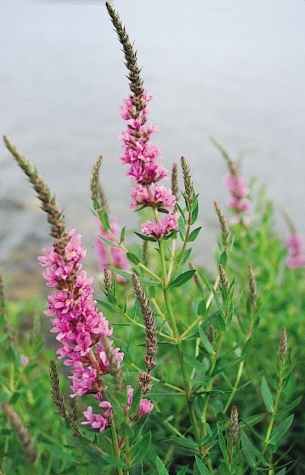
Family of flowering plants
title: "Lythraceae" type: doc version: 1 created: 2026-02-28 author: "Wikipedia contributors" status: active scope: public tags: ["lythraceae", "myrtales-families"] description: "Family of flowering plants" topic_path: "general/lythraceae" source: "https://en.wikipedia.org/wiki/Lythraceae" license: "CC BY-SA 4.0" wikipedia_page_id: 0 wikipedia_revision_id: 0
::summary Family of flowering plants ::
| fossil_range = | image = Purple loosestrife.jpg | image_caption = Lythrum salicaria | taxon = Lythraceae | authority = J.St.-Hil. | subdivision_ranks = Genera | subdivision = 28 – see text |synonyms = *Sonneratiaceae Engl. & Gilg
- Trapaceae |synonyms_ref =
Lythraceae is a family of flowering plants that includes 28 genera and about 620 species of herbs, shrubs, and trees. The larger genera include Cuphea (275 spp.), Lagerstroemia (56), Nesaea (50), Rotala (45), and Lythrum (35).{{cite book |last=Judd |first=Walter S. |author2=Christopher S. Campbell |author3=Elizabeth A. Kellogg | author3link=Elizabeth Anne Kellogg|author4=Peter F. Stevens|author4-link=Peter F. Stevens |author5=Michael J. Donoghue |title=Plant Systematics: A Phylogenetic Approach |edition=3rd |year=2008 |publisher=Sinauer Associates |location=Sunderland, MA |isbn=978-0-87893-407-2 |pages=412–414 }} It also includes the members of the former families of the pomegranate (Punica granatum, formerly in Punicaceae) and of the water caltrop (Trapa natans, formerly in Trapaceae). Lythraceae has a worldwide distribution, with most species in the tropics, but ranging into temperate climate regions as well.
The family is named after the type genus, Lythrum, the loosestrifes (e.g. Lythrum salicaria purple loosestrife) and also includes henna (Lawsonia inermis). It now includes the pomegranate, formerly classed in a separate family Punicaceae. The family also includes the widely cultivated crape myrtle trees. Botanically, the leaves are usually in pairs (opposite), and the flower petals emerge from the rim of the calyx tube. The petals often appear crumpled.
Characteristics
Lythraceae species are most often herbs, and less often shrubs or trees; the shrubs and trees often have flaky bark. Traits shared by species within the Lythraceae that distinguish them from belonging to other plant families are the petals being crumpled in the bud and the many-layered outer integument of the seed.
Leaves
The leaves generally have an opposite arrangement, but sometimes are whorled or alternate. They are simple with smooth margins and pinnate venation. Stipules are typically reduced, appearing as a row of minute hairs, or absent.
Flowers
The flowers are bisexual, radially or occasionally bilaterally symmetric, with a well-developed hypanthium. The flowers are most commonly quadimerous but can be heximerous, with four to eight sepals and petals. The sepals may be distinct, partially fused to form a tube, or touching without overlapping. The petals are crumpled in the bud and wrinkled at maturity, and are typically distinct and overlapping; they are occasionally absent. Usually, twice as many stamens as petals are seen, arranged in two whorls, and the stamens are often unequal in length. Occasionally, the stamens are reduced to one whorl, or are more numerous with multiple whorls. The ovary is typically superior, infrequently semi-inferior, or rarely inferior. The two to many carpels can be fused together (syncarpous), with two to numerous ovules in each locule, with axile placentation of the ovules.
Heterostyly – the presence of two (distylous) or three (tristylous) distinct flower morphs within a species differing in the lengths of the pistil and stamens – is common within the Lythraceae.
Fruits and seeds
The fruit is usually a dry, dehiscent capsule, occasionally a berry. The seeds are usually flattened and/or winged, with a multilayered outer integument. Epidermal hairs that expand and become mucilaginous when wet are found in about half the genera.
Distribution
The Lythraceae are widely distributed, but with most species tropical and some temperate. They are absent from the Sahara and most arid regions of Australia. Many species occur in aquatic or semi-aquatic habitats (Decodon, Didiplis, Rotala, Sonneratia, Trapa). The oldest fossils of the family are pollen from the Late Cretaceous (Campanian) of Wyoming in western North America, around 82 to 81* *million years old.
Economic importance
Edible crops include the pomegranate (Punica granatum) and the water caltrop (Trapa bicornis or T. natans). The pomegranate is cultivated for the fleshy arils surrounding the seeds, and the water caltrop for its seeds. Henna (Lawsonia inermis) is cultivated for the dye of the same name, derived from its leaves.
Ornamentals are grown from a number of genera, including Cuphea, Lagerstroemia (crape myrtles), and Lythrum (loosestrifes).
Purple loosestrife (Lythrum salicaria) is an invasive exotic weed of wetlands throughout Canada and the United States.
Taxonomy
Within the order Myrtales, the family Lythraceae is most closely related to the Onagraceae, with the Combretaceae sister to both families. Molecular phylogeny work has led to the inclusion of the formerly recognized families Duabangaceae, Punicaceae, Sonneratiaceae, and Trapaceae.
Genera
Lythraceae consists of 28 genera in five subfamilies:
Lythroideae
Authority: de Jussieu ex Walker-Arnott, 1832; previously 'Lythraceae ''sensu stricto'''
-
Adenaria Kunth
-
Ammannia (synonyms Crenea Aubl., Hionanthera A.Fern. & Diniz, and Nesaea Comm. ex Kunth)
-
Capuronia Lourteig
-
Cuphea P.Browne
-
Decodon J.F.Gmel.
-
Didiplis Raf.
-
Diplusodon Pohl
-
Galpinia N.E.Br.
-
Ginoria Jacq. (synonym Haitia Urb.)
-
Gyrosphragma T.B.Cavalc. & Facco
-
Heimia Link
-
Koehneria S.A.Graham, Tobe & Baas
-
Lafoensia Vand.
-
Lawsonia L.
-
Lourtella S.A.Graham, Baas & Tobe
-
Lythrum L.
-
Pehria Sprague
-
Pemphis J.R.Forst. & G.Forst.
-
Physocalymma Pohl
-
Pleurophora D.Don
-
Rotala L.
-
Tetrataxis Hook.f.
-
Woodfordia Salisb.
-
Subfamily Punicoideae (Horan. 1834) S. A. Graham, Thorne & Reveal 1998 = 'Punicaceae', 1 genus: :**Punica* L.
-
Subfamily Sonneratioideae (Engl. & Gilg 1924) S. A. Graham, Thorne & Reveal 1998, 1 genus: :**Sonneratia* L.f.
-
Subfamily Duabangoideae (Takht. 1986) S. A. Graham, Thorne & Reveal 1998 = 'Duabangaceae', 1 genus: :**Duabanga* Buch.-Ham.
-
Subfamily Trapoideae Voigt 1845 = 'Trapaceae', 1 genus: :**Trapa* L.
-
Subfamily Incertae sedis :†Shirleya* Pigg & DeVore (Miocene, Washington state)
Gallery
Image:Lagerstroemia indica 0002.jpg|Crepe myrtle Image:Lagerstroemia_indica-petals.jpg|Crepe myrtle flowers - the petals emerge from the calyx tube. Image:Blutweiderich 0506112.jpg|Lythrum salicaria Image:Cuphea ignea1.jpg|Cuphea ignea Image:Cuphea nudicostata 3.jpg|Cuphea nudicostata Image:Pomegranate flower and fruit.jpg|Pomegranate File:Unidentified Rotala species W IMG_3730.jpg|Rotala species
References
References
- "Myrtales".
- Angiosperm Phylogeny Group. (2009). "An update of the Angiosperm Phylogeny Group classification for the orders and families of flowering plants: APG III". Botanical Journal of the Linnean Society.
- Stevens, P.F.. (2001{{ndash}}2011). "Angiosperm Phylogeny Website".
- Mabberley, David J.. (2008). "Mabberley's Plant Book: A portable dictionary of plants, their classification and uses". Cambridge University Press.
- (2022-08-03). "Palynological study of the family J.St.-Hil. in Iran; with special emphasis on the genera Ammannia, Lythrum, and Rotala". Feddes Repertorium.
- (2022-01-07). "Lawsonia (Lythraceae)".
- "Neotropical Lythraceae". Royal Botanic Gardens, Kew.
- Graham, Shirley A.. (March 2013). "Fossil Records in the Lythraceae". The Botanical Review.
- "Plants Profile for Lythrum salicaria (purple loosestrife)". United States Department of Agriculture.
- "Lythraceae J.St.-Hil.". [[Royal Botanic Gardens, Kew]].
- (2016). "The number of known plants species in the world and its annual increase". Phytotaxa.
- Graham, S. A., R.F. Thorne, & J.L. Reveal. (1998). "Validation of subfamily names in ''Lythraceae''.". Taxon.
- (2005). "''Shirleya grahamae'' gen. et sp. nov.(Lythraceae), ''Lagerstroemia''-like fruits from the middle Miocene Yakima Canyon flora, central Washington State, USA". American Journal of Botany.
::callout[type=info title="Wikipedia Source"] This article was imported from Wikipedia and is available under the Creative Commons Attribution-ShareAlike 4.0 License. Content has been adapted to SurfDoc format. Original contributors can be found on the article history page. ::