Lichenomphalia
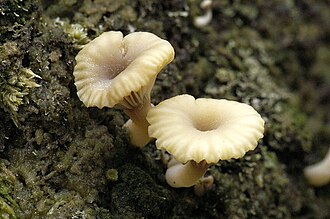
Genus of fungi
title: "Lichenomphalia" type: doc version: 1 created: 2026-02-28 author: "Wikipedia contributors" status: active scope: public tags: ["agaricales-genera", "lichen-genera", "hygrophoraceae", "basidiolichens", "taxa-described-in-2002"] description: "Genus of fungi" topic_path: "general/agaricales-genera" source: "https://en.wikipedia.org/wiki/Lichenomphalia" license: "CC BY-SA 4.0" wikipedia_page_id: 0 wikipedia_revision_id: 0
::summary Genus of fungi ::
| image = Lichenomphalia umbellifera - Lindsey 1a.jpg | image_caption = Lichenomphalia umbellifera | taxon = Lichenomphalia | authority = Redhead, Lutzoni, Moncalvo & Vilgalys (2002) | type_species = Lichenomphalia hudsoniana | type_species_authority = (H.S.Jenn.) Redhead, Lutzoni, Moncalvo & Vilgalys (2002) | synonyms_ref = | synonyms =
- Phytoconis Bory (1797)
- Botrydina Bréb. (1839)
- Coriscium Vain. (1890) | subdivision_ranks = Species | subdivision =
Lichenomphalia is both a basidiolichen and an agaric genus. Most of the species have inconspicuous lichenized thalli that consist of scattered, small, loose, nearly microscopic green balls or foliose small flakes containing single-celled green algae in the genus Coccomyxa, all interconnected by a loose network of hyphae. The agaric fruit bodies themselves are nonlichenized and resemble other types of omphalinoid mushrooms. These agarics lack clamp connections and do not form hymenial cystidia. The basidiospores are hyaline, smooth, thin-walled, and nonamyloid. Most of the species were originally classified in the genera Omphalina or Gerronema. Historically the species were classified with those other genera in the family, the Tricholomataceae together with the nonlichenized species. Lichenomphalia species can be grouped into brightly colored taxa, with vivid yellow and orange colors, versus the grey brown group, depending upon the microscopic pigmentation deposits. Molecular research comparing DNA sequences now place Lichenomphalia close to the redefined genus Arrhenia, which together with several other genera not traditionally considered to be related, fall within the newly redefined Hygrophoraceae.
Etymology
Lichenomphalia is derived from the word lichen combined with the old, shorter, generic name Omphalia from whence the more familiar, longer, diminutive generic name Omphalina was derived. Basically it means the lichen omphalias.
Thallus names and nomenclature
Long before the connection was made between the nonlichenized agaric fruitbodies and the lichenized thalli, botanists and lichenologists named the asexual lichen thalli of Lichenomphalia species several times in a number of genera. Linnaeus in 1753 described the lichen thallus of L. umbellifera as an 'alga' named Byssus botryoides while simultaneously including the fruitbodies of L. umbellifera within his concept of Agaricus umbelliferus, the basionym for the name L. umbellifera. Byssus botryoides is the type species of the now officially rejected generic names Phytoconis and Botrydina. Acharius in 1810 described the thalli of L. hudsoniana as a lichen, Endocarpon viride, which is the type of another officially rejected name, Coriscium. The names 'Botrydina' and 'Coriscium' are often used to describe the thalli of different Lichenomphalia even though they are rejected names listed in the International Code of Botanical Nomenclature (Appendix V). Prior to officially rejecting these names, the names Botrydina and Phytoconis were both applied to describe Lichenomphalia species. Hence literature on these lichenized agarics appears under a myriad of names, such as Omphalina, Gerronema, Phytoconis, Botrydina and Coriscium.
Photobionts
Species in Lichenomphalia form symbiotic relationships with green algae of the genus Coccomyxa. Studies have shown that at least five Lichenomphalia species (L. grisella, L. hudsoniana, L. luteovitellina, L. velutina, and L. umbellifera) share a single phylogenetic species, Coccomyxa subellipsoidea, as their photobiont. Research on L. meridionalis has demonstrated that it can associate with two different strains of C. subellipsoidea, with their distribution varying according to altitude – one strain predominating at lower elevations and another at higher elevations. Some Lichenomphalia specimens, particularly L. meridionalis collected at lower elevations, can also contain cyanobacteria alongside their primary green algal partner, suggesting the potential for a three-way symbiotic relationship in certain environmental conditions.
Species
::figure[src="https://upload.wikimedia.org/wikipedia/commons/6/63/2011-06-20_Lichenomphalia_chromacea_(Cleland)_Redhead,_Lutzoni,Moncalvo&_Vilgalys_152659.jpg" caption="''Lichenomphalia chromacea'', Australia"] ::
, Species Fungorum accepts 15 species of Lichenomphalia.
- Lichenomphalia alpina (Britzelm.) Redhead, Lutzoni, Moncalvo & Vilgalys (2002)
- Lichenomphalia altoandina Sand.-Leiva & Niveiro (2017) – Chile
- Lichenomphalia aurantiaca (Redhead & Kuyper) Redhead, Lutzoni, Moncalvo & Vilgalys (2002) – Colombia
- Lichenomphalia chromacea (Cleland) Redhead, Lutzoni, Moncalvo & Vilgalys (2002) – Australia
- Lichenomphalia cinereispinula Neville & Fouchier (2009) – Europe
- Lichenomphalia hudsoniana (H.S.Jenn.) Redhead, Lutzoni, Moncalvo & Vilgalys (2002) – widespread in Northern Hemisphere
- Lichenomphalia lobata (Redhead & Kuyper) Redhead, Lutzoni, Moncalvo & Vilgalys (2002) – Colombia; Ecuador; Venezuela
- Lichenomphalia luteovitellina (Pilát & Nannf.) Redhead, Lutzoni, Moncalvo & Vilgalys (2008)
- Lichenomphalia meridionalis (Contu & La Rocca) P.-A.Moreau & Courtec. (2008)
- Lichenomphalia oreades (Singer) Voitk, Thorn & I.Saar (2017)
- Lichenomphalia pararustica (Clémençon) Elborne (2008)
- Lichenomphalia tasmanica Kantvilas (2012) – Tasmania, Australia
- Lichenomphalia umbellifera (L.) Redhead, Lutzoni, Moncalvo & Vilgalys (2002) – widespread in Northern Hemisphere
- Lichenomphalia velutina (Quél.) Redhead, Lutzoni, Moncalvo & Vilgalys (2002) – China; Europe; Greenland; North America;
- Lichenomphalia wallacei (P.D.Orton) Lüderitz (2018)
References
References
- Source dataset. [[Species Fungorum]] Plus: Species Fungorum for CoL+. "''Lichenomphalia''". [[Catalog of Life]] Version 2021-12-18.
- McNeill. (2006). "International Code of Botanical Nomenclature (Vienna Code)". Regnum Vegetabile.
- (2020). "Symbiont composition of the basidiolichen ''Lichenomphalia meridionalis'' varies with altitude in the Iberian Peninsula". The Lichenologist.
- (1995). "''Omphalina'' (Basidiomycota, Agaricales) as a model system for the study of coevolution in lichenized fungi". Cryptogamic Botany.
- Lutzoni, F.M.. (1997). "Phylogeny of lichen- and non-lichen-forming omphalinoid mushrooms and the utility of testing for compatibility among multiple data sets". Systematic Biology.
- (1997). "Accelerated evolution as a consequence of transitions to mutualism". Proceedings of the National Academy of Sciences.
- Matheny, P.B.. (2006). "Major clades of Agaricales: a multilocus phylogenetic overview". Mycologia.
- Moncalvo, J-M.. (2002). "One hundred and seventeen clades of euagarics". Molecular Phylogenetics and Evolution.
- (2009). "Une nouvelle espèce méditerranéenne de ''Lichenomphalia'': ''L .cinereispinula'' Neville & Fouchier nov. sp.". Bulletin Semestriel de la Fédération des Associations Mycologiques Méditerranéennes.
- Norvell, L.L.. (1994). "''Omphalina'' sensu lato in North America. 1-2: 1: ''Omphalina wynniae'' and the genus ''Chrysomphalina''. 2: ''Omphalina'' sensu Bigelow". Mycotaxon.
- Redhead, S.A.. (2002a). "Phylogeny of agarics: partial systematics solutions for core omphalinoid genera in the Agaricales (euagarics)". Mycotaxon.
- Redhead, S.A.. (2002b). "Phylogeny of agarics: partial systematics solutions for bryophilous omphalinoid agarics outside of the Agaricales (euagarics)". Mycotaxon.
- (2017). "''Lichenomphalia altoandina'', a new species of Hygrophoraceae from the Chilean Altiplano". Mycologia.
- (2003). "Slow algae, fast fungi: exceptionally high nucleotide substitution rate differences between lichenized fungi ''Omphalina'' and their symbiotic green algae ''Coccomyxa''". Molecular Phylogenetics and Evolution.
::callout[type=info title="Wikipedia Source"] This article was imported from Wikipedia and is available under the Creative Commons Attribution-ShareAlike 4.0 License. Content has been adapted to SurfDoc format. Original contributors can be found on the article history page. ::