Lazurite
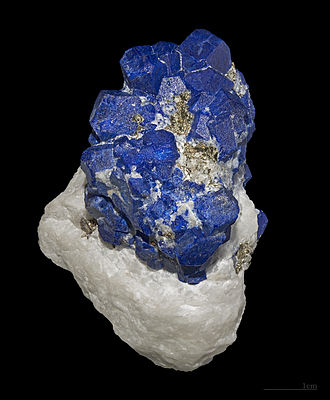
Alumino-silicate mineral whose blue colour is due to a sulfide species and not copper
title: "Lazurite" type: doc version: 1 created: 2026-02-28 author: "Wikipedia contributors" status: active scope: public tags: ["sodalite-group", "sodium-minerals", "calcium-minerals", "aluminium-minerals", "pigments", "cubic-minerals", "minerals-in-space-group-218"] description: "Alumino-silicate mineral whose blue colour is due to a sulfide species and not copper" topic_path: "general/sodalite-group" source: "https://en.wikipedia.org/wiki/Lazurite" license: "CC BY-SA 4.0" wikipedia_page_id: 0 wikipedia_revision_id: 0
::summary Alumino-silicate mineral whose blue colour is due to a sulfide species and not copper ::
::data[format=table title="Infobox mineral"]
| Field | Value |
|---|---|
| name | Lazurite |
| category | Tectosilicate minerals |
| group | Feldspathoid group, sodalite group |
| boxbgcolor | #2e337f |
| boxtextcolor | #FFFFFF |
| image | Lazurite.jpg |
| caption | Lazurite, Ladjuar Medam (Lajur Madan; Lapis-lazuli Mine), Sar-e-Sang District, Koksha Valley (Kokscha; Kokcha), Badakhshan (Badakshan; Badahsan) Province, Afghanistan |
| formula | |
| IMAsymbol | Lzr |
| strunz | 9.FB.10 |
| system | Isometric |
| class | Hextetrahedral (3m) |
| H-M symbol: ( 3m) | |
| symmetry | P3n |
| unit cell | a = 9.09 Å; Z = 2 |
| color | Deep blue, azure, violet-blue, greenish blue |
| habit | Crystals occur as dodecahedra, or rarely cubes; granular, disseminated, or massive |
| cleavage | Imperfect on {110} |
| fracture | Uneven |
| tenacity | Brittle |
| mohs | 5–5.5 |
| luster | Vitreous |
| refractive | 1.502–1.522 |
| opticalprop | Isotropic; anomalously anisotropic |
| gravity | 2.38–2.45 |
| fusibility | 3.5 |
| solubility | Soluble in HCl |
| diaphaneity | Translucent to opaque |
| references | |
| :: |
| name = Lazurite | category = Tectosilicate minerals | group = Feldspathoid group, sodalite group | boxwidth = | boxbgcolor = #2e337f | boxtextcolor = #FFFFFF | image = Lazurite.jpg | imagesize = | caption = Lazurite, Ladjuar Medam (Lajur Madan; Lapis-lazuli Mine), Sar-e-Sang District, Koksha Valley (Kokscha; Kokcha), Badakhshan (Badakshan; Badahsan) Province, Afghanistan | formula = | IMAsymbol = Lzr | strunz = 9.FB.10 | system = Isometric | class = Hextetrahedral (3m) H-M symbol: ( 3m) | symmetry = P3n | unit cell = a = 9.09 Å; Z = 2 | color = Deep blue, azure, violet-blue, greenish blue | habit = Crystals occur as dodecahedra, or rarely cubes; granular, disseminated, or massive | twinning = | cleavage = Imperfect on {110} | fracture = Uneven | tenacity = Brittle | mohs = 5–5.5 | luster = Vitreous | refractive = 1.502–1.522 | opticalprop = Isotropic; anomalously anisotropic | birefringence = | pleochroism = | streak = | gravity = 2.38–2.45 | density = | melt = | fusibility = 3.5 | diagnostic = | solubility = Soluble in HCl | diaphaneity = Translucent to opaque | other = | references =
Lazurite, old name Azure spar is a tectosilicate mineral with sulfate, sulfur and chloride with formula . It is a feldspathoid and a member of the sodalite group. Lazurite crystallizes in the isometric system although well‐formed crystals are rare. It is usually massive and forms the bulk of the gemstone lapis lazuli.
Mineral
Lazurite is a deep‐blue to greenish‐blue. The colour is due to the presence of anions. It has a Mohs hardness of 5.0 to 5.5 and a specific gravity of 2.4. It is translucent with a refractive index of 1.50. It is fusible at 3.5 on Wolfgang Franz von Kobell's fusibility scale, and soluble in HCl. It commonly contains or is associated with grains of pyrite.
Lazurite is a product of contact metamorphism of limestone and is typically associated with calcite, pyrite, diopside, humite, forsterite, hauyne and muscovite.
Other blue minerals, such as the carbonate mineral, azurite, and the phosphate mineral, lazulite, may be confused with lazurite, but are easily distinguished with careful examination. At one time, lazurite was a synonym for azurite.
Lazurite was first described in 1890 for an occurrence in the Sar-e-Sang District, Koksha Valley, Badakhshan Province, Afghanistan. It is also mined at Lake Baikal in Siberia; Mount Vesuvius; Burma; Canada; and the United States.
The most important mineral component of lapis lazuli is lazurite.{{Cite web|url=https://www.mindat.org/min-2330.html |title=Lapis lazuli: Mineral information, data and localities.|website=www.mindat.org|access-date=2024-08-30|archive-date=2020-01-29|archive-url=https://web.archive.org/web/20200129083053/https://www.mindat.org/min-2330.html|url-status=live}} (25% to 40%)
Redefinition
Most lapis lazuli gets its blue color from Hauyne and almost none contain "true lazurite". This was changed in 2021, as lazurite was redefined so that it is enough for a quarter (instead of half) of the cages to contain sulfide.
Structure
Lazurite and hauyne seem to have the same structure and both are sulfate-dominant minerals. Lazurite is a pigment (opalescent) and has a bright blue streak (especially as a component of the semiprecious stone lapis lazuli). Many hauynes have a white or pale blue streak and are translucent. The difference might be a consequence of the redox state (sulfate to sulfide ratio).
References
References
- Warr, L.N.. (2021). "IMA–CNMNC approved mineral symbols". Mineralogical Magazine.
- [http://rruff.geo.arizona.edu/doclib/hom/lazurite.pdf Handbook of Mineralogy]
- [http://www.mindat.org/min-2357.html Mindat with location data]
- [http://webmineral.com/data/Lazurite.shtml Webmineral data]
- Hurlbut, Cornelius S. and Klein, Cornelis, 1985, ''Manual of Mineralogy'', 20th ed., Wiley, p. 459 {{ISBN. 0-471-80580-7
- "Mineralogical Society of America".
- ''Krivovichev V. G.'' Mineralogical glossary. Scientific editor [[:uk:Булах Андрій Глібович. A. G. Bulakh]]. — St.Petersburg: St.Petersburg Univ. Publ. House. 2009. — 556 p. — ISBN 978-5-288-04863-0. ''(in Russian)''
- Tauson VL, Sapozhnikov AN. (2003). "On the nature of lazurite coloring". Zapiski Vserossijskogo Mineralogicheskogo Obshchestva.
- Eastaugh, Nicholas. (2004). "The Pigment Compendium: Optical Microscopy of Historical Pigments". Elsevier Butterworth-Heinemann.
- "Tile fragment". Victoria and Albert Museum.
- "Lazurite".
- (2014). "The Sar-e-Sang Lapis Mines". Mineralogical Record.
- (2012). "The sulfur speciation in S-bearing minerals: New constraints by a combination of electron microprobe analysis and DFT calculations with special reference to sodalite-group minerals". American Mineralogist.
::callout[type=info title="Wikipedia Source"] This article was imported from Wikipedia and is available under the Creative Commons Attribution-ShareAlike 4.0 License. Content has been adapted to SurfDoc format. Original contributors can be found on the article history page. ::