Kumbum
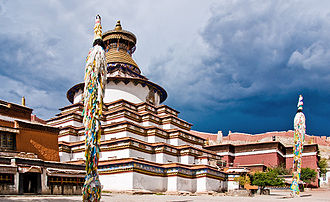
Type of Tibetan Buddhist temple
title: "Kumbum" type: doc version: 1 created: 2026-02-28 author: "Wikipedia contributors" status: active scope: public tags: ["tibet", "buddhist-temples-in-tibet"] description: "Type of Tibetan Buddhist temple" topic_path: "society/religion" source: "https://en.wikipedia.org/wiki/Kumbum" license: "CC BY-SA 4.0" wikipedia_page_id: 0 wikipedia_revision_id: 0
::summary Type of Tibetan Buddhist temple ::
::callout[type=note] the architectural type ::
::figure[src="https://upload.wikimedia.org/wikipedia/commons/1/14/Kumbum_Gyantse.jpg" caption="The Kumbum of [[Gyantse]], often regarded as the most well-known Kumbum"] ::
::figure[src="https://upload.wikimedia.org/wikipedia/commons/9/90/Dolpopa's_Great_Stupa_at_Jomonang,_Tibet.jpg" caption="Kumbum of [[Jonang]] or Jomonang"] ::
A Kumbum ( "one hundred thousand holy images") is a multi-storied aggregate of Buddhist chapels in Tibetan Buddhism. The most famous Kumbum forms part of Palcho Monastery.
The first Kumbum was founded in the fire sheep year 1427 by a Gyantse prince. It has nine lhakangs or levels, is 35 m high surmounted by a golden dome, and contains 77 chapels which line its walls. Many of the statues were damaged during the Cultural Revolution but have since been replaced with clay images, though they lack the artistic merit of the originals. The 14th century murals showing Newar and Chinese influences, survived much better.
The Kumbum or great gomang ("many-doored") stupa at Gyantse is a three-dimensional mandala meant to portray the Buddhist cosmos. The Kumbum, like other mandalas, which are portrayed by a circle within a square, enables the devotee to take part in the Buddhist perception of the universe and can depict one's potential as they move through it. Mandalas are meant to aid an individual on the path to enlightenment. The Kumbum holds a vast number of images of deities throughout its structure with Vajradhara (Sanskrit:Vajradhāra, Tibetan: rdo rje 'chang (Dorje Chang), English: Vajraholder), the cosmic Buddha, at the top.
:"The lhakangs of the nine levels of the Kumbum, decreasing in number at each level, are structured according to the compendium of Sakya tantras called Drubtab Kantu. Thus each lhakang and each level creates a mandala, and the entire Kumbum represents a three-dimensional path to the Buddha's enlightenment in terms of increasingly subtle tantric mandalas."
The best known Kumbum is the Gyantse Kumbum, built in 1497 by a prince of Gyantse, but there are other surviving examples at Jonang or Jomonang, built by Dolpopa Sherab Gyaltsen and consecrated in 1333, and the Chung Riwoche Kumbum at Päl Riwoche, which was built by Thang Tong Gyalpo, who began work on it in 1449. A further one is at Kumbum Monastery near Xining in Qinghai. The Great Stupa of Universal Compassion being built near Bendigo, Australia is modelled on the Gyantse Kumbum.
Footnotes
Gallery
Image:Kumbum eyes.jpg|Artwork on the exterior of the Kumbum in Gyantse. Image:Entrance Pango Chorten, Gyantse.JPG|Entrance to Pango Chorten, Gyantse, 1993 Image:Wrathful Deity, Gyantse.JPG|Wrathful Deity, Pango Chorten, Gyantse. Image:Pango Chorten, Gyantse.JPG|Pango Chorten, Gyantse. Image:Tara, Gyantse Kumbum.JPG|Tara statue. Gyantse Kumbum. 1993 Image:Protective deity, Gyantse Kumbum.JPG|Protective deity, Gyantse Kumbum. 1993 Image:Sitting Buddha, Gyantse Kumbum.JPG|Sitting Buddha, Gyantse Kumbum. 1993 Image:Deity, Gyantse Kumbum.JPG|Deity, Gyantse Kumbum. 1993 Image:Statue, Gyantse Kumbum.JPG|Statue, Gyantse Kumbum. 1993 File:Bundesarchiv Bild 135-S-07-24-30, Tibetexpedition, Großer Chörten in Gyantse.jpg|Gyantse Kumbum and gompa, 1938
Literature
- von Schroeder, Ulrich. 2006. Empowered Masters: Tibetan Wall Paintings of Mahasiddhas at Gyantse. (p. 224 pages with 91 colour illustrations). Chicago: Serindia Publications.
References
- Vitali, Roberto. ''Early Temples of Central Tibet'', p. 133. (1990). Serindia Publications. London. {{ISBN. 0-906026-25-3.
- ''Tibet'', p. 167. 6th edition. (2005). Bradley Mayhew and Michael Kohn. Lonely Planet. {{ISBN. 1-74059-523-8.
- Dowman, Keith. 1988. ''The Power-places of Central Tibet: The Pilgrim's Guide''. Routledge & Kegan Paul, London and New York. {{ISBN. 0-7102-1370-0, p. 270
- Dowman, Keith. 1988. ''The Power-places of Central Tibet: The Pilgrim's Guide''. Routledge & Kegan Paul, London and New York. {{ISBN. 0-7102-1370-0, p. 270
- ''Tibet: A Fascinating Look at the Roof of the World, Its People and Culture'', p. 120. (1986). Elizabeth B. Booz. Passport Books. Chicago.
- Vitali, Roberto. ''Early Temples of Central Tibet'', p. 127. (1990) Serindia Publications. London. {{ISBN. 0-906026-25-3.
- Gerner, Manfred ''[http://www.bhutanstudies.org.bt/admin/pubFiles/Chakzampa.pdf Chakzampa Thangtong Gyalpo - Architect, Philosopher and Iron Chain Bridge Builder] {{webarchive. link. (2008-06-25 '', p. 15. Thimphu: Center for Bhutan Studies 2007. {{ISBN). 99936-14-39-4
::callout[type=info title="Wikipedia Source"] This article was imported from Wikipedia and is available under the Creative Commons Attribution-ShareAlike 4.0 License. Content has been adapted to SurfDoc format. Original contributors can be found on the article history page. ::