Keiki
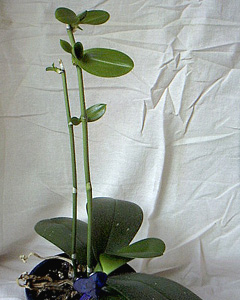
Plant produced asexually by an orchid plant
title: "Keiki" type: doc version: 1 created: 2026-02-28 author: "Wikipedia contributors" status: active scope: public tags: ["orchid-biology", "orchid-cultivation", "asexual-reproduction"] description: "Plant produced asexually by an orchid plant" topic_path: "science/biology" source: "https://en.wikipedia.org/wiki/Keiki" license: "CC BY-SA 4.0" wikipedia_page_id: 0 wikipedia_revision_id: 0
::summary Plant produced asexually by an orchid plant ::
::figure[src="https://upload.wikimedia.org/wikipedia/commons/a/a1/keiki.jpg" caption="Apical keikis on ''Phalaenopsis'' mother plant"] ::
::figure[src="https://upload.wikimedia.org/wikipedia/commons/2/27/keiki_blossom.jpg" caption="Apical keiki in flower on ''Phalaenopsis'' mother plant"] ::
In horticulture, a keiki ( ) is a plant produced asexually by an orchid plant, especially Dendrobium, Epidendrum (sensu lato), and Phalaenopsis orchids. The baby plant is an exact clone of the mother plant, sometimes flowering while still attached to the mother. The word keiki is Hawaiian for 'baby' or 'child', literally meaning 'the little one'.
On a Phalaenopsis, a keiki is a small plant growing from one node along the flower stem. Keiki growth may be induced by prolonged exposure to high temperatures during the final phase of spike growth. On a Dendrobium, the keiki is typically found sprouting along the length of the cane or from the end of the cane.
In addition to keikis which grow on flower spikes, Phalaenopsis may occasionally produce basal keikis at the base of the orchid.
Removing keikis
::figure[src="https://upload.wikimedia.org/wikipedia/commons/b/b7/Phalaenopsis_keiki_growth_progression.jpg" caption="Phalaenopsis keiki growth progression"] ::
If a new plant is desired, the keiki should be left on the mother plant until it develops a healthy root system at least 3 inch long and has two or three leaves (for a Phalaenopsis) or canes (Dendrobium). For a Phalaenopsis keiki, this may take 6–12 months from when the keiki first forms. At this point, it can be carefully removed with a sharp knife and planted in its own pot. Keikis are cut below and above the stem, leaving a small piece of stem on the baby plant.
Some species orchids like Phalaenopsis pulchra frequently produce keikis, which flower while still attached to the mother plant.
If a new plant is not desired, the keiki can be removed at any time. Removing the entire inflorescence after flowering is complete can prevent the production of keikis and result in a "tidier" appearance for the plant.
Hormone paste
Keiki paste is a cytokinin hormone which induces growth in the node of a Phalaenopsis inflorescence. It should not be confused with paste or powder containing auxins, which are used to force the production of roots.
Nodes on Phalaenopsis spikes will form either vegetative growth (keiki) or floral growth (a branch with flower buds). If the node tissue is already differentiated so that it will become a floral branch, there is no way to change the result; therefore, the paste must be applied to the node before it is differentiated. However, there is no way to predict if an undifferentiated node will become a keiki or a floral branch.
References
References
- Matthew Blanchard, Roberto Lopez, Erik Runkle, PhD, and Yin-Tung Wang, PhD [https://sharepoint.agriculture.purdue.edu/agriculture/flowers/Shared%20Documents/3%20-%20Growing%20the%20Best%20Phalaenopsis%20Part%204.pdf "Growing the Best ''Phalaenopsis''"], ''WWW.AOS.ORG'' ORCHIDS APRIL 2007 {{webarchive. link. (June 27, 2010)
- [http://www.easyorchids.co.uk/site/keiki-propagation.html "Keiki propagation"], ''EasyOrchids'' {{webarchive. link. (April 9, 2012)
::callout[type=info title="Wikipedia Source"] This article was imported from Wikipedia and is available under the Creative Commons Attribution-ShareAlike 4.0 License. Content has been adapted to SurfDoc format. Original contributors can be found on the article history page. ::