JT-60
Japanese tokamak
title: "JT-60" type: doc version: 1 created: 2026-02-28 author: "Wikipedia contributors" status: active scope: public tags: ["tokamaks", "nuclear-technology-in-japan"] description: "Japanese tokamak" topic_path: "geography/japan" source: "https://en.wikipedia.org/wiki/JT-60" license: "CC BY-SA 4.0" wikipedia_page_id: 0 wikipedia_revision_id: 0
::summary Japanese tokamak ::
::data[format=table title="Infobox fusion device"]
| Field | Value |
|---|---|
| name | JT-60 |
| fullname | Japan Torus-60 |
| type | Tokamak |
| city | Naka |
| state | Ibaraki Prefecture |
| country | Japan |
| coordinates | |
| affiliation | Japan Atomic Energy Agency |
| major_radius | 3.4 m |
| minor_radius | 1.0 m |
| volume | |
| field | 4 T (toroidal) |
| time | |
| operation_start_year | 1985 |
| operation_end_year | 2010 |
| prev | JFT-2M |
| next | JT-60SA |
| related | TFTR |
| website | |
| :: |
|name = JT-60 |fullname = Japan Torus-60 |image = |imagetitle = |type = Tokamak |city = Naka |state = Ibaraki Prefecture |country = Japan |coordinates = |affiliation = Japan Atomic Energy Agency |major_radius = 3.4 m |minor_radius = 1.0 m |volume = |field = 4 T (toroidal) |heating = |temperature = |power = |time = |current = |construction_date = |operation_start_year = 1985 |operation_end_year = 2010 |ongoing = |prev = JFT-2M |next = JT-60SA |related = TFTR |website = |other_links = |name = JT-60SA |fullname = Japan Torus-60 Super Advanced |image = |imagetitle = A front view of JT-60SA in 2023 |type = Tokamak |city = Naka |state = Ibaraki Prefecture |country = Japan |coordinates = |affiliation = QST + F4E |major_radius = |minor_radius = |volume = |field = |heating = |temperature = |power = |time = |current = |construction_date = 2013–2020 |operation_start_year = 2023 |operation_end_year = |ongoing = yes |prev = JT-60U |next = |related = ITER |website = |other_links = JT-60 (short for Japan Torus-60) is a large research tokamak, the flagship of the Japanese National Institute for Quantum Science and Technology's fusion energy directorate. As of 2023 the device is known as JT-60SA and is the largest operational superconducting tokamak in the world, built and operated jointly by the European Union and Japan in Naka, Ibaraki Prefecture. SA stands for super advanced tokamak, including a D-shaped plasma cross-section, superconducting coils, and active feedback control.
JT-60 claimed that it held the record for the highest value of the fusion triple product achieved: = . The product quoted is not a valid fusion triple product since the plasmas did not satisfy the steady state of the Lawson criterion as discussed below.
JT-60 also claimed without proof that it held the record for the hottest ion temperature ever achieved (522 megakelvins). In reality the TFTR machine at Princeton routinely measured higher ion temperatures during the 1993-1996 campaign, as discussed below.
Original design
JT-60 was first designed in the 1970s during a period of increased interest in nuclear fusion from major world powers. In particular, the US, UK and Japan were motivated by the excellent performance of the Soviet T-3 in 1968 to further advance the field. The Japanese Atomic Energy Research Institute (JAERI), previously dedicated to fission research since 1956, allocated efforts to fusion.
JT-60 began operations on April 8, 1985, and demonstrated performance far below predictions, much like the TFTR and JET that had begun operations shortly prior.
Over the next two decades, TFTR, JET and JT-60 led the effort to regain the performance originally expected of these machines. JT-60 underwent a major modification during this time, JT-60U (for "upgrade") in March 1991. The change resulted in significant improvements in plasma performance.
JT-60/TFTR disputed records
By 1996, JT-60 had achieved its record ion temperature of 45 keV, which is claimed to have exceeded the highest temperatures measured at that time in the TFTR tokamak in Princeton. Detailed measurements of the ion temperatures analyzed during TFTR's experimental campaign with deuterium-tritium plasmas in 1993–1996, found numerious discharges with temperatures greater than 50 keV in both deuterium-only and deuterium-tritium plasmas. A 2025 publication of a reanalysis of TFTR transport and confinement results for a selected scan of discharges mentions that several "supershots", not in the scan, had ion temperatures of 70 keV with a measurement error bar of 28%.
The TFTR team did not highlight these high temperatures for several reasons. The ion temperature measurements in JT-60, TFTR, and JET measured only singly ionized trace carbon impurity ions, not the temperatures of the hydrogenic ions. The carbon ions do not fuse, and displace the deuterium and tritium ions which can fuse. The hydrogenic ion temperatures can be calculated in the TRANSP analysis code. The methods used are published and widely used in analysis of experimental results. 'Simulations of deuterium-tritium experiments in TFTR' R.V. Budny,et al. Nuclear Fus. Vol 32 (1992) p 429-447 cphttps://iopscience.iop.org/article/10.1088/0029-5515/32/3/I07/pdf These temperatures are the relevant ones for calculating the deuterium and tritium fusion reactions. They generally are less than the carbon temperatures. Secondly, the end goal of this research, practical minimally poluting fusion energy, does not require ion temperatures greater than about 25 keV. An example of simulation of a burning plasma in ITER is "Predictions of H-mode performance in ITER", R. V. Budny, R. Andre, G. Bateman, F. Halpern, C.E. Kessel, A. Kritz and D. McCune Nuclear Fus. (2008) 075005 https://iopscience.iop.org/article/10.1088/0029-5515/48/7/075005
The fusion triple product metric applies only to plasmas in steady state, as stated explicitly in the Lawson criterion. The JT-60 plasmas with high values were far from steady state; in fact, their conditions rose rapidly in time to those values, and then suffered major disruptions, which extinguished the plasmas abruptly. Examples are in. HIGH PERFORMANCE EXPERIMENTS IN JT-60U REVERSED SHEAR DISCHARGES T. FUJITA, et al. IAEA-CN-69/EX1/2 Also the derivation of the fusion triple product assumes that the fusion power results from thermonuclear fusion (from thermal deuterium and tritium). Instead the high fusion power in past tokamak experiments resulted dominatly from beam-thermal reactions.
Thus the JT-60's claimed record for the triple product is not a 'fusion triple product'. Steady state discharges have been achieved in other devices such as Tore Supra and WEST have announced results for the fusion triple product.
JT-60U (Upgrade)
The main objective of the JT-60U upgrade was to "investigate energy confinement near the breakeven condition, [a] non-inductive current drive and burning plasma physics with deuterium plasmas." To accomplish this, the poloidal field coils and the vacuum vessel were replaced. Construction began in November 1989 and was completed in March 1991. Operations began in July.
JT-60U researchers claimed that on October 31, 1996, they achieved an estimated breakeven factor of Q = 1.05 at . In other words, if the homogenous deuterium fuel was theoretically replaced with a 1:1 mix of deuterium and tritium, the fusion reaction is estimated to have created an energy output 1.05 times the energy injected into the tokamak. An estimate based on a discharge in 1968 gave Q = 1.25.High performance experiments in JT-60U reversed shear discharges T. Fujita, 1999 Nucl. Fusion 39 1627 DOI 10.1088/0029-5515/39/11Y/302 The record of the central ratio Q achieved in a tokamak discharge is 1.3 in JET in 1998. "Core fusion power gain and alpha heating in JET, TFTR, and ITER", R.V. Budny, J.G. Cordey and TFTR Team and JET Contributors, Nuclear Fus. (2016) 056002 #5 (May) https://iopscience.iop.org/article/10.1088/0029-5515/56/5/056002 //home/budny/papers/NF/core_q_dt/nf_56_5_056002.pdf
A credible estimate of extrapolation of a deuterium plasma to a deuterium-tritium plasma requires starting with a validated and verified integrated computer model, and then reruning with a deuterium-tritium mixture to calculate the fusion yield. Details of the deuterium plasma also need to be shown for credibility. An example of such an estimate was published before TFTR started its deuterium-tritium campaign in 1993–1996. Simulations of deuterium–tritium experiments in TFTR Budny R.V. et al 1992 Nucl. Fusion 32 429 DOI 10.1088/0029-5515/32/3/I07 This paper calculated that the Q would be 0.32. In retrospect, the record achieved was 0.28 (discharge 80539) so the projection were optimistic. A much larger amount of energy was injected into the TFTR and JT-60U test chambers. JT-60U was not equipped to utilize tritium, as it would add extensive costs and safety risks.
In February 1997, a modification to the divertor from an open-type shape to a semi-closed W-shape for greater particle and impurity control was started and later completed in May. Experiments simulating the helium exhaust in ITER were promptly performed with the modified divertor, with great success. In 1998, the modification allowed JT-60U to reach an estimated fusion energy gain factor of Q = 1.25 at , as discussed above.
In December 1998, a modification to the vacuum pumping system that began in 1994 was completed. In particular, twelve turbomolecular pumps with oil bearings and four oil sealed rotary vacuum pumps were replaced with magnetically suspended turbomolecular pumps and dry vacuum pumps. The modification reduced the 15-year-old system's consumption of liquid nitrogen by two thirds.
In fiscal year 2003, the plasma discharge duration of JT-60U was successfully extended from to .
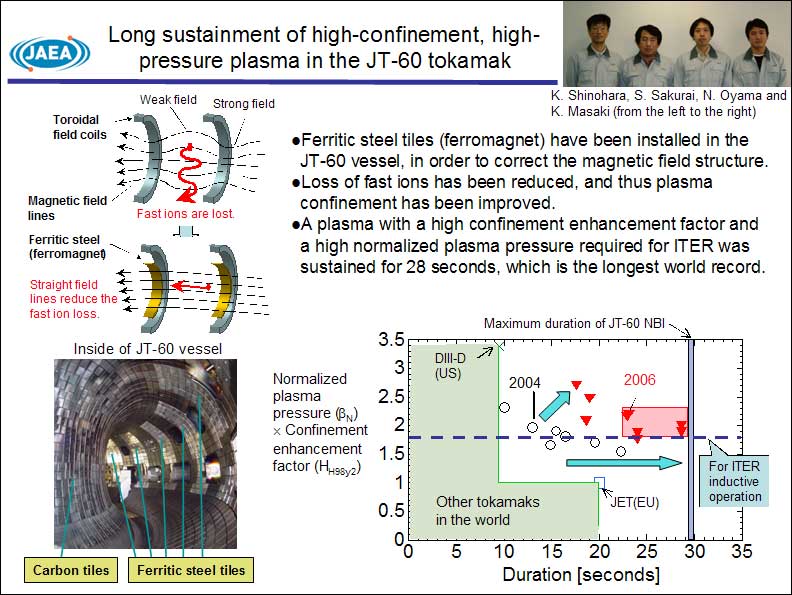
In 2005, ferritic steel (ferromagnet) tiles were installed in the vacuum vessel to correct the magnetic field structure and hence reduce the loss of fast ions. The JAEA used new parts in the JT-60, having improved its capability to hold the plasma in its powerful toroidal magnetic field.
Sometime in 2007-2008, in order to control plasma pressure at the pedestal region and to evaluate the effect of fuel on the self-organization structure of plasma, a supersonic molecular beam injection (SMBI) system was installed in JT-60U. The system's design was a collaboration between Cadarache, CEA, and JAEA. Q JT-60U ended operations on August 29, 2008.
JT-60SA
::figure[src="https://upload.wikimedia.org/wikipedia/commons/0/05/JT-60SA_Tokamak.jpg" caption="JT-60SA under construction in 2016."] ::
JT-60SA is the successor to JT-60U, operating as a satellite to ITER as described by the Broader Approach Agreement. It is a fully superconducting tokamak with flexible components that can be adjusted to find optimized plasma configurations and address key physics issues. Assembly began in January 2013 and was completed in March 2020. After a major short circuit during integrated commissioning in March 2021 necessitating lengthy repairs, it was declared active on December 1, 2023. The overall cost of its construction is estimated to be around , adjusted for inflation.
Weighing roughly 2600 ST, JT-60SA's superconducting magnet system includes 18 D-shaped niobium-titanium toroidal field coils, a niobium-tin central solenoid, and 12 equilibrium field coils.
History
The idea of an advanced tokamak, a tokamak utilizing superconducting coils, traces back to the early 1960's. The idea seemed very promising, but was not without its problems. Around January 1972, engineers at JAERI initiated an effort to further research the idea and try to solve its hurdles. This initiative progressed in parallel with the development of JT-60, and by 1983-84 it was decided that it constituted its own experimental reactor: FER (Fusion Experimental Reactor).
However, the JT-60U upgrade in 1991 demonstrated the significant flexibility of the JT-60 facilities and assembly site, so by January 1993 FER was designated as a modification to JT-60U and renamed JT-60SU (for Super Upgrade).
In January 1996, a paper detailing the superconducting properties of NbAl composite wire and its fabrication process was published in the 16th International Cryogenic Engineering/Materials Conference journal. Engineers assessed the potential use of the aluminide in JT-60SU's 18 toroidal coils.
Designs and intentions for the modification varied over the next decade, until February 2007, when the Broader Approach Agreement was signed between Japan and the European Atomic Energy Community. In it, the Satellite Tokamak Program established a clear, defined goal for JT-60SA: act as a small-scale ITER. This way, JT-60SA could give hindsight to engineers assembling and operating the full-scale reactor in the future.
It was planned for JT-60 to be disassembled and then upgraded to JT-60SA by adding niobium-titanium superconducting coils by 2010. It was intended for the JT60SA to be able to run with the same shape plasma as ITER. The central solenoid was designed to use niobium-tin (because of the higher (9 T) field).
Assembly
Construction of the tokamak officially began on with the assembly of the cryostat base, which was shipped from Avilés, Spain over a 75-day-long journey. The event was highly publicized through local and national news, and reporters from 10 media organizations were able to witness it in person.
Assembly of the vacuum vessel began in May 2014. The vacuum vessel was manufactured as ten sectors with varying arcs (20°×1, 30°×2, 40°×7) that had to be installed sequentially. On June 4, 2014, two of ten sectors were installed. In November 2014 seven sectors had been installed. In January 2015 nine sectors had been installed.
Construction was to continue until 2020 with first plasma planned in September 2020. Assembly was completed on March 30, 2020, and in March 2021 it reached its full design toroidal field successfully, with a current of 25.7 kA.
Short circuit
On March 9, 2021, a coil energization test was being performed on equilibrium field coil no. 1 (EF1) when the coil current rapidly increased, then suddenly flatlined. The reactor was safely shut down over the next few minutes, during which the pressure in the cryostat increased from to . Investigations immediately followed.
The incident, which came to be known as the "EF1 feeder incident", was found to be caused by a major short circuit resulting from insufficient insulation of the quench detection wire conductor exit. The formed arc damaged the shells of EF1, causing a helium leak to the cryostat.
In total, 90 locations required repairs and machine sensors needed to be rewired. However, the intricate JT-60SA was designed and assembled with intense precision, meaning access to the machine was sometimes limited. Risks of further delay to plasma operations compounded the issue.
The JT-60SA team was disappointed with the incident, given how close the machine was to operation, but persevered.
Repairs were completed in May 2023 and preparations for operation began.
Present operations
JT-60SA achieved first plasma on October 23, 2023, making it the largest operational superconducting tokamak in the world as of 2026. The reactor was declared active on December 1, 2023.
Specifications
(60 stands for JT-60, 60U stands for JT-60U, 60SA stands for JT-60SA) ("60SA I" refers to the initial/integrated research phase of JT-60SA, "60SA II" refers to the extended research phase) ::data[format=table title="style="text-align:left" | Plasma{{Cite journal |last1=Hosogane |first1=N. |last2=Ninomiya |first2=H. |last3=Matsukawa |first3=M. |last4=Ando |first4=T. |last5=Neyatani |first5=Y. |last6=Horiike |first6=H. |last7=Sakurai |first7=S. |last8=Masaki |first8=K. |last9=Yamamoto |first9=M. |last10=Kodama |first10=K. |last11=Sasajima |first11=T. |last12=Terakado |first12=T. |last13=Ohmori |first13=S. |last14=Ohmori |first14=Y. |last15=Okano |first15=J. |date=November 2002 |title=Development and Operational Experiences of the JT-60U Tokamak and Power Supplies |url=https://www.tandfonline.com/doi/full/10.13182/FST02-A234 |journal=Fusion Science and Technology |language=en |volume=42 |issue=2–3 |pages=368–385 |doi=10.13182/FST02-A234 |bibcode=2002FuST...42..368H |s2cid=120683442 |issn=1536-1055 |access-date=2024-02-25 |archive-date=2024-02-25 |archive-url=https://web.archive.org/web/20240225031557/https://www.tandfonline.com/doi/abs/10.13182/FST02-A234 |url-status=live |url-access=subscription }}{{Cite report|title=Annual Report of Division of Thermonuclear Fusion Research and Division of Large Tokamak Development for the Period of April 1, 1976 to March 31, 1977 |date=1978 |language=ja |doi=10.11484/jaeri-m-7479 |author1=核融合研究部 |publisher=日本原子力研究開発機構 }}{{Cite web |title=Annual report of Fusion Research and Development Directorate of JAEA for FY2008 and FY2009 |date=2011 |language=ja |doi=10.11484/jaea-review-2011-009 |author1=核融合研究開発部門 |publisher=日本原子力研究開発機構 }}"]
| Volume | Current | Major radius | Minor radius | Aspect ratio | Height | Pulse length | Elongation | Triangularity | 60 | 60U | 60SA I | 60SA II |
|---|---|---|---|---|---|---|---|---|---|---|---|---|
| * - * | * - * | 3.52 - 3.15 | ||||||||||
| 3.4 | ** | ** | ||||||||||
| 2.54 | 1.83 | 0.50 | ||||||||||
| 2.52 | 1.93 | 0.57 | ||||||||||
| :: |
::data[format=table title="style="text-align:left" | Vacuum Vessel{{Cite journal |last1=Ishida |first1=S. |last2=Barabaschi |first2=P. |last3=Kamada |first3=Y. |date=2011-09-01 |title=Overview of the JT-60SA project |url=https://iopscience.iop.org/article/10.1088/0029-5515/51/9/094018 |journal=Nuclear Fusion |volume=51 |issue=9 |article-number=094018 |bibcode=2011NucFu..51i4018I |doi=10.1088/0029-5515/51/9/094018 |issn=0029-5515 |s2cid=122120186|url-access=subscription }}"]
| Material | Baking temp. | One-turn resistance | 60 | 60U | 60SA |
|---|---|---|---|---|---|
| Inconel 625 | |||||
| Inconel 625 | |||||
| SS 316L | |||||
| :: |
::data[format=table title="style="text-align:left" | Toroidal Field Coils"]
| # | Turns | Material | Coil current | Inductance | Resistance | Time constant | 60 | 60U | 60SA |
|---|---|---|---|---|---|---|---|---|---|
| 18 | 1296 | 52.1 kA | 2.1 H | 84 mΩ | 25 s | ||||
| 18 | 1296 | AgOFCu | 52.1 kA | 2.1 H | 97 mΩ | 21.65 s | |||
| :: |
Notes
References
References
- (24 October 2023). "First plasma 23 October".
- "What is JT-60SA?".
- "Naka Fusion Institute".
- "JT-60 HOME PAGE". [[Japan Atomic Energy Agency]].
- [http://www-jt60.naka.jaea.go.jp/english/jt60/project/html/history.html JT-60 Operational History and the Progress of Plasma Performance] {{webarchive. link. (2016-02-23)
- "Plasma physics found in JT-60 tokamak over the last 20 years".
- (1986). "Annual Report of the Fusion Research Center for the Period of April 1, 1984 to March 31, 1985". 日本原子力研究開発機構.
- Naka Fusion Institute. (June 2008). "FUSION - Future Energy of the Earth". Japan Atomic Energy Agency.
- (2025). "Isotopic mass effects of tritium-fueled high-performance TFTR supershots". [[IOP Publishing]].
- Achievement of High Fusion Performance in JT-60U Reversed Shear Discharges S. Ishida, et al. 1997 Physical Review Letters 79 3917
- (2022). "Progress toward fusion energy breakeven and gain as measured against the Lawson criterion". [[Physics of Plasmas]].
- (1991). "Annual report of the Naka Fusion Research Establishment for the period of April 1, 1990 to March 31, 1991". 日本原子力研究開発機構.
- (1992). "Annual report of Naka Fusion Research Establishment for the period of April 1, 1991 to March 31, 1992". 日本原子力研究開発機構.
- (26 December 2018). "JT-60U Experimental Report No. 39 (November 11, 1996): JT-60U Achieved Optimized Negative Magnetic Shear Discharges with QDT > 1". [[National Institutes for Quantum and Radiological Science and Technology.
- (1997). "Annual Report from April 1, 1996 to March 31, 1997". Naka Fusion Research Establishment.
- (1 October 1998). "Annual Report of Naka Fusion Research Establishment from April 1, 1997 to March 31, 1998".
- (1997). "Local current profile modification in tokamak reactors in various radiofrequency ranges". International Atomic Energy Agency IAEA.
- (7 August 1998). "JT-60U Reaches 1.25 of Equivalent Fusion Power Gain".
- Clery, Daniel. (2014-07-29). "A Piece of the Sun: The Quest for Fusion Energy". Overlook Press.
- "HIGH PERFORMANCE EXPERIMENTS IN JT-60U REVERSED SHEAR DISCHARGES".
- "Annual Report of Naka Fusion Research Establishment from April 1, 1998 to March 31, 1999".
- "Annual Report of Naka Fusion Research Establishment from April 1, 2003 to March 31, 2004".
- (9 May 2006). "Achievement of long sustainment of a high-confinement, high-pressure plasma in JT-60 - A big step towards extended burn in ITER with the use of ferritic steel -".
- "ferromagnet diagrams".
- (20 October 1998). "Annual Report of Fusion Research and Development Directorate of JAEA from April 1, 2007 to March 31, 2008".
- (2011). "Annual report of Fusion Research and Development Directorate of JAEA for FY2008 and FY2009". 日本原子力研究開発機構.
- (13 November 2023). "Broader Approach agreement".
- (December 2023). "JT-60SA is officially the most powerful Tokamak".
- (January 2021). "JT-60SA - Toward the Realization of Fusion Energy".
- "Superconducting Coils for a Fusion Reactor".
- 核融合研究部. (1979). "核融合研究部および大型トカマク開発部 年報; 昭和52年度". 日本原子力研究開発機構.
- (1986). "核融合実験炉(FER)概念設計; 昭和59年度、60年度". 日本原子力研究開発機構.
- (1993). "15th IEEE/NPSS Symposium on Fusion Engineering: October 11 - 15, 1993, Hyannis, Massachusetts". IEEE Service Center.
- (1997). "Proceedings of the Sixteenth International Cryogenic Engineering Conference/ International Cryogenic Materials Conference: Kitakyushu, Japan, 20-24 May 1996". Elsevier.
- (1997). "定常炉心試験装置の設計研究,第5編; 電源設備". 日本原子力研究開発機構.
- European Commission. Directorate General for Energy.. (2020). "Broader approach :cutting edge fusion energy research activities.". Publications Office.
- "JAEA 2006-2007 annual report".
- martial. (2013-04-05). "JT-60SA: The Tokamak assembly begins".
- "The JT-60SA project Introduction". [[Japan Atomic Energy Agency]].
- (April 2020). "JT-60SA: World's largest superconducting tokamak completed!". National Institutes for Quantum and Radiological Science and Technology.
- "02.03.2021 – JT-60SA successfully reaches its full design toroidal field – JT-60SA".
- (28 November 2022). "Team spirit, resilience, and adaptability key to JT-60SA repairs".
- (5 June 2023). "Operations restart with vacuum pumping on 30.05.2023".
- "EU and Japan celebrate start of operations of the JT-60SA fusion reactor and reaffirm close cooperation on fusion energy - European Commission".
- (November 2002). "Development and Operational Experiences of the JT-60U Tokamak and Power Supplies". Fusion Science and Technology.
- (1978). "Annual Report of Division of Thermonuclear Fusion Research and Division of Large Tokamak Development for the Period of April 1, 1976 to March 31, 1977". 日本原子力研究開発機構.
- (2011). "Annual report of Fusion Research and Development Directorate of JAEA for FY2008 and FY2009". 日本原子力研究開発機構.
- (2011-09-01). "Overview of the JT-60SA project". Nuclear Fusion.
::callout[type=info title="Wikipedia Source"] This article was imported from Wikipedia and is available under the Creative Commons Attribution-ShareAlike 4.0 License. Content has been adapted to SurfDoc format. Original contributors can be found on the article history page. ::