Jiong
Chinese character
title: "Jiong" type: doc version: 1 created: 2026-02-28 author: "Wikipedia contributors" status: active scope: public tags: ["emoticons", "chinese-words-and-phrases", "chinese-character-components"] description: "Chinese character" topic_path: "geography/china" source: "https://en.wikipedia.org/wiki/Jiong" license: "CC BY-SA 4.0" wikipedia_page_id: 0 wikipedia_revision_id: 0
::summary Chinese character ::
::callout[type=note] the emoticon ::
::figure[src="https://upload.wikimedia.org/wikipedia/commons/9/93/Jiong_seal_clerical.PNG" caption="Oracle bone]] scripts (top to bottom)"] ::
Jiong () is a once obscure Chinese character meaning a "patterned window". Since 2008, it has become an internet phenomenon and widely used to express embarrassment and gloom because of the character's resemblance to a sad facial expression.
It has historically been used as a Chinese dictionary radical and has Shuowen Jiezi number 240, but it is not included among the Kangxi radicals, nor by the Table of Indexing Chinese Character Components.
Original meanings
- Window, according to Xu Shen's 2nd-century dictionary Shuowen Jiezi: "窻牖麗廔闓明" ('an open and light window').
- Granary. 米囧 means "put the new rice into a granary".
- Sacrificial place. Based on Chouli.
- Toponym.
Characters with Shuowen radical 240
::data[format=table]
| strokes | character |
|---|---|
| +0 | 囧 冏 |
| +4 | 朙 |
| +5 | 𥁰 |
| +6 | 𧖸 |
| +9 | 𥂗 |
| :: |
Internet emoticon
::figure[src="https://upload.wikimedia.org/wikipedia/commons/e/e3/Symbol_囧_vote.svg" caption="A stylised version of the 囧 emoticon"] ::
The character for jiong is nowadays more widely used on the Internet as an ideographic emoticon representing a range of moods, as it resembles a person's face. It is commonly used to express ideas or feelings such as annoyance, shock, embarrassment, awkwardness, etc.
The use of jiong as an emoticon can be traced to 2005 or earlier; it was referenced on 20 January 2005 in a Chinese-language article on Orz. The character is sometimes used in conjunction with orz, OTZ, or its other variants to form "囧rz", representing a person on their hands and knees (jiong forming the face, while r and z represent arms and legs, respectively) and symbolising despair or failure.
Encoding
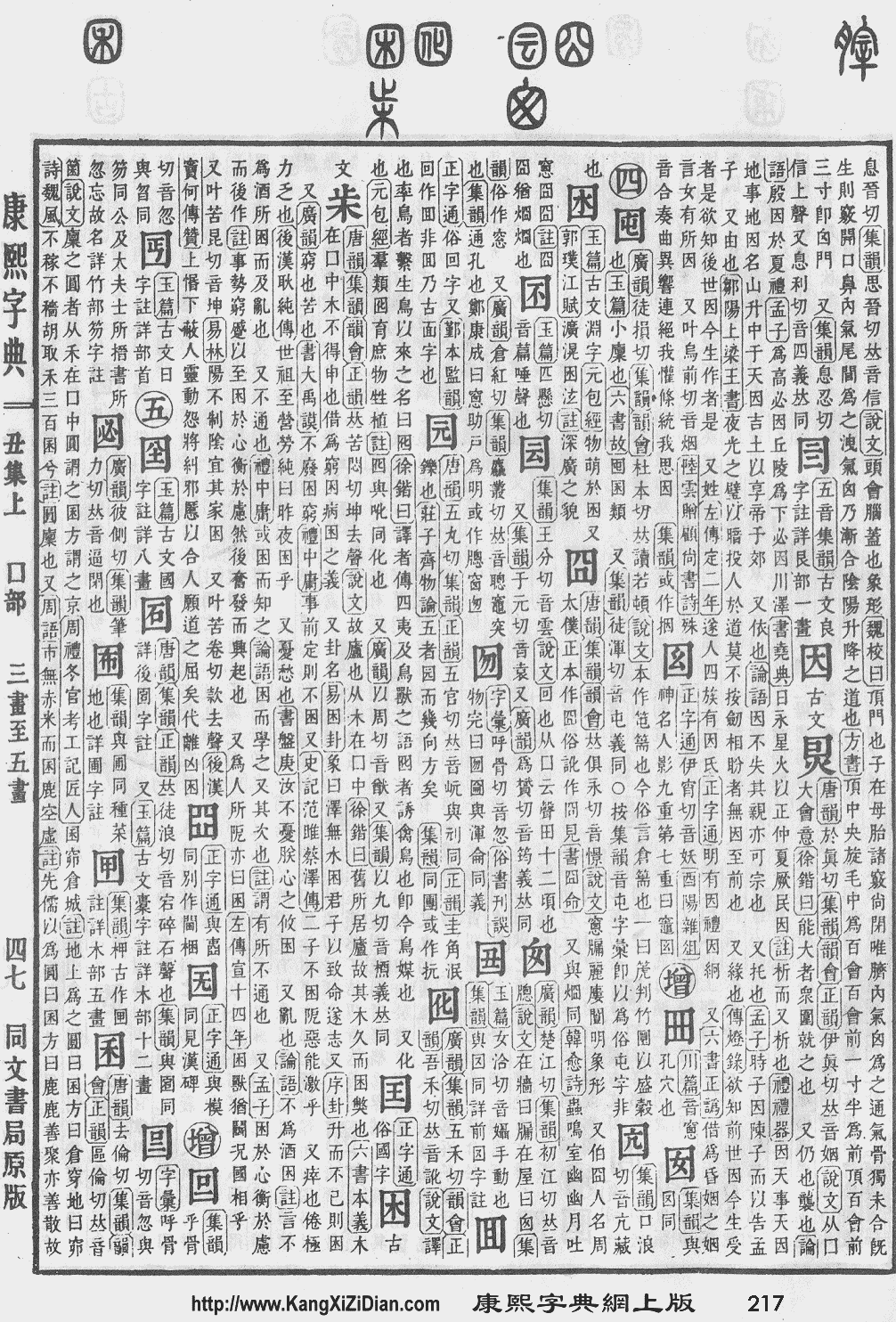
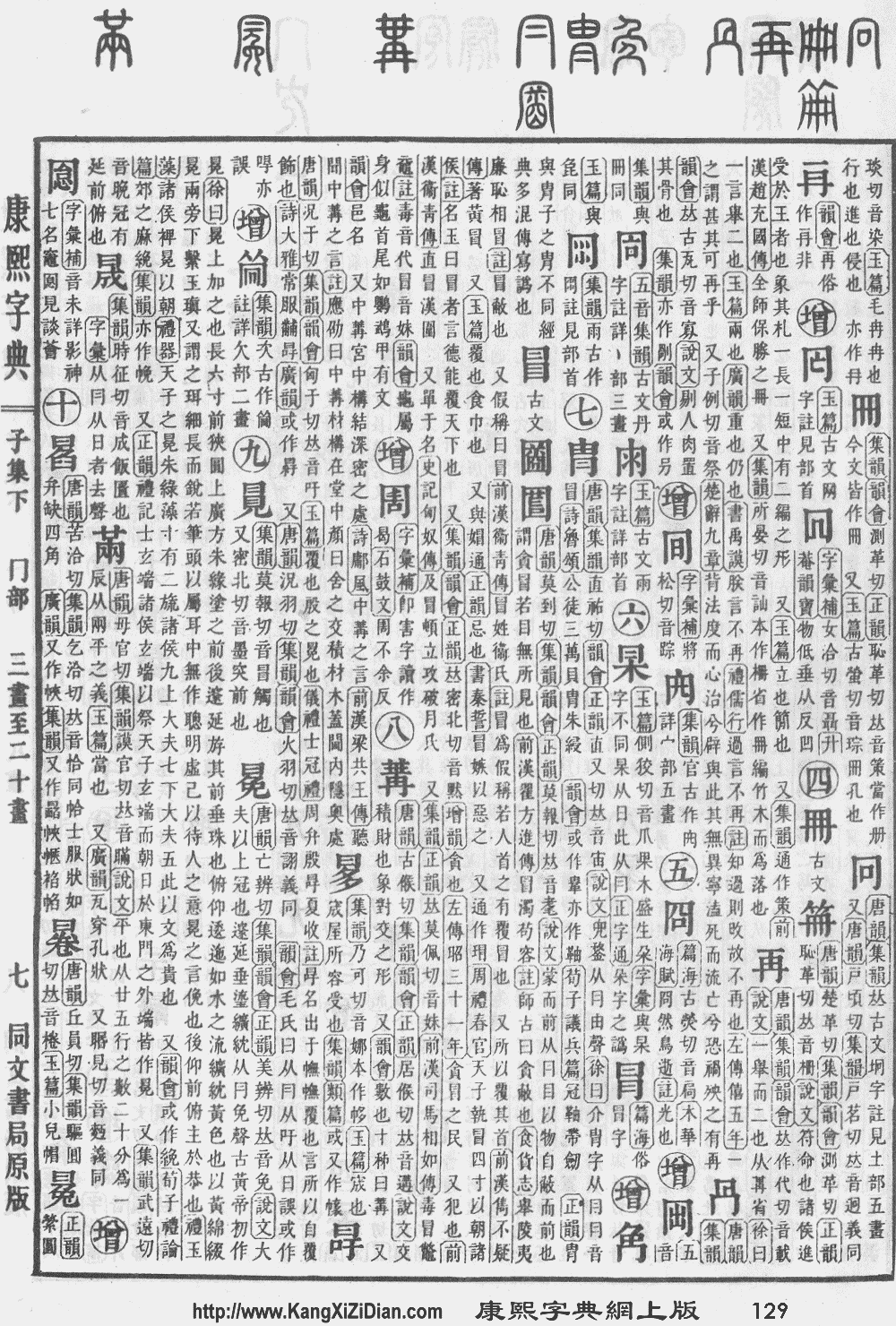
The character is included in Unicode at (囧). Unicode also includes U+518F (冏), which is considered a variant. |56E7|name1=CJK Unified Ideograph-56E7 |518F|name2=CJK Unified Ideograph-518F |map1=Shift JIS|map1char2=99 67 |map2=EUC-JP|map2char1=8F B6 FA|map2char2=D1 C8 |map3=GBK / GB 18030|map3char1=87 E5|map3char2=83 D7 |map4=KPS 9566-2011|map4char2=C8 82 |map5=Big5|map5char1=CA A8|map5char2=CA 6A |map6=EUC-TW|map6char1=8E A2 A3 C8|map6char2=8E A2 A3 AC |map7=CCCII / EACC|map7char1=21 73 77|map7char2=21 69 6E |namedref1=Kangxi Dictionary reference |ref1char1=Page 217, character 10 |ref1char2=Page 129, character 12
References
Bibliography
- {{cite book |last1=Hammond |first1=Kenneth J. |last2=Richey |first2=Jeffrey L. |title=The Sage Returns: Confucian Revival in Contemporary China |url=https://books.google.com/books?id=g6ytBQAAQBAJ&pg=PA141 |date=3 December 2014 |publisher=SUNY Press |isbn=978-1-4384-5493-1
- {{cite book |last1=Li |first1=Yuming |last2=Li |first2=Wei |title=The Language Situation in China |url=https://books.google.com/books?id=4PHnBQAAQBAJ&pg=PA252 |date=1 April 2014 |publisher=De Gruyter |isbn=978-1-61451-365-0
- {{cite book |last1=Ru |first1=Xin |last2=Lu |first2=Xueyi |last3=Li |first3=Peilin |title=The China Society Yearbook |url=https://books.google.com/books?id=7ecJc4PhmqUC&pg=PA311 |date=25 March 2010 |publisher=BRILL |isbn=978-90-04-18221-9
References
- "心情很orz嗎? 網路象形文字幽默一下".
- "MJ008830". 文字情報基盤検索システム.
- Unicode Consortium. (2015-12-02). "Shift-JIS to Unicode".
- "EUC-JP-2007". [[International Components for Unicode]].
- Standardization Administration of China (SAC). (2005-11-18). "GB 18030-2005: Information Technology—Chinese coded character set".
- Chung, Jaemin. (2018-01-05). "Information on the most recent version of KPS 9566 (KPS 9566-2011?)".
- van Kesteren, Anne. "big5". [[WHATWG]].
- "[囧] 2-2348". CNS 11643 Word Information.
- "[冏] 2-232C". CNS 11643 Word Information.
- "Unihan data for U+56E7".
- "Unihan data for U+518F".
- "EACC to Unicode".
- "Page 217". [[Kangxi Dictionary]].
- "Page 129". [[Kangxi Dictionary]].
::callout[type=info title="Wikipedia Source"] This article was imported from Wikipedia and is available under the Creative Commons Attribution-ShareAlike 4.0 License. Content has been adapted to SurfDoc format. Original contributors can be found on the article history page. ::