Iris milesii
Species of flowering plant
title: "Iris milesii" type: doc version: 1 created: 2026-02-28 author: "Wikipedia contributors" status: active scope: public tags: ["iris-(plant)", "flora-of-west-himalaya", "flora-of-sichuan", "flora-of-tibet", "flora-of-yunnan", "environment-of-himachal-pradesh", "plants-described-in-1883", "taxa-named-by-michael-foster-(physiologist)"] description: "Species of flowering plant" topic_path: "general/iris-plant" source: "https://en.wikipedia.org/wiki/Iris_milesii" license: "CC BY-SA 4.0" wikipedia_page_id: 0 wikipedia_revision_id: 0
::summary Species of flowering plant ::
|image = Iris milesii I IMG 6615.jpg |image_caption = |genus = Iris |parent = Iris sect. Lophiris |display_parents = 2 |species = milesii |authority = Foster |synonyms = None known |synonyms_ref =
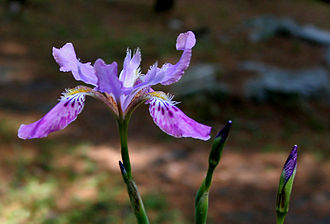
Iris milesii (also known as the red flower iris) is a plant species in the genus Iris, subgenus Limniris and in the section Lophiris (crested irises). It is a rhizomatous, beardless perennial plant, native to the Himalayas, India and China. It has pinkish-violet, or pinkish purple, or pinkish-lavender or pinkish lilac flowers, with a fringed yellow or orange crest (or ridge). It is cultivated as an ornamental plant in temperate regions.
Description
It is similar in form to Iris tectorum (another crested iris).
It has a short, thick, fleshy, greenish rhizomes,
It has around 8, yellowish green, or greyish green, or pale green. They die away in the autumn,
It has slender, It has 2–4, branches, which are 15 - long.
Iris milesii and Iris wattii are by far the tallest species of the crested irises group.
The stems have several spathes (leaves of the flower bud), that are 2.5 - long, and 2 - wide.
The stems (and the branches) hold between 3 and 4 flowers, in early summer, between April and May, or May to July. They are short lived, but a continuous display can carry on for many weeks, 8 to 10 weeks.
The flowers are 6 - in diameter, they are smaller than Iris japonica, and Iris tectorum. The flowers come in shades of pinkish-violet, or pale mauve.
It has 2 pairs of petals, 3 large sepals (outer petals), known as the 'falls' and 3 inner, smaller petals (or tepals, known as the 'standards'. The falls are reflexed, obovate, 3 cm long, with a blade marked with dark purple, violet or lilac, lines, spots or mottled (streaks or blotches), it has a finely fringed, or toothed, orange, or white, or yellow crest (or ridge). The standards are narrowly obovate, 4 - long. They are self-fertile.
It has articulated pedicels, that are 2.5 - long.
It has a small perianth tube, 1–1.5 cm long, 2.5 cm long stamen, milky white anthers, 3 cm cylindric ovary.
It has reddish purple, or lilac style branches, which are 3 cm long with deeply fringed (fimbriated) edges.
After the iris has flowered, it produces an ovoid-globose, or ovoid-cylindrical seed capsule, between June and August.
It is 2.8 - cm long, with veining. Inside the capsule, are pyriform (pear shaped) black brown seeds, with a white aril.
Biochemistry
::figure[src="https://upload.wikimedia.org/wikipedia/commons/a/a9/Iris_milesii_-_Fleur.jpg" caption="Iris milesii from [[Jardin des Plantes]], Botanical garden in Paris, France"] ::
In May 1984, a study was carried out on the rhizomes of Iris milesii, to ascertain their chemical constituency. Several isoflavones (chemical compounds) were found.
In December 1884, a further study was carried out on the rhizomes of Iris milesii and Iris kemaonensis (under old spelling 'kumaonensis'). It found several isoflavones in both rhizomes.
Tetrahydroxy-3'-methoxyisoflavone (C16H12O7) can be found naturally within the iris, rhizomes.
Genetics
As most irises are diploid, having two sets of chromosomes, this can be used to identify hybrids and classification of groupings. It has been counted several times, 2n=26, Simonet, 1932 and 2n=26, Chimphamba, 1973. It is normally published as 2n=26.
Taxonomy
It has the common names of red-flower iris, and waterbird iris (in Australia).
It is written as 红花鸢尾 in Chinese script, and known as hong hua yuan wei in Pidgin in China.
The Latin specific epithet milesii refers to Mr Frank Miles, who introduced it into cultivation in about 1880. These plants were grown from seeds collected by his cousin in the Kulu district to the north of Simla.
It was first published and described by Michael Foster in Gardeners' Chronicle Volume 20 page 231 in 1883. John Gilbert Baker also described the iris in Curtis's Botanical Magazine Volume 112, tab.6889 in 1886.
It was verified by United States Department of Agriculture and the Agricultural Research Service on 9 January 2003 and then updated on 1 December 2004.
Iris milesii is an accepted name by the RHS.
Distribution and habitat
::figure[src="https://upload.wikimedia.org/wikipedia/commons/6/68/Iris_milesii_-_Fleurs_2.jpg" caption="Iris milesii"] ::
Iris milesii is native to temperate and tropical regions of Asia,
Range
It is found in temperate Asia, within the Chinese provinces, of Sichuan, Xizang and Yunnan.
It is also found in tropical Asia, within the States and union territories of India, in Himachal Pradesh, Uttar Pradesh, Jammu and Kashmir.
It is also thought to be found in Tibet.
Habitat
It grows in the conifer forest margins of hillsides, in meadows, in open groves (and clearings), and wet valleys.
They can be found at an altitude of 1500 - above sea level.
Conservation
They are 'abundant' in the wild.
Cultivation
::figure[src="https://upload.wikimedia.org/wikipedia/commons/c/c0/Iris_milesii_in_Kullu_distt,_HP_W_IMG_6674.jpg" caption="Flower buds of Iris milesii, from Himachal Pradesh, India."] ::
Iris milesii is very hardy, to between USDA Zone 3 and Zone 8, or Zone 10. It is not hardy in the North Carolina climate, because it does not survive the winter. It is hardy in UK, to −15 °C (or lower for short periods). It is also hardy, to Europe Zone H3, although it still needs a sheltered position.
It is tolerant of normal garden soil, but prefers well drained, sandy, peaty soils. It does not like lime. It is tolerant of soils that are mildly acidic or mildly alkaline.
It prefers a sunny or semi-shade position.
It also has average water needs. It prefers to have moisture during the growing season, but it will not survive in waterlogged sites/
It can be grown in mixed flower border, or rock gardens.
It does suffer virus problems that Iris tectorum.
It is not rarely found in cultivation.
Propagation
It can also be propagated by division or by seed growing.
Although the Iris can produce plenty to seed, propagation via division is quicker and more reliable.
Toxicity
Like many other irises, most parts of the plant are poisonous (rhizome and leaves), if mistakenly ingested can cause stomach pains and vomiting. Also handling the plant may cause a skin irritation or an allergic reaction.
References
Sources
- Chowdhery, H. J. & B. M. Wadhwa. 1984. Flora of Himachal Pradesh.
- Mathew, B. 1981. The Iris. 75.
- Nasir, E. & S. I. Ali, eds. 1970–. Flora of [West] Pakistan.
- Waddick, J. W. & Zhao Yu-tang. 1992. Iris of China.
References
- (23 March 2013). "Iris milesii Baker ex Foster is an accepted name". theplantlist.org ([[The Plant List]]).
- British Iris Society (1997) {{Google books. pL6uPLo7l2gC. A Guide to Species Irises: Their Identification and Cultivation
- Dykes, William. (2009). "Handbook of Garden Irises". beardlessiris.org (The Group for Beardless Irises).
- CkxWrDqtWLQC. The European Garden Flora Flowering Plants: A Manual for the Identification (2011)
- "Iris milesii". rareplants.co.uk.
- Stebbings, Geoff. (1997). "The Gardener's Guide to Growing Irises". David and Charles.
- Austin, Claire. (2005). "Irises; A Garden Encyclopedia". Timber Press.
- "Chapter II iris clump and other (part3)". irisbotanique.over-blog.com.
- "Evansia Or Crested Irises". herbs2000.com.
- "FOC Vol. 24 Page 308". efloras.org (Flora of China).
- Burgess, Miss J.. (16 April 1935). "CRESTED IRISES OF EVANSIA SECTION". historiciris.blogspot.co.uk.
- "Search for AGM plants". rhs.org.
- Walker, Ken. (24 December 2012). "Iris milesii". signa.org (Species Iris Group of North America).
- (1991). "Perennials Vol. 1". Pan Books Ltd..
- "encyclopedia". cgf.net (Cotswold Garden Flowers).
- (14 April 2014). "Iris summary". pacificbulbsociety.org.
- Elizabeth Lawrence{{Google books. mUNzZvIFuuYC. Through the Garden Gate
- Agarwal, V.K.. (14 May 1984). "Phenolic constituents of Iris milesii rhizomes". Regional Research Laboratory.
- Agarwal, V.K.. (1984). "Isoflavones of two Iris species". Phytochemistry.
- John Buckingham and V. Ranjit N. Munasinghe {{Google books. jFW3BgAAQBAJ. Dictionary of Flavonoids with CD-ROM
- J. B. Harborne {{Google books. snL1BwAAQBAJ. The Flavonoids: Advances in Research since 1980
- "Iris milesii (Water Bird Iris)". plantdelights.com.
::callout[type=info title="Wikipedia Source"] This article was imported from Wikipedia and is available under the Creative Commons Attribution-ShareAlike 4.0 License. Content has been adapted to SurfDoc format. Original contributors can be found on the article history page. ::