Indian threadfish
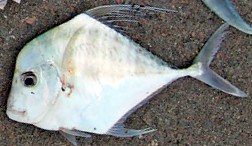
Species of fish
title: "Indian threadfish" type: doc version: 1 created: 2026-02-28 author: "Wikipedia contributors" status: active scope: public tags: ["alectis", "fish-of-india", "fish-of-the-indian-ocean", "fish-described-in-1830"] description: "Species of fish" topic_path: "geography/india" source: "https://en.wikipedia.org/wiki/Indian_threadfish" license: "CC BY-SA 4.0" wikipedia_page_id: 0 wikipedia_revision_id: 0
::summary Species of fish ::
| status = LC | status_system = IUCN3.1 | status_ref = | image = Diamond trevally juvenile.jpg | taxon = Alectis indica | authority = (Rüppell, 1830) | synonyms =
- Scyris indicus (Rüppell, 1830)
- Seriolichthys indicus (Rüppell, 1830)
- Hynnis insanus (Valenciennes, 1862)
- Hynnis momsa (Herre, 1927) | synonyms_ref = | range_map = Alectis indicus distribution..PNG | range_map_caption =Approximate distribution of the Indian threadfish
The Indian threadfish (Alectis indica), also known as the Indian threadfin, diamond trevally, mirror fish or plumed trevally, is a large species of coastal marine fish of the jack family, Carangidae. The species is widespread in the waters of the tropical Indo-West Pacific Ocean, ranging from east Africa to India, Asia, Indonesia and Australia. Adult fish tend to inhabit coastal waters over reefs down to 100 m in depth, while juveniles inhabit a variety of environments including estuaries and seagrass beds. The Indian threadfish is similar to the other two species in the genus Alectis, with a slight concavity in the profile of the head the most obvious distinguishing feature. It is a large species, growing to 165 cm and 25 kg in weight. The species is carnivorous, consuming fishes, cephalopods and crustaceans. The Indian threadfish is of minor commercial importance, and has been the subject of aquaculture in Singapore.
Taxonomy and naming
The Indian threadfish is one of three members of the diamond trevally genus Alectis, which itself is one of 33 genera encapsulated in the jack family, Carangidae. The Carangidae are part of the order Carangiformes.
The species was first recognized and scientifically described by the German naturalist Eduard Rüppell in 1830 under the name Scyris indicus, with the type specimen collected from the Red Sea. After Rüppell's designation, a number of other naturalists unknowingly re-described the species, with the names Hynnis insanus, Caranx gallus and Hynnis momsa applied to the species by the various authors. Rüppell's original classification was also revised; the fish was first placed in Seriolichthys, and finally in the senior genus Alectis by James Douglas Ogilby in 1913. The species' name has been given as Alectis indicus in the literature, however the genus Alectis is feminine and thus the spelling indica is the correct one.
The common name of the species, 'Indian threadfish' or 'Indian threadfin' refers to its distribution which includes Indian waters, and the characteristic elongated dorsal fins in juveniles. Other common names, such as mirror fish and diamond trevally, describe other aspects of the species' appearance.
Distribution and habitat
::figure[src="https://upload.wikimedia.org/wikipedia/commons/0/09/Diamond_trevally_2.jpg" caption="Indian]] and [[Western Pacific Ocean]]s, ranging from [[Madagascar]], [[east Africa]] and the [[Red Sea]] to India, [[China]], [[South East Asia]], north to [[Japan]] and south to [[Indonesia]] and northern [[Australia]]. The easternmost report is that of a specimen taken off [[French Polynesia]] in the Pacific."] ::
The species is generally an inhabitant of coastal waters from depths of 20 m to 100 m, although the juveniles may be pelagic, riding ocean currents. In some years currents bring the juveniles as far south as Sydney, Australia where they inhabit of estuaries in the summer, before dying off in the cold winter. The African pompano shows a similar pattern in Australian waters. The juveniles are also known to inhabit estuaries in other regions (including South Africa) as well as seagrass beds. Adults generally inhabit areas of reef below 20 m.
Description
::figure[src="https://upload.wikimedia.org/wikipedia/commons/f/f6/Diamond_trevally_3.jpg" caption="scales]]. The lateral line is strongly curved anteriorly, with a section of 6 to 11 [[scute]]s toward the tail. Juveniles have long, filamentous trailing anal and dorsal fin spines, much like those of ''[[Alectis ciliaris]]''. The species is known to grow to 165 cm and 25 kg."] ::
The body of adults is a silvery blue-green colour above, being darkest on the head and silver below. The upper operculum has a small diffuse dark spot. The long filamentous soft dorsal and anal fins as well as the pelvic fin are a dark blue to black colour, while the others are pale green to hyaline in appearance. Juveniles have 5 to 7 broad dark vertical cross bands through their body.
Ecology
The Indian threadfish is a predatory fish, consuming of a wide range of fishes, small squids, jellyfish and crustaceans. As with A. ciliaris, the trailing fins of juveniles are thought to resemble jellyfish medusae, causing predators to avoid the young fish. Relatively little is known about reproduction in the species, although observations made in Indonesia show spawning occurs in pairs at daytime between ebbing and flooding tides. The spawning area in this instance was a shoal of 35–45 m, located in a deeper channel between two islands.
Relationship to humans
::figure[src="https://upload.wikimedia.org/wikipedia/commons/0/05/Alectis_indica_2.jpg" caption="Alectis indica in an aquarium"] ::
The Indian threadfish is a commercial fish of minor importance throughout its range, often forming part of artisanal fishery catches. Beach seines and hook-and-line methods are the predominant methods of capture. The species is commercially farmed in small numbers in Singapore using aquaculture techniques. These farmed fish generally sell for between 7 and 11 US dollars per kg, as high or higher than other jacks farmed in the country. They are also considered quality gamefish, although are not purposely targeted by anglers, and are often taken as bycatch. The IGFA all tackle world record for the species stands at 16.00 kg (35b 4oz) caught off of Gazaruto island, Mozambique in 2007.
Juveniles are moderately popular aquarium fishes, but require fairly large tanks and peaceful neighbours.
References
References
- (2016). "''Alectis indica''".
- {{FishBase. Alectis. indica. (2019)
- (2016). "Fishes of the World". Wiley.
- Hosese, D.F.. (2007). "Zoological Catalogue of Australia Vol. 35 (2) Fishes". CSIRO.
- "Institute for Biodiversity Science & Sustainability | California Academy of Sciences".
- Carpenter, Kent E.. (2001). "FAO species identification guide for fishery purposes. The living marine resources of the Western Central Pacific. Volume 5. Bony fishes part 3 (Menidae to Pomacentridae)". FAO.
- Blaber, S.J.M.. (1983). "The biology of Carangidae (Teleostei) in Natal estuaries". Blackwell Synergy.
- (2002). "Diversity of fishes in seagrass beds in the Quirimba Archipelago, northern Mozambique". CSIRO.
- Hutchins, B.. (1986). "Sea Fishes of Southern Australia: Complete Field Guide for Anglers and Divers". Swainston Publishing.
- Gunn, John S.. (1990). "A revision of selected genera of the family Carangidae (Pisces) from Australian waters". Records of the Australian Museum.
- Westernhagen, H. Von. (1974). "Observations on the natural spawning of ''Alectis indicus'' (Rüppell) and ''Caranx ignobilis'' (Forsk.) (Carangidae)". Blackwell Synergy.
- Potts, D.T.. (1997). "Before the Emirates: an Archaeological and Historical Account of Developments in the Region c. 5000 BC to 676 AD in ''Perspectives on the United Arab Emirates''".
- Chou, R.. (1997). "Commercial marine fish farming in Singapore". Blackwell Synergy.
- "Threadfin, indian". IGFA.
- Pet education. "Indian threadfin". Foster & Smith, Inc.
::callout[type=info title="Wikipedia Source"] This article was imported from Wikipedia and is available under the Creative Commons Attribution-ShareAlike 4.0 License. Content has been adapted to SurfDoc format. Original contributors can be found on the article history page. ::