Ignicoccus
Genus of archaea
title: "Ignicoccus" type: doc version: 1 created: 2026-02-28 author: "Wikipedia contributors" status: active scope: public tags: ["archaea-genera", "thermoproteota", "thermophiles", "extremophiles"] description: "Genus of archaea" topic_path: "general/archaea-genera" source: "https://en.wikipedia.org/wiki/Ignicoccus" license: "CC BY-SA 4.0" wikipedia_page_id: 0 wikipedia_revision_id: 0
::summary Genus of archaea ::
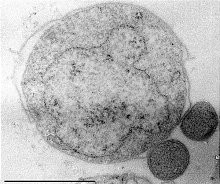
| image = Urzwerg.jpg | image_caption = Ignicoccus hospitalis (with two smaller, symbiotic Nanoarchaeum equitans) | taxon = Ignicoccus | authority = Huber, Burggraf, Mayer, Wyschkony, Rachel & Stetter 2000 | type_species = Ignicoccus islandicus | type_species_authority = Huber & Stetter 2000 | subdivision_ranks = Species | subdivision =
- I. islandicus
- I. pacificus
- I. hospitalis
Ignicoccus is a genus of hyperthermophillic Archaea living in marine hydrothermal vents. They were discovered in samples taken at the Kolbeinsey Ridge north of Iceland, as well as at the East Pacific Rise (at 9 degrees N, 104 degrees W) in 2000.
Systematics
According to the comparisons of 16S rRNA genes, Ignicoccus represents a new, deeply branching lineage within the family of the Desulfurococcaceae. Three species are known: I. islandicus, I. pacificus and I. hospitalis strain KIN4I.
Cell structure
The archaea of the genus Ignicoccus have tiny coccoid cells with a diameter of about 2 μm, that exhibit a smooth surface, an outer membrane and no S-layer.
They have a previously unknown cell envelope structure—a cytoplasmic membrane, a periplasmic space (with a variable width of 20 to 400 nm, containing membrane-bound vesicles), and an outer membrane (approximately 10 nm wide, resembling the outer membrane of gram-negative bacteria). The latter contains numerous tightly, irregularly packed single particles (about 8 nm in diameter) and pores with a diameter of 24 nm, surrounded by tiny particles, arranged in a ring (with a diameter of 130 nm) and clusters of up to eight particles 12 nm in diameter each.
The two layers of membrane previously reported are actually a type of endomembrane system consisting of cytoplasmic protrusions. In I. hospitalis, these structures harbor the endosymbiotic archaeon Nanoarchaeum equitans.
Physiology
Ignicocci live in a temperature range of 70–98 °C (optimum around 90 °C). They gain energy by reduction of elemental sulfur to hydrogen sulfide using molecular hydrogen as the electron donor. A unique symbiosis with (or parasitism by) Nanoarchaeum equitans has also been reported.
Phylogeny
The currently accepted taxonomy is based on the List of Prokaryotic names with Standing in Nomenclature (LPSN) and National Center for Biotechnology Information (NCBI)
::data[format=table]
| 16S rRNA based LTP_06_2022 | 53 marker proteins based GTDB 09-RS220 |
|---|---|
| label1=Ignicoccus | |
| :: |
References
References
- (November 2000). "Ignicoccus gen. nov., a novel genus of hyperthermophilic, chemolithoautotrophic Archaea, represented by two new species, Ignicoccus islandicus sp nov and Ignicoccus pacificus sp nov. and Ignicoccus pacificus sp. nov". International Journal of Systematic and Evolutionary Microbiology.
- (2 May 2002). "A new phylum of Archaea represented by a nanosized hyperthermophilic symbiont". Nature.
- (March 2002). "The ultrastructure of Ignicoccus: evidence for a novel outer membrane and for intracellular vesicle budding in an archaeon". Archaea.
- (13 June 2017). "A Complex Endomembrane System in the Archaeon ''Ignicoccus hospitalis'' Tapped by ''Nanoarchaeum equitans''". Frontiers in Microbiology.
- J.P. Euzéby. "Ignicoccus". [[List of Prokaryotic names with Standing in Nomenclature]] (LPSN).
- Sayers. "Ignicoccus". [[National Center for Biotechnology Information]] (NCBI) taxonomy database.
- "The LTP".
- "LTP_all tree in newick format".
- "LTP_06_2022 Release Notes".
- "GTDB release 09-RS220".
- "ar53_r220.sp_label".
- "Taxon History".
::callout[type=info title="Wikipedia Source"] This article was imported from Wikipedia and is available under the Creative Commons Attribution-ShareAlike 4.0 License. Content has been adapted to SurfDoc format. Original contributors can be found on the article history page. ::