Holland Codes
Theory of career development & vocational choice created by John L. Holland
title: "Holland Codes" type: doc version: 1 created: 2026-02-28 author: "Wikipedia contributors" status: active scope: public tags: ["motivational-theories", "career-development", "higher-education", "personality-typologies", "personality-tests"] description: "Theory of career development & vocational choice created by John L. Holland" topic_path: "general/motivational-theories" source: "https://en.wikipedia.org/wiki/Holland_Codes" license: "CC BY-SA 4.0" wikipedia_page_id: 0 wikipedia_revision_id: 0
::summary Theory of career development & vocational choice created by John L. Holland ::
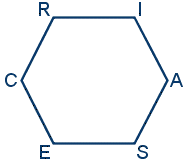
::figure[src="https://upload.wikimedia.org/wikipedia/commons/2/2a/Holland_Codes_hexagon.gif" caption="[[John L. Holland]]'s RIASEC hexagon of ''The Holland Codes.''" alt=""] ::
The Holland Codes or the Holland Occupational Themes (RIASEC) are a taxonomy of interests based on a theory of careers and vocational choice that was initially developed by American psychologist John L. Holland.{{cite web |url=http://associationdatabase.com/aws/NCDA/pt/sd/news_article/6521/_PARENT/layout_details/false |title=John L. Holland, 1919–2008: A Select Bibliography added to the Tribute & Obituary |access-date=December 7, 2015 |date=November 2, 2008|publisher=NCDA
The Holland Codes serve as a component of the interests assessment, the Strong Interest Inventory. In addition, the US Department of Labor's Employment and Training Administration has been using an updated and expanded version of the RIASEC model in the "Interests" section of its free online database ONET (Occupational Information Network){{cite web |url=http://www.onetonline.org/find/descriptor/browse/Interests/ |title=ONET OnLine: Interests |access-date=December 7, 2015 |publisher=Occupational Information Network |url=http://www.bls.gov/careeroutlook/1999/Spring/art01.pdf |title=Replace with a database: ONET replaces the Dictionary of Occupational Titles|access-date=December 7, 2015 |last=Matthew |first=Mariana |date=1999 |publisher=Occupational Outlook Quarterly Online, Spring 1999 Vol. 43, Number 1 |url=https://www.onetcenter.org/dl_files/SecondOIP_Summary.pdf |title=Second Generation Occupational Interest Profiles for the ONET System: Summary |access-date=December 7, 2015 |last=Rounds |first=James Patrick |date=2008 |publisher=The National Center for O*NET Development, June 2008
Overview
Holland's theories of vocational choice, The Holland Occupational Themes, "now pervades career counseling research and practice". The 1959 article in particular ("A Theory of Vocational Choice", published in the Journal of Counseling Psychology) is considered the first major introduction of Holland's "theory of vocational personalities and work environments".
Holland originally labeled his six types as "motoric, intellectual, esthetic, supportive, persuasive, and conforming". He later developed and changed them to: "Realistic (Doers), Investigative (Thinkers), Artistic (Creators), Social (Helpers), Enterprising (Persuaders), and Conventional (Organizers)".{{cite web |url=http://www.nhes.nh.gov/elmi/career/documents/holland-code-sparks.pdf |title=Holland Codes |access-date=December 7, 2015 |publisher=New Hampshire Employment Security, Economic and Labor Market Information Bureau |url=https://www.psychologytoday.com/blog/cui-bono/201306/selfless-service-part-ii-different-types-seva |title=Selfless Service, Part II: Different Types of Seva |access-date=December 7, 2015 |last=Johnson |first=John |date=June 1, 2013|publisher=Psychology Today |last=Holland |first=John |author-link= |date=1997 |title=Making Vocational Choices: A Theory of Vocational Personalities and Work Environments (Third Edition)' |url= |location=Florida |publisher=PAR |page= |isbn=0-911907-27-0
According to the Committee on Scientific Awards, Holland's "research shows that personalities seek out and flourish in career environments they fit and that jobs and career environments are classifiable by the personalities that flourish in them". Holland also wrote of his theory that "the choice of a vocation is an expression of personality". Furthermore, while Holland suggested that people can be "categorized as one of six types", he also argued that "a six-category scheme built on the assumption that there are only six kinds of people in the world is unacceptable on the strength of common sense alone. But a six category scheme that allows a simple ordering of a person's resemblance to each of the six models provides the possibility of 720 different personality patterns."
Related model
Prediger's two-dimensional model
Prediger constructed the scale of "work task" and "work relevant abilities" based on Holland's model, and carried out factor analysis and multidimensional scale analysis to clarify the basic structure. As a result, two axes of Data/Ideas and Things/People were extracted. Although Prediger's inquiry did not start from interest per se, it eventually led to the birth of models other than RIASEC, suggesting that the structure of occupational interest may provide a basic dimension.
Tracey and Rounds's octagonal model
In the United States, the energetic trial is being made with the aim of the new model which surpasses Holland hexagon model in 1990's. Tracey & Rounds's octagonal model is one such example. Based on the empirical data, they argue that occupational interests can be placed circularly in a two-dimensional plane consisting of People/Things and Data/ldeas axes, and the number of regions can be arbitrarily determined. According to their model, only Holland's hexagonal model does not adequately represent the structure of occupational interest, and it is possible to retain validity as an octagonal or 16 square model if necessary.
Tracey, Watanabe, & Schneider conducted an international comparative study of job interests among Japanese and U.S. university students, and the results suggest that the Tracey & Rounds's octagonal model is more fitted to Japanese students than Holland's hexagonal model.
Tracey and Rounds's spherical model
Tracey & Rounds criticizes that the conventional models of occupational interest structure do not correctly depict the positional relationship of occupations because they neglect occupational prestige, i.e., "social prestige" or "high socioeconomic status" and proposes a spherical model that assigns occupations to a 3-dimensional space incorporating occupational prestige. In this model, 18 regions of interest are displayed on a spherical space. The left hemisphere has a high status area, with Health Sciences at the top. The right hemisphere has a low status area, with Service Provision as the lowest ground.
Though this model is excellent in the point of more accurately describing the relation between various occupations, it makes the occupation interest structure more complicated, and there is a weak point that it is difficult to be adapted to the data except for the U.S.
List of types
::quote Holland]] made a career out of studying the world of work, pioneering the theory that if people were aware of their personality type or combination of types—realistic, investigative, artistic, social, enterprising or conventional—then they would be happier workers. ::
R: Realistic (Doers)
Holland defines the "Realistic Type" as a person who has “a preference for activities that entail the explicit, ordered, or systematic manipulation of objects, tools, machines, and animals…these behavioral tendencies lead in turn to the acquisition of manual, mechanical, agricultural, electrical, and technical competencies.”{{cite book |last=Holland |first=John |author-link= |date=1997 |title=Making Vocational Choices: A Theory of Vocational Personalities and Work Environments (Third Edition)' |url= |location=Florida |publisher=PAR |page= 21 |isbn=0-911907-27-0
- Agriculture{{cite web |url=https://lmi.delaware.gov/Publications/delaware-career-compass |title=Delaware Department of Labor@Delaware Career Compass |access-date=January 17, 2021 |publisher=State of Delaware}}
- Architect (with Artistic and Enterprising)
- Athletics
- Carpenter (with Conventional and Investigative)
- Culinary arts/Chef (with Artistic and Enterprising)
- Chemistry/Chemist (with Investigative and Conventional)
- Computer engineering/Computer science/Information technology/Computer programmer (with Investigative and Conventional){{cite web |url=https://georgetown.app.box.com/s/ckqw7fdbptyjbjxz3ylh |title=Career/Major Interests Game |access-date=December 7, 2015 |publisher=Georgetown University
- Dentist (with Investigative and Social)
- Engineer (with Investigative and Conventional)
- Fashion design (with Artistic and Enterprising)
- Firefighter (with Social and Enterprising)
- Graphic designer (with Artistic and Enterprising)
- Model (people) (with Artistic and Enterprising)
- Musician (with Artistic and Enterprising)
- Nurse (with Social, Conventional, and Investigative)
- Outdoor recreation
- Park Naturalist (with Social and Artistic)
- Personal trainer (with Enterprising and Social)
- Photographer (with Artistic and Enterprising)
- Physical therapy (with Social and Investigative)
- Driver
- Sports medicine/Wilderness medicine (with Social and Investigative){{cite web |url=https://www.onetonline.org/link/summary/29-1069.11 |title=Sports Medicine Physicians |access-date=June 25, 2020 |publisher=ONET
- Surgeon (with Investigative and Social)
- Veterinarian (with Investigative and Social)
- Web developer (with Conventional, Artistic, and Investigative)
- Zoologists and Wildlife Biologists (with Investigative)
I: Investigative (Thinkers)
Holland defines the "Investigative Type" as a person who has "a preference for activities that entail the observational, symbolic, systematic and creative investigation of physical, biological, and cultural phenomena (in order to understand and control such phenomena)... these behavioral tendencies lead in turn to an acquisition of scientific and mathematical competencies."{{cite book |last=Holland |first=John |author-link= |date=1997 |title=Making Vocational Choices: A Theory of Vocational Personalities and Work Environments (Third Edition)' |url= |location=Florida |publisher=PAR |page= 22 |isbn=0-911907-27-0
- Actuary (with Conventional and Enterprising)
- Archivist/Librarian (with Social and Conventional)
- Biostatistics/Masters in Public Health (with Conventional){{cite web |url=https://www.onetonline.org/link/summary/15-2041.01 |title=Summary Report for:15-2041.01 – Biostatisticians |access-date=April 11, 2018 |publisher=Occupational Information Network
- Carpenter (with Conventional and Realistic)
- CPA (Certified Public Accountant) (with Conventional and Enterprising)
- Chemistry/Chemist (with Realistic and Conventional)
- Community Health Workers/Masters in Public Health (with Social and Enterprising){{cite web |url=https://www.onetonline.org/link/summary/21-1094.00 |title=Summary Report for:21-1094.00 – Community Health Workers |access-date=April 11, 2018 |publisher=Occupational Information Network
- Computer engineering/Computer science/Information technology/Computer programmer (with Realistic and Conventional)
- Counselor (with Social and Artistic)
- Dentist (with Realistic and Social)
- Dietitian/Nutritionist (with Social and Enterprising)
- Doctor (Medical school/Medical research) (with Social)
- Engineer (with Realistic and Conventional)
- Engineering Manager (with Enterprising and Conventional)
- Financial analyst (with Conventional and Enterprising)
- Epidemiology/Masters in Public Health (with Social){{cite web |url=https://www.onetonline.org/link/summary/19-1041.00 |title=Summary Report for: 19-1041.00 – Epidemiologists |access-date=April 11, 2018 |publisher=Occupational Information Network
- Lawyer (with Enterprising and Social)
- Natural Sciences Manager (with Enterprising)
- Nurse (with Realistic, Conventional, and Social)
- Paralegal (with Conventional and Enterprising)
- Pharmacist (with Social and Conventional),
- Physical therapy (with Social and Realistic)
- Physics
- Poets, Lyricists and Creative Writers (with Artistic)
- Professor/Research – PhD
- Psychology/Psychologist (with Social and Artistic); Art therapist/Dance therapy/Drama therapy/Music therapy/Narrative therapy/Culinary therapy{{cite web |url=https://www.thechicagoschool.edu/insight/from-the-magazine/michael-kocet-culinary-therapy/ |title=From cooking to counseling |access-date=May 31, 2020 |last=Vaughn |first=Shamontiel |date=October 31, 2017 |publisher=The Chicago School of Professional Psychology |url=https://www.psychologytoday.com/us/blog/minding-the-body/201505/kitchen-therapy-cooking-mental-well-being |title=Kitchen Therapy: Cooking Up Mental Well-Being |access-date=May 31, 2020 |last=Andrews |first=Linda |date=May 19, 2015 |publisher=Psychology Today
- Social Work (with Social)
- Speech-language pathology/Myofunctional therapist (With Social and Artistic)
- Sports medicine/Wilderness medicine (with Social and Realistic)
- Surgeon (with Realistic and Social)
- Technical writer, Proofreader, Copy Editor (with Artistic and Conventional){{cite web |url=https://www.onetonline.org/link/summary/27-3042.00 |title=Summary Report for:27-3042.00 – Technical Writers |access-date=July 28, 2018 |publisher=Occupational Information Network |url=https://www.onetonline.org/link/summary/43-9081.00 |title=Summary Report for:43-9081.00 – Proofreaders and Copy Markers |access-date=January 14, 2020 |publisher=Occupational Information Network
- Tutor (with Social){{cite web |url=https://www.onetonline.org/link/summary/25-3099.02 |title=Summary Report for: 25-3099.02 – Tutors |access-date=June 16, 2017 |publisher=Occupational Information Network
- Veterinarian (with Realistic and Social)
- Web developer (with Conventional, Realistic, and Artistic)
- Zoologists and Wildlife Biologists (with Realistic)
A: Artistic (Creators)
Holland defines the "Artistic Type" as a person who has "a preference for ambiguous, free, unsystematized activities that entail the manipulation of physical, verbal, or human materials to create art forms or products...these behavioral tendencies lead in turn to the acquisition of artistic competencies."{{cite book |last=Holland |first=John |author-link= |date=1997 |title=Making Vocational Choices: A Theory of Vocational Personalities and Work Environments (Third Edition)' |url= |location=Florida |publisher=PAR |page= 23 |isbn=0-911907-27-0
- Architect (with Realistic and Enterprising)
- Broadcast journalism (with Enterprising)
- Culinary arts (with Realistic and Enterprising){{cite web |url=https://www.azwestern.edu/sites/default/files/awc/advisement-services/Degrees%20with%20Holland%20codes.pdf |title=Degrees with Holland Codes |access-date=February 7, 2018 |publisher=Arizona Western College |archive-date=April 13, 2019 |archive-url=https://web.archive.org/web/20190413022313/https://www.azwestern.edu/sites/default/files/awc/advisement-services/Degrees%20with%20Holland%20codes.pdf |url-status=dead
- Entrepreneur (with Social and Enterprising)
- Fashion design (with Realistic and Enterprising)
- Graphic designer (with Enterprising and Realistic)
- Model (people) (with Realistic and Enterprising)
- Musician (with Enterprising and Realistic)
- Park Naturalist (with Social and Realistic)
- Poets, Lyricists and Creative Writers (with Investigative){{cite web |url=https://www.onetonline.org/link/summary/27-3043.05 |title=Summary Report for: 25-3099.02 – Poets, Lyricists and Creative Writers |access-date=June 16, 2017 |publisher=Occupational Information Network
- Psychology/Psychologist (with Social and Investigative); Art therapist/Dance therapy/Drama therapy/Music therapy/Narrative therapy/Culinary therapy
- Photographer (with Realistic and Enterprising)
- Speech-language pathology/Myofunctional therapist (With Social and Investigative)
- Technical writer, Proofreader, Copy Editor (with Investigative and Conventional)
- Trainer (business) (with Social and Conventional)
- Translator (with Social)
- Web developer (with Conventional, Realistic, and Investigative)
S: Social (Helpers)
Holland defines the "Social Type" as a person who has "a preference for activities that entail the manipulation of others to inform, train, develop, cure, or enlighten...these behavioral tendencies lead in turn to an acquisition of human relations competencies."{{cite book |last=Holland |first=John |author-link= |date=1997 |title=Making Vocational Choices: A Theory of Vocational Personalities and Work Environments (Third Edition)' |url= |location=Florida |publisher=PAR |page= 24 |isbn=0-911907-27-0
- Archivist/Librarian (with Conventional and Investigative)
- CFP (Certified Financial Planner)/Personal Financial Planner (with Conventional and Enterprising)
- Clergy (with Artistic and Enterprising)
- Community Organizer
- Community Health Workers/Masters in Public Health (with Investigative and Enterprising)
- Counselors (various)/Advisers (with Investigative, Enterprising, Conventional, and Artistic)
- Customer service (with Conventional and Enterprising)
- Dentist (with Investigative and Realistic)
- Dietitian/Nutritionist (with Investigative and Enterprising)
- Doctor (Medical school/Medical research) (with Investigative)
- Educational administration (with Enterprising and Conventional)
- Educational consultant (with Conventional and Enterprising)
- Entrepreneur (with Enterprising and Artistic)
- Epidemiology/Masters in Public Health (with Investigative)
- Personal Financial Planner/Certified Financial Planner (with Enterprising and Conventional)
- Firefighter (with Realistic and Enterprising)
- Fitness Trainer and Aerobics Teacher (with Enterprising and Realistic)
- Foreign Service/Diplomacy (with Enterprising and Artistic)
- Human Resources (with Conventional and Enterprising)
- Lawyer (with Investigative and Enterprising)
- Nurse (with Realistic, Conventional, and Investigative)
- Park Naturalist (with Realistic and Artistic)
- Pharmacist (with Investigative and Conventional)
- Physical therapy (with Realistic and Investigative)
- Psychology/Psychologist (with Artistic and Investigative); Art therapist/Dance therapy/Drama therapy/Music therapy/Narrative therapy/Culinary therapy
- Social Advocate
- Sociology
- Social Work
- Speech-language pathology/Myofunctional therapist (With Investigative and Artistic){{cite web |url=https://www.onetonline.org/link/summary/29-1127.00 |title=Speech-Language Pathologists |access-date=June 21, 2020 |publisher=ONET Online
- Surgeon (with Realistic and Investigative)
- Teacher (Early childhood education, Primary school, Secondary school, Teaching English as a second language, Special education, and Substitute teaching) (with Artistic){{cite web |url=http://www.roguecc.edu/Counseling/HollandCodes/codes.asp?code=S&results=S14+E10+I6+A5+C5+R3 |title=Job Environment: Social |access-date=December 7, 2015 |publisher=Rogue Community College
- Sports medicine/Wilderness medicine (with Investigative and Realistic)
- Trainer (business) (with Artistic and Conventional)
- Translator (with Artistic)
- Tutor (with Investigative)
- Veterinarian (with Investigative and Realistic)
E: Enterprising (Persuaders)
Holland defines the "Enterprising Type" as a person who has "a preference for actives that entail the manipulation of others to attain organization goals or economic gain...these behavioral tendencies lead in turn to an acquisition of leadership, interpersonal, and persuasive competences."{{cite book |last=Holland |first=John |author-link= |date=1997 |title=Making Vocational Choices: A Theory of Vocational Personalities and Work Environments (Third Edition)' |url= |location=Florida |publisher=PAR |page= 25 |isbn=0-911907-27-0
- Actuary (with Investigative and Conventional)
- Architect (with Artistic and Realistic)
- Business (with Social and Conventional)
- Broker or Agent (i.e. Automobile broker, Real Estate broker etc.)
- Buyer
- CPA (Certified Public Accountant) (with Investigative and Conventional)
- CFP (Certified Financial Planner)/Personal Financial Planner (with Social and Conventional)
- Community Health Workers/Masters in Public Health (with Investigative and Social)
- Culinary arts (with Artistic and Realistic)
- Clergy (with Artistic and Social)
- Customer service (with Conventional and Social)
- Dietitian/Nutritionist (with Social and Investigative)
- Educational administration (with Social and Conventional)
- Educational consultant (with Conventional and Social)
- Engineering Manager (with Investigative and Conventional)
- Entrepreneur (with Social and Artistic)
- Fashion design (with Artistic and Realistic)
- Financial analyst (with Investigative and Conventional)
- Foreign Service/Diplomacy (with Social and Artistic){{cite web |url=http://www.pnw.edu/career-center/wp-content/uploads/sites/9/Career-Interests-Academic-Majors.pdf |title=Purdue Career Center |access-date=May 15, 2016 |publisher=Purdue University
- Firefighter (with Social and Realistic)
- Fitness Trainer and Aerobics Teacher (with Realistic and Social)
- Fundraising
- Graphic designer (with Artistic and Realistic)
- Human Resources (with Conventional and Social)
- Broadcast journalism (with Artistic)
- Lawyer (with Investigative and Social)
- Management/Management Consultant
- Market Research Analyst (with Investigative)
- Model (people) (with Artistic and Realistic)
- Musician (with Artistic and Realistic)
- Natural Sciences Manager (with Investigative)
- Paralegal (with Conventional and Investigative)
- Photographer (with Artistic and Realistic)
- Public Health Educator/Masters in Public Health (with Social){{cite web |url=https://www.onetonline.org/link/summary/21-1091.00 |title=Summary Report for:21-1091.00 – Health Educators |access-date=April 11, 2018 |publisher=Occupational Information Network
- Property manager/Community association manager (with Conventional){{cite web |url=https://www.onetonline.org/link/summary/11-9141.00 |title=Summary Report for - Property, Real Estate, and Community Association Managers |access-date=December 17, 2020 |publisher=Occupational Information Network
- Public relations/Publicity/Advertising/Marketing (with Artistic)
- Sales (with Conventional and Social)
C: Conventional (Organizers)
Holland defines the "Conventional Type" as a person who has "a preference for actives that entail the explicit, ordered, systematic manipulation of data (keeping records, filing materials, reproducing materials, organizing business machines and data processing equipment to attain organizational or economic goals)...these behavioral tendencies lead in turn to an acquisition of clerical, computational, and business system competencies."{{cite book |last=Holland |first=John |author-link= |date=1997 |title=Making Vocational Choices: A Theory of Vocational Personalities and Work Environments (Third Edition)' |url= |location=Florida |publisher=PAR |page= 26-7 |isbn=0-911907-27-0
- Actuary (with Investigative and Enterprising)
- Archivist/Librarian (with Social and Investigative)
- Biostatistics/Masters in Public Health (with Investigative)
- Carpenter (with Realistic and Investigative)
- Chemistry/Chemist (with Investigative and Realistic)
- CFP (Certified Financial Planner)/Personal Financial Planner (with Social and Enterprising)
- CPA (Certified Public Accountant) (with Investigative and Enterprising)
- Computer engineering/Computer science/Information technology/Computer programmer (with Investigative and Realistic)
- Customer service (with Enterprising and Social)
- Educational administration (with Social and Enterprising)
- Educational consultant (with Social and Enterprising)
- Engineer (with Investigative and Realistic)
- Engineering Manager (with Investigative and Enterprising)
- Financial analyst (with Investigative and Enterprising)
- Personal Financial Planner/Certified Financial Planner (with Social and Enterprising){{cite web |url=https://www.onetonline.org/link/summary/13-2052.00 |title=Summary Report for:13-2052.00 – Personal Financial Advisors |access-date=April 30, 2018 |publisher=ONET
- Human Resources (HR) (with Enterprising and Social)
- Maths teacher (with Social)
- Nurse (with Realistic, Social, and Investigative)
- Office administration (with Enterprising)
- Paralegal (with Enterprising and Investigative)
- Pharmacist (with Social and Investigative),
- Property manager/Community association manager (with Enterprising)
- Real Estate Agent (with Enterprising)
- Statistician (with Realistic and Investigative)
- Technical writer, Proofreader, Copy Editor (with Artistic and Investigative)
- Trainer (business) (with Social and Artistic)
- Web developer (with Artistic, Realistic, and Investigative)
Notes
References
- "Teste vocacional Fce".
- (1999-08-01). "Holland's Theory and the Development of Interest Inventories". Journal of Vocational Behavior.
- "[http://www.counseling.org/docs/david-kaplan's-files/nauta.pdf?sfvrsn=2 The Development, Evolution, and Status of Holland's Theory of Vocational Personalities: Reflections and Future Directions for Counseling Psychology]." ''Journal of Counseling Psychology'', Vol 57(1), 2010, 11–22.
- Its origins "can be traced to an article in the ''[[Journal of Applied Psychology]]'' in 1958 and a subsequent article in 1959 that set out his theory of vocational choices. ... The basic premise was that one's occupational preferences were in a sense a veiled expression of underlying character."Athanasou, James. "[http://www.thefreelibrary.com/Obituary%3A+John+L.+Holland+1919-2008.-a0203231318 Obituary: John L. Holland 1919–2008]" ''Australian Journal of Career Development'', September 22, 2009.
- L., Holland, John. (1997). "Making vocational choices: a theory of vocational personalities and work environments". Psychological Assessment Resources.
- "Award for distinguished scientific applications of psychology: John L. Holland". ''American Psychologist'', Vol 63(8), Nov 2008, 672–674.
- Holland, John. ''Making Vocational Choices: A Theory of Careers''. (Prentice-Hall, 1973).
- Prediger, Dale J. (December 1982). "Dimensions underlying Holland's hexagon: Missing link between interests and occupations?". Journal of Vocational Behavior.
- Prediger, Dale. (February 1996). "Alternative Dimensions for the Tracey–Rounds Interest Sphere". Journal of Vocational Behavior.
- Prediger, Dale J.. (1999). "Basic structure of work-relevant abilities.". Journal of Counseling Psychology.
- (1995). "The arbitrary nature of Holland's RIASEC types: A concentric-circles structure.". Journal of Counseling Psychology.
- (February 1996). "The Spherical Representation of Vocational Interests". Journal of Vocational Behavior.
- "11-9041.00 - Architectural and Engineering Managers".
- "Example Career: Natural Sciences Managers".
- [https://www.onetonline.org/link/summary/21-1012.00 Educational, Guidance, School, and Vocational Counselors]
- [https://elmhurstcounseling.com/downloads/HollandCodeDescriptions.pdf Holland Theme Codes]
::callout[type=info title="Wikipedia Source"] This article was imported from Wikipedia and is available under the Creative Commons Attribution-ShareAlike 4.0 License. Content has been adapted to SurfDoc format. Original contributors can be found on the article history page. ::