HMS E19
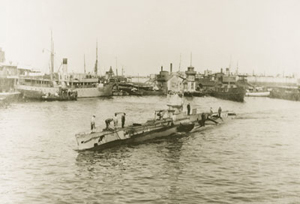
British submarine in service during WWI
title: "HMS E19" type: doc version: 1 created: 2026-02-28 author: "Wikipedia contributors" status: active scope: public tags: ["british-e-class-submarines-of-the-royal-navy", "ships-built-in-barrow-in-furness", "1915-ships", "world-war-i-submarines-of-the-united-kingdom", "world-war-i-shipwrecks-in-the-baltic-sea", "lost-submarines-of-the-united-kingdom", "royal-navy-ship-names", "maritime-incidents-in-1918", "shipwrecks-of-finland", "scuttled-vessels-of-the-united-kingdom"] description: "British submarine in service during WWI" topic_path: "history" source: "https://en.wikipedia.org/wiki/HMS_E19" license: "CC BY-SA 4.0" wikipedia_page_id: 0 wikipedia_revision_id: 0
::summary British submarine in service during WWI ::
::data[format=table title="Infobox ship"]
| Field | Value |
|---|---|
| section1 | {{Infobox ship/image |
| image | British submarine E19 in Tallinn 1915–1918.jpg |
| image_caption | At Reval (Tallinn) during World War I |
| section2 | {{Infobox ship/career |
| country | United Kingdom |
| flag | |
| name | E19 |
| laid_down | 27 November 1914 |
| launched | 13 May 1915 |
| commissioned | 12 July 1915 |
| fate | Scuttled 8 April 1918 at Helsinki to avoid capture |
| section3 | {{Infobox ship/characteristics |
| class | E-class submarine |
| displacement | *662 tons (surfaced) |
| length | 54.86 m |
| beam | 6.86 m |
| draught | 3.81 m |
| propulsion | Twin-shaft, 2 × 800 bhp Vickers diesel, 2 × 420 shp electric motors |
| speed | *15.25 knots (surfaced) |
| range | 325 nm surfaced |
| endurance | 24 days |
| complement | 3 officers, 28 ratings |
| armament | *2 × 18 inch (450 mm) bow tube |
| :: |
|section1={{Infobox ship/image |image=British submarine E19 in Tallinn 1915–1918.jpg |image_caption=At Reval (Tallinn) during World War I
|section2={{Infobox ship/career |hide_header= |country=United Kingdom |flag= |name=E19 |namesake= |ordered= |awarded= |builder= |original_cost= |yard_number= |way_number= |laid_down=27 November 1914 |launched=13 May 1915 |sponsor= |christened= |completed= |acquired= |commissioned=12 July 1915 |recommissioned= |decommissioned= |maiden_voyage= |in_service= |out_of_service= |renamed= |reclassified= |refit= |struck= |reinstated= |homeport= |identification= |motto= |nickname= |honours= |honors= |fate=Scuttled 8 April 1918 at Helsinki to avoid capture |notes= |badge=
|section3={{Infobox ship/characteristics |hide_header= |header_caption= |class=E-class submarine |type= |displacement=*662 tons (surfaced)
- 807 tons (submerged) |length=54.86 m |beam=6.86 m |height= |draught=3.81 m |power= |propulsion=Twin-shaft, 2 × 800 bhp Vickers diesel, 2 × 420 shp electric motors |sail_plan= |speed=*15.25 knots (surfaced)
- 9.75 knots (submerged) |range=325 nm surfaced |endurance=24 days |test_depth= |boats= |complement=3 officers, 28 ratings |sensors= |EW= |armament=*2 × 18 inch (450 mm) bow tube
- 2 × 18" beam tubes
- 1 × 18" stern tube
- (10 torpedoes)
- 1 × 2 pdr deck gun |armour= |armor= |aircraft= |aircraft_facilities= |notes= '*HMS *E19''''' was an E-class submarine of the Royal Navy, commissioned in 1914 at Vickers, Barrow-in-Furness. During World War I she was part of the British submarine flotilla in the Baltic.
Design
Like all post-E8 British E-class submarines, E19 had a displacement of 662 LT at the surface and 807 LT while submerged. She had a total length of 180 ft and a beam of 22 ft. She was powered by two 800 hp Vickers eight-cylinder two-stroke diesel engines and two 420 hp electric motors. The submarine had a maximum surface speed of 16 kn and a submerged speed of 10 kn. British E-class submarines had fuel capacities of 50 LT of diesel and ranges of 3255 mi when travelling at 10 kn. E19 was capable of operating submerged for five hours when travelling at 5 kn.
E19 was probably the first of the E-class to be fitted with a deck gun during construction, in this instance, possibly uniquely, with only a 2-pounder, forward of the conning tower. She had five 18 inch (450 mm) torpedo tubes, two in the bow, one either side amidships, and one in the stern; a total of 10 torpedoes were carried.
E-Class submarines had wireless systems with 1 kW power ratings; in some submarines, these were later upgraded to 3 kW systems by removing a midship torpedo tube. Their maximum design depth was 100 ft although in service some reached depths of below 200 ft. Some submarines contained Fessenden oscillator systems.
Crew
Her complement was three officers and 28 men.
Service history
Under the command of Lieutenant Commander Francis Cromie, E19 was, in September 1915, the last of five British submarines to manage the passage through the Oresund into the Baltic Sea. She was then able to sink several German ships, most notably on 11 October 1915 when she sank four German freighters just south of Öland within a few hours and without any casualties. On 7 November 1915 E19 sank the German light cruiser .
E19 was scuttled by her crew outside Helsinki 1.5 nm south of Harmaja Light, Gulf of Finland, along with , , , , , and to avoid seizure by advancing German forces who had landed nearby.
Trivia
A beer, Slottskällans Vrak, has been brewed using yeast recovered from beer bottles found on the wreck of SS Nicomedia, a ship sunk by E19 off Öland.
References
References
- {{Cite Colledge2006
- (20 February 2013). "British Submarines of World War I". Osprey Publishing.
- Akerman, P. (1989). ''Encyclopaedia of British submarines 1901–1955''. p.150. Maritime Books. {{ISBN. 1-904381-05-7
- "E Class". Chatham Submarines.
- "Vrakdykning Deluxe".
- "The E19 massacre".
- [http://www.abc.se/~pa/uwa/sub-mass.htm The Submarine Massacre of 1915]
- fi
- [http://users.tkk.fi/~jaromaa/Navygallery/Submarines/submarines.htm Finnish Submarines] {{webarchive. link. (2007-03-11 in [http://users.tkk.fi/~jaromaa/Navygallery/ Finnish Navy in World War II] {{webarchive). link. (2007-05-15)
- "Vrak - direkt från SS ''Nicomedia''".
::callout[type=info title="Wikipedia Source"] This article was imported from Wikipedia and is available under the Creative Commons Attribution-ShareAlike 4.0 License. Content has been adapted to SurfDoc format. Original contributors can be found on the article history page. ::