HD 76151
Star in the constellation Hydra
title: "HD 76151" type: doc version: 1 created: 2026-02-28 author: "Wikipedia contributors" status: active scope: public tags: ["hydra-(constellation)", "g-type-main-sequence-stars", "gliese-and-gj-objects", "henry-draper-catalogue-objects", "hipparcos-objects", "bright-star-catalogue-objects", "durchmusterung-objects"] description: "Star in the constellation Hydra" topic_path: "science/astronomy" source: "https://en.wikipedia.org/wiki/HD_76151" license: "CC BY-SA 4.0" wikipedia_page_id: 0 wikipedia_revision_id: 0
::summary Star in the constellation Hydra ::
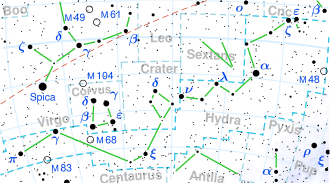
| image = |image=Hydra constellation map.svg|alt=|float=center|width=300 |label=|position=right |mark=Red circle.svg|mark_width=10|mark_link=HD 76151 |x=870|y=192 | caption = Location of HD 76151 (circled in red) | epoch = J2000.0 | equinox = J2000.0 (ICRS) | constell = Hydra | ra = | dec = | appmag_v=6.00 | type = Main sequence | class = G2V | u-b = +0.22 | b-v = +0.67 | r-i = +0.21 | radial_v = | prop_mo_ra = −413.648 | prop_mo_dec = 30.619 | pm_footnote = | parallax = 59.3595 | p_error = 0.0408 | parallax_footnote = | absmag_v= 4.81 | source = | mass = | radius = | gravity = | temperature = | metal_fe = | rotation = 15 days | rotational_velocity = 3 | age_gyr = | names= | Simbad=HD+76151
HD 76151 is a high proper motion, G-type main-sequence star and solar analog in the constellation of Hydra 54.95 light-years from Earth. It has an apparent visual magnitude of approximately 6.00, which means it is faintly visible to the naked eye under good viewing conditions. An infrared excess has been detected around this star, most likely indicating the presence of a circumstellar disk at a radius of 7.9 AU. The temperature of this dust is 99 K.
HD 76151 has an age of roughly 5.5 billion years old, with estimates ranging from 3.4 to 9.6 billion years. The stellar atmosphere has an effective temperature of around 5790 K. The radius of HD 76151 is 1.125 solar radius based on spectroscopic observations, though Gaia DR3 estimates a radius of 0.977 solar radius. It is slightly metal-rich and is a member of the thin disk population.
References
| title=XHIP: An extended hipparcos compilation | last1=Anderson | first1=E. | last2=Francis | first2=Ch. | journal=Astronomy Letters | arxiv=1108.4971 | volume=38 | issue=5 | pages=331 | year=2012 | bibcode=2012AstL...38..331A | doi=10.1134/S1063773712050015 | s2cid=119257644 | postscript=. }}
| display-authors=1 | last1=Eiroa | first1=C. | last2=Marshall | first2=J. P. | last3=Mora | first3=A. | last4=Montesinos | first4=B. | last5=Absil | first5=O. | last6=Augereau | first6=J. Ch. | last7=Bayo | first7=A. | last8=Bryden | first8=G. | last9=Danchi | first9=W. | last10=del Burgo | first10=C. | last11=Ertel | first11=S. | last12=Fridlund | first12=M. | last13=Heras | first13=A. M. | last14=Krivov | first14=A. V. | last15=Launhardt | first15=R. | last16=Liseau | first16=R. | last17=Löhne | first17=T. | last18=Maldonado | first18=J. | last19=Pilbratt | first19=G. L. | last20=Roberge | first20=A. | last21=Rodmann | first21=J. | last22=Sanz-Forcada | first22=J. | last23=Solano | first23=E. | last24=Stapelfeldt | first24=K. | last25=Thébault | first25=P. | last26=Wolf | first26=S. | last27=Ardila | first27=D. | last28=Arévalo | first28=M. | last29=Beichmann | first29=C. | last30=Faramaz | first30=V. | last31=González-García | first31=B. M. | last32=Gutiérrez | first32=R. | last33=Lebreton | first33=J. | last34=Martínez-Arnáiz | first34=R. | last35=Meeus | first35=G. | last36=Montes | first36=D. | last37=Olofsson | first37=G. | last38=Su | first38=K. Y. L. | last39=White | first39=G. J. | last40=Barrado | first40=D. | last41=Fukagawa | first41=M. | last42=Grün | first42=E. | last43=Kamp | first43=I. | last44=Lorente | first44=R. | last45=Morbidelli | first45=A. | last46=Müller | first46=S. | last47=Mutschke | first47=H. | last48=Nakagawa | first48=T. | last49=Ribas | first49=I. | last50=Walker | first50=H. | title=DUst around NEarby Stars. The survey observational results | journal=Astronomy & Astrophysics | volume=555 | page=A11 | date=July 2013 | doi=10.1051/0004-6361/201321050 | bibcode=2013A&A...555A..11E | arxiv=1305.0155 | s2cid=377244 }}
| title=Near-Infrared Spectroscopy of the Sun and Solar Analog Star HD 76151: Compiling an Extensive Line List in Y-, J-, H-, and K-Bands | last1=Senturk | first1=S. | last2=Sahin | first2=T. | last3=Güney | first3=Ferhat | last4=Bilir | first4=Selçuk | last5=Marışmak | first5=Mahmut | display-authors=1 | journal=The Astrophysical Journal | volume=976 | issue=2 | at=id. 175 | date=October 2024 | doi=10.3847/1538-4357/ad85e4 | doi-access=free | arxiv=2410.08270 | bibcode=2024ApJ...976..175S }}
References
- CDS]] ID [http://vizier.u-strasbg.fr/viz-bin/Cat?V/50 V/50]. Accessed on line January 20, 2011.
- "HD 76151".
- {{Cite Gaia DR3. 5760701787150565888
- (October 2010). "A spectroscopy study of nearby late-type stars, possible members of stellar kinematic groups". Astronomy and Astrophysics.
- CDS]] ID [http://cdsarc.u-strasbg.fr/viz-bin/Cat?V/117A V/117A]. Accessed on line January 20, 2011.
::callout[type=info title="Wikipedia Source"] This article was imported from Wikipedia and is available under the Creative Commons Attribution-ShareAlike 4.0 License. Content has been adapted to SurfDoc format. Original contributors can be found on the article history page. ::