FOCSA Building
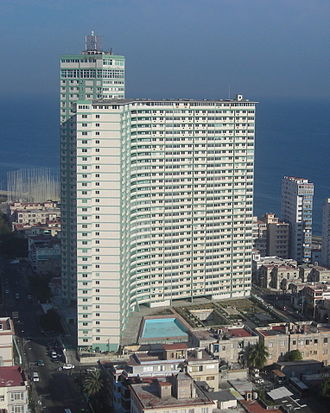
Residential and commercial building located in the Vedado neighborhood of Havana, Cuba
title: "FOCSA Building" type: doc version: 1 created: 2026-02-28 author: "Wikipedia contributors" status: active scope: public tags: ["residential-buildings-completed-in-1956", "buildings-and-structures-in-havana", "20th-century-architecture-in-cuba"] description: "Residential and commercial building located in the Vedado neighborhood of Havana, Cuba" topic_path: "arts" source: "https://en.wikipedia.org/wiki/FOCSA_Building" license: "CC BY-SA 4.0" wikipedia_page_id: 0 wikipedia_revision_id: 0
::summary Residential and commercial building located in the Vedado neighborhood of Havana, Cuba ::
::data[format=table title="Infobox building"]
| Field | Value |
|---|---|
| name | FOCSA Building |
| image | Edificio Focsa-La Habana-Cuba.jpg |
| image_size | 260px |
| image_alt | |
| image_caption | |
| map_size | |
| topped_out | 4 |
| building_type | Residential |
| architectural_style | Modern |
| location | El Vedado |
| address | 17 y M |
| location_city | Havana |
| location_country | Cuba |
| coordinates | |
| start_date | February 1954 |
| completion_date | June 1956 |
| demolition_date | |
| cost | 7,000,000 pesos |
| owner | Revolutionary government |
| height | 121 meter |
| structural_system | Wall and slab |
| material | 48,000 kPa concrete |
| size | 280 mm wall, 171 mm slab |
| floor_count | 39 |
| floor_area | 77,000 m2 (res) |
| elevator_count | 4 tenant + 2 service |
| grounds_area | 10,000 m2 |
| architect | Martín Domínguez Esteban, Ernesto Gómez Sampera |
| developer | Fomento de Obras y Construcciones, Sociedad Anónima; FOCSA |
| engineer | Sáenz, Cancio & Martín |
| structural_engineer | Luis Sáenz Duplace |
| services_engineer | Gustavo Becquer, mechanical Fernando H.Meneses, electrical |
| civil_engineer | Bartolome Bestard and Manuel Padron |
| rooms | 374 apartments |
| parking | 500 cars |
| :: |
| name =FOCSA Building | native_name = | native_name_lang = | logo = | logo_size = | logo_alt = | logo_caption = | image =Edificio Focsa-La Habana-Cuba.jpg | image_size =260px | image_alt = | image_caption = | map_type = | map_alt = | map_caption = | map_size = |mapframe-zoom=14 | map_dot_label = | map_dot_mark = | relief = | former_names = | alternate_names = | etymology = | status = | cancelled = | topped_out =4 | building_type = Residential | architectural_style = Modern | classification = | location = El Vedado | address = 17 y M | location_city = Havana | location_country = Cuba | coordinates = | altitude = | current_tenants = | namesake = | groundbreaking_date = | start_date = February 1954 | stop_date = | est_completion = | topped_out_date = | completion_date = June 1956 | opened_date = | inauguration_date = | relocated_date = | renovation_date = | closing_date = | demolition_date = | cost = 7,000,000 pesos | ren_cost = | client = | owner = Revolutionary government | landlord = | affiliation = | height = 121 meter | architectural = | tip = | antenna_spire = | roof = | diameter = | circumference = | weight = | other_dimensions = | structural_system = Wall and slab | material = 48,000 kPa concrete | size = 280 mm wall, 171 mm slab | floor_count = 39 | floor_area = 77,000 m2 (res) | elevator_count = 4 tenant + 2 service | grounds_area = 10,000 m2 | architect = Martín Domínguez Esteban, Ernesto Gómez Sampera | architecture_firm = | developer = Fomento de Obras y Construcciones, Sociedad Anónima; FOCSA | engineer = Sáenz, Cancio & Martín | structural_engineer = Luis Sáenz Duplace | services_engineer = Gustavo Becquer, mechanical Fernando H.Meneses, electrical | civil_engineer = Bartolome Bestard and Manuel Padron | other_designers = | quantity_surveyor = | main_contractor = | awards = | designations = | known_for = | ren_architect = | ren_firm = | ren_engineer = | ren_str_engineer = | ren_serv_engineer = | ren_civ_engineer = | ren_oth_designers = | ren_qty_surveyor = | ren_contractor = | ren_awards = | rooms =374 apartments | parking =500 cars | website = | embed = | embedded = | references = | footnotes = }} The FOCSA Building is a residential and commercial block in the Vedado neighborhood of Havana, Cuba. At 121 meter, it was the tallest building in Cuba for over 6 decades until the construction of La Torre López-Callejas. It was named after the contracting company Fomento de Obras y Construcciones, Sociedad Anónima, and the architects were Ernesto Gómez Sampera (1921–2004), Mercedes Diaz (his wife), and Martín Domínguez Esteban (1897-1970), who was the architect of the Radiocentro CMQ Building. The structural engineer was Luis Sáenz Duplace, of the firm Sáenz, Cancio & Martín, and professor of engineering at the University of Havana. The civil engineers were Bartolome Bestard and Manuel Padron. Gustavo Becquer and Fernando H.Meneses were the mechanical and electrical engineers, respectively. It is located on a site bordered by Calles 17 and M and Calles 19 and N in the Vedado.
History
::figure[src="https://upload.wikimedia.org/wikipedia/commons/9/96/Martín_Domínguez_Esteban_FOCSA.jpg" caption="Aerial view of the FOCSA Building seen from the west showing the floating corridors, circa 1958."] ::
The building was built between 1954 and 1956, is 121 metres (394 feet), and located in the Vedado section of Havana. In 1952 the CMQ Radio and TV Network located at Calle Rampa and M in el Vedado planned to provide administrative offices, a radio station and housing for employees. CMQ selected a 110,000 sq. ft. plot of land costing approximately 700,000 pesos. The company Fomento de Hipotecas Aseguradas (FHA) financed 80% of the cost of the residences and 60% of the commercial shops. El Banco Continental Cubano granted a credit of 6 million pesos.
Work began in February 1954 and finished in June 1956. At the time of construction it was the second-largest residential concrete building in the world, second only to the Martinelli Building in São Paulo, Brazil. It surpassed the López Serrano Building in height, which had been Cuba's tallest building.
In the early 1960s, middle-class owners of residential floor units in the building had their properties nationalized by the current government. In the 1970-1980s the building housed Soviet and Eastern bloc specialists and advisors and the ground store supermarket was for non-Cubans only. In 2000 an elevator cable snapped killing one person. In the 2000s the building was repainted and renovated and much of the building was given over to temporary housing of foreign guest workers, primarily from Venezuela.
Construction
::figure[src="https://upload.wikimedia.org/wikipedia/commons/0/09/FOCSA_BUILDING_FLOOR_PLAN.jpg" caption="FOCSA Building Typical Floor Plan."] ::
The building rises to a height of 121 m above its footings; 280 mm bearing walls separate the apartments and in turn support the 171 mm reinforced concrete slabs at each level. The bearing walls are solid and have no openings except at the basement and lobby floors to facilitate access between rooms.
The building was chosen in February 1997 by the Unión Nacional de Arquitectos e Ingenieros de la Construcción de Cuba (UNAICC) as one of the seven wonders of Cuban civil engineering.
Area distribution
The FOCSA has 39 floors 4 of which are dedicated to commercial use; two floors are for parking. 28 floors have 13 residences each. The 34th floor has six penthouses on a plinth made possible by the structural walls which stop below this floor. Each penthouse is the size of two apartments (A+B, C+D, E+F, etc.). The penthouses have a dedicated elevator and patio-courtyards open to the sky. All apartment floors are terrazzo on cinders.
The site is divided into three parts:
- A shallow, mixed-use “wall and slab” Y of 35 floors above a base.
- The podium of outdoor amenities including two swimming pools and a club for guests and tenants. The podium covers the entire site.
- Four floors of building services, commercial spaces, and parking for 500 cars located below the podium.
Apartments are a one-half level up or down from the service and tenant corridors. A typical floor contains 13 apartments; five have two bedrooms and a maid's room. The cost of the apartments was $21,500 for the larger units in the center and $17,500 for the smaller ones. An additional $30 per floor was charged the higher up in the building the unit was located; the highest apartments were the first to be sold.
Located in the tower are the building's four tenant and two service elevators and two sets of stairs. One of the service elevators is dedicated to the restaurant and the observation floor. The other service elevator is for the apartments and is linked to the service corridors. The tower also contains offices on the 37th floor for the restaurant, “La Torre,” on the 38th floor and an observation room on the 39th floor.
The podium contains a clubhouse, and offices and swimming pools for adults and children. It has gardens, lighted paths, and benches. There is a ramp to the street located at the corner of 19th and M; the podium was used as a staging area during the construction of the project. Below the podium at the fourth level are building offices.
Porte-cochere
::figure[src="https://upload.wikimedia.org/wikipedia/commons/a/a6/FOCSA_Building_entrance._Havana._Cuba.jpg" caption="Calles M and 17, FOCSA building entrance."] ::
Marked by a two-lane covered porte-cochѐre at street level is the building's entrance. Inside is the building desk, a large waiting area, and the tenant elevator lobby. The restaurant “El Emperador,” and a supermarket, a bank, a post office, theaters, and two radio stations are also located on the ground floor. (COCO and Radio Metropolitana) There are various cafés situated around the perimeter of the site and along a double-loaded corridor traversing the site from Calle M to N. Light filters to the interior corridor from openings in the podium. On the second floor are the administrative offices for the building.
Corridors
The wall of the apartments extends through the rear wall to form the support of the corridors on the exterior. The corridors are separated vertically from each other by approximately twenty inches to provide for apartment ventilation and view to the west. There are three sets of service and tenant corridors every other floor. The center corridor is for service to the building; the other two corridors are for tenants. The service and tenant corridors are undifferentiated on the exterior, except that the service corridors are shorter in length; this reflects the location of the service stairs of the end units, A and L. Service and tenant corridors are located at different heights. From each apartment, the exit stair goes up to the tenant corridor and down to the service corridor. There was a private elevator in the initial design to each apartment (X on the plan), however it was never installed.
Ventilation
The 510 mm separation of the floating corridors allows for cross ventilation of the apartments and views to the west. The dropped ceiling over the bathrooms and maid's room allow for natural ventilation to flow through the apartments. Closet doors have vent grilles on their tops and bottoms to allow for air circulation.
Penthouses
::figure[src="https://upload.wikimedia.org/wikipedia/commons/3/3a/FOCSA_roof_showing_courtyard_openings_of_penthouses.jpg" caption="Roof showing penthouse courtyard openings"] ::
Penthouse apartments have a "patio" that is open to the sky with access to water that is located next to the kitchen.
One penthouse on the south side of the FOCSA Building appears in the 1968 film Memories of Underdevelopment, written and directed by Tomás Gutiérrez Alea. It features as the apartment of the protagonist Sergio Carmona Mendoyo, played by Sergio Corrieri.
Gallery
File:Section at Stairs FOCSA Building.jpg|Service corridor, the section at tenant stairs.
File:Twenty_inch_space_between_corridors_closeup_FOCSA_Building.jpg|20 in separation between corridors showing apartment windows.
File:Section at Apartments Showing Corridor Separation.jpg|20 in separation of corridors for ventilation and views. File:Balcony_separation_at_FOCSA_Building_in_Havana.png|20 in separation between service and tenant corridors. File:Tenant corridor FOCSA Building.jpg|Tenant corridor, looking north. Alternates in section with service corridors. File:Corridors FOCSA Building.png|Tenant (blue) & service (red) stairs from apartments to corridors. File:FOCSA Building, Havana, Cuba TOWER APARTMENTS-ELEVATORS.jpg|Tower Apartments. File:Typical apartment floor plan FOCSA Building.jpeg|Typical apartment showing tenant stairs.
Notes
References
References
- https://www.periodicocubano.com/la-construccion-del-hotel-de-lopez-callejas-ya-trae-problemas-para-los-transeuntes-de-la-calle-23-en-la-habana/ {{Bare URL inline. (August 2024)
- Deupi, Victor and Lejeune, Jean-Francois. Cuban Modernism: Mid-Century Architecture 1940–1970, Berlin, Boston: Birkhäuser, 2021. https://doi.org/10.1515/9783035616446
- Fox, Arthur. “Concrete Apartment House 39 Stories High.” Engineering News-Record 7/1955:34-37. Print.
- "Coral as a Building_Material".
- [http://www.cubaheadlines.com/2008/04/09/10340/the_majestic_focsa_building_in_cuba.html The Majestic FOCSA Building], August 2, 2011
- Juan de las Cuevas Toraya, published in 2001.[http://arquitectura-cuba.blogspot.com/2009/10/edificio-focsa-1956.html arquitecturacuba.blogspot.com] – visited 2/2010
- (December 2024). "Radio Metropolitana".
- Falcon, Olga. Chapter IV, Page 301, Illustration 45. [https://eprints.mdx.ac.uk/10787/1/568411_.pdf "Urban Utopias in Havana's Representations. An Interdisciplinary Analysis"] {{Webarchive. link. (2018-09-12 , [[Middlesex University]], London. September 11, 20118)
- [[:File:Corridors FOCSA Building.png]]
::callout[type=info title="Wikipedia Source"] This article was imported from Wikipedia and is available under the Creative Commons Attribution-ShareAlike 4.0 License. Content has been adapted to SurfDoc format. Original contributors can be found on the article history page. ::