Fighting Force
1997 video game
title: "Fighting Force" type: doc version: 1 created: 2026-02-28 author: "Wikipedia contributors" status: active scope: public tags: ["1997-video-games", "3d-beat-'em-ups", "beat-'em-ups", "cancelled-sega-saturn-games", "cooperative-video-games", "core-design-games", "crave-entertainment-games", "eidos-interactive-games", "fiction-featuring-the-turn-of-the-3rd-millennium", "multiplayer-and-single-player-video-games", "nintendo-64-games", "organized-crime-video-games", "playstation-(console)-games", "playstation-network-games", "video-games-about-cults", "video-games-developed-in-the-united-kingdom", "video-games-featuring-female-protagonists", "video-games-set-in-new-york-city", "video-games-set-in-2000", "windows-games"] description: "1997 video game" topic_path: "technology/operating-systems" source: "https://en.wikipedia.org/wiki/Fighting_Force" license: "CC BY-SA 4.0" wikipedia_page_id: 0 wikipedia_revision_id: 0
::summary 1997 video game ::
::data[format=table title="Infobox video game"]
| Field | Value |
|---|---|
| image | PlayStation Fighting Force Cover.jpg |
| caption | North American PlayStation cover art |
| developer | Core Design |
| publisher | Eidos Interactive (PS, Win) |
| Crave Entertainment (N64) | |
| producer | Ken Lockley |
| programmer | Sarah Avory |
| artist | Roberto Cirillo |
| composer | Martin Iveson |
| released | PlayStation |
| Windows |
| | genre | Beat 'em up | | modes | Single-player, multiplayer | | platforms | PlayStation, Windows, Nintendo 64 | | title | Fighting Force | ::
| image = PlayStation Fighting Force Cover.jpg | caption = North American PlayStation cover art | developer = Core Design | publisher = Eidos Interactive (PS, Win) Crave Entertainment (N64) | producer = Ken Lockley | programmer = Sarah Avory | artist = Roberto Cirillo | composer = Martin Iveson | released = PlayStation Windows
| genre = Beat 'em up | modes = Single-player, multiplayer | platforms = PlayStation, Windows, Nintendo 64 | title = Fighting Force
Fighting Force is a beat 'em up video game developed by Core Design and published in 1997 by Eidos Interactive for PlayStation and Windows. A Nintendo 64 version was published by Crave Entertainment in 1999. Announced by Core shortly after the success of Tomb Raider, Fighting Force was highly anticipated but met with mixed reviews. It was followed by Fighting Force 2.
Gameplay
Players control one of four characters as they move through urban and science fiction environments, battling waves of oncoming enemies with weapons including soda cans, knives, cars, and guns. The player can make some choices as to which territory to travel through.
Story
The four characters have various reasons for taking on Dr. Dex Zeng, a criminal mastermind with an army at his command who predicted that the world would end in the year 2000. After New Year's Eve 1999, Dr. Zeng believed that there was an error preventing the apocalypse, so decides to correct it by destroying the world himself. The action starts with a police cordon around Zeng's office skyscraper, moving to such locales as a shopping mall, subway and Coast Guard base before finally ending at the top of Zeng's island headquarters.
Characters
::figure[src="https://upload.wikimedia.org/wikipedia/commons/1/1d/Smasher_Tire.jpg" caption="A screenshot of Ben "Smasher" Jackson punching a generic enemy"] ::
Players choose from a selection of four characters: Hawk Manson, Mace Daniels, Alana McKendricks and Ben "Smasher" Jackson. Hawk Manson and Mace Daniels are two all-around characters. Hawk is somewhat stronger than Mace who is in turn faster than Hawk. Ben "Smasher" Jackson is a large and slow bruiser capable of lifting and throwing the engines of cars at enemies. Alana McKendricks is a fast but soft-hitting teenager with an effective jump-kick. All four characters have a special move that can be performed with the loss of a portion of health.
Development and release
Core Design originally pitched the game to Sega as a potential fourth entry in Sega's Streets of Rage series. Sega declined; according to Core, Sega explained that it had its own plans for continuing the series.
The story line and character designs were done by Marc Silvestri. The character of Dr. Zeng was inspired by Heaven's Gate.
A "Battle Arena" mode was added to the game during development, but it was cut from the final version.
In addition to the PlayStation, Windows, and Nintendo 64 versions, a Sega Saturn version was developed and eventually completed. After Eidos decided against publishing this version, Sega Europe secured the publishing rights and announced a European release date of November 1997, but ultimately cancelled the release. An early prototype, with older character designs, was leaked in November 2008. In February 2024, the released Core running demo disc (which provided a real-time demo of multiple Core Design Saturn titles), which post-dates the leaked beta, was hacked to be playable.
Eidos demonstrated a playable Nintendo 64 version at the 1998 E3. Eidos later cancelled this version of the game, but in February 1999 publisher Crave Entertainment purchased the rights from Eidos and put the game into its release schedule. The Nintendo 64 version was released in North America and Europe in 1999, under the title Fighting Force 64. Differences include partially improved graphics and changes in the available number of player lives.
In June 2024, Limited Run Games announced that they are working with copyright owner Square Enix to release the game and its sequel in Fighting Force Collection for the PlayStation 4, PlayStation 5, Nintendo Switch and Windows (via Steam). The collection was released on 23 January 2026.
Reception
| N64 = true | PS = true | na = true | GR_N64 = 55% | GR_PS = 64% | Edge_PS = 6/10 | EGM_N64 = 3.25/10 | EGM_PS = 7.625/10 | Fam_PS = 25/40 | GI_N64 = 6.75/10 | GI_PS = 6.5/10 | GameFan_N64 = 58% | GameFan_PS = 71% | GameRev_N64 = D | GSpot_N64 = 4/10 | GSpot_PS = 5.3/10 | Hyper_N64 = 65% | Hyper_PS = 65% | IGN_N64 = 6.4/10 | IGN_PS = 5.5/10 | N64_N64 = 26% | NGen_PS = | NP_N64 = 6.7/10 | OPM_PS =
The original PlayStation release received mostly mixed reviews. Critics overwhelmingly commented that the game has a satisfyingly large amount of interactive scenery to destroy or collect weapons from, but agreed that despite the transition to 3D, the gameplay was not meaningfully different from the 2D beat 'em ups of earlier console generations. GameSpot summed it up as "basically a 3D version of Capcom's classic, Final Fight, except the characters and enemies lack the personality that made Final Fight exciting." Some, however, looked on the game's lack of innovation as a virtue rather than a liability; Shawn Smith commented in Electronic Gaming Monthly, "What's cool about Fighting Force is that it plays like the old side-scrolling games of the same nature. Then you might ask, why not just make a 2-D one. Well, when the 3-D works, why not go with it?" Next Generation took more of a middle ground, stating that "despite its derivative nature, Fighting Force is a very fun game. Yet, it's just not the same huge leap forward for the Final Fight genre that we might have expected from the creators of Tomb Raider."
Besides a lack of originality, some critics criticized it for repetitiveness IGN, while contradicting GamePro by actually praising the game's controls, offered a somewhat more pessimistic overall take: "With solid graphics, impeccable control, yet almost zero innovation or variety, Fighting Force is a mixed bag. If in doubt, rent before you buy." In Japan, where the game was ported and published by Electronic Arts Victor under the name Metal Fist on 15 January 1998, Famitsu gave it a score of 25 out of 40.
PC Zone gave the PC version 88%, calling it "a computer game in which a lot of people get hurt in a variety of entertaining ways, with excellent 3D visuals and a surprising amount of detail." However, PC Gamer UK gave it 62%, calling it "A middle class game without fire in its belly that refuses to strive for better things."
GamePro and Nintendo Power gave the Nintendo 64 average reviews while the game was still in development under Eidos, months before the company handed its development rights over to Crave.
The game was a commercial success, selling 1 million units worldwide and satisfying a demand for a Streets of Rage like 3D beat 'em up experience in the industry at the time. In the United States, the game sold 596,404 units.
Legacy
A sequel, Fighting Force 2, was released on December 13, 1999 for the PlayStation and Dreamcast. Unlike the first title, Fighting Force 2 focuses on the character of Hawk Manson exclusively, and rewards a more stealthy approach.
A second sequel, Fighting Force 3 was also in development for the Xbox and PlayStation 2, but was cancelled during development.
Notes
References
References
- (1998-02-11). "EIDOS INTERACTIVE: New development team".
- IGN staff. (1 June 1999). "Superman, Fighting Force Ship". [[Ziff Davis]].
- EGM staff. (May 1997). "Fighting Force: A 3-D Final Fight Done Right". Ziff Davis.
- Yeo, Matt. (July 1997). "Fighting Force (Preview)". [[Ascential.
- EGM staff. (July 1997). "A Force to Be Reckoned With". Ziff Davis.
- (April 1997). "Core". Ziff Davis.
- (March 1998). "Fighting Farce". [[International Data Group.
- (November 1997). "Fighting Force (Preview 2)". EMAP.
- (February 1998). "Virtua Writer". [[Emap International Limited]].
- "Fighting Force Unreleased? Not really".
- "A preview of [Fighting Force] appeared on the "Core Demo Disc," but it's a "rolling demo" and not playable... until now!".
- (16 February 2024). "Fighting Force, unbound".
- IGN staff. (29 April 1999). "Eidos Gives Up on N64". Ziff Davis.
- IGN staff. (9 February 1999). "Crave Nabs Fighting Force". Ziff Davis.
- (20 June 2024). "Fighting Force Collection announced for PS5, PS4, Switch, and PC".
- Moore, Logan. (January 21, 2026). "2 PS1 Games From the 1990s Returning on New Platforms This Week".
- "Fighting Force 64 for Nintendo 64". [[CBS Interactive]].
- "Fighting Force for PlayStation". CBS Interactive.
- Edge staff. (December 1997). "Fighting Force". [[Future plc.
- EGM staff. (May 1999). "Fighting Force 64". Ziff Davis.
- EGM staff. (December 1997). "Fighting Force". Ziff Davis.
- "メタルフィスト [PS]". [[Enterbrain]].
- (May 1999). "Fighting Force 64". [[GameStop.
- (December 1997). "Fighting Force". FuncoLand.
- (May 1999). "Fighting Force 64". Shinno Media.
- (December 1997). "Fighting Force". Metropolis Media.
- Ryu. (September 1999). "Fighting Force 64 - N64 Review". [[CraveOnline]].
- MacDonald, Ryan. (22 April 1999). "Fighting Force 64 Review". CBS Interactive.
- Gerstmann, Jeff. (1 December 1997). "Fighting Force Review". CBS Interactive.
- Toose, Dan. (August 1999). "Fighting Force 64". [[nextmedia.
- Toose, Dan. (January 1998). "Fighting Force". Next Media Pty Ltd.
- Boulding, Aaron. (2 June 1999). "Fighting Force 64". Ziff Davis.
- IGN staff. (3 November 1997). "Fighting Force". Ziff Davis.
- Bickham, Jes. (August 1999). "Fighting Force [64]". Future Publishing.
- (January 1998). "Fighting Force". [[Future US.
- (November 1998). "Fighting Force 64". [[Nintendo.
- (December 1997). "Fighting Force". Ziff Davis.
- Johnny Ballgame. (January 1998). "Fighting Force". IDG.
- Romero, Joshua. "Fighting Force - Review". [[All Media Network]].
- Brooker, Charlie. (November 1997). "Fighting Force". [[Dennis Publishing]].
- Bickham, Jes. (April 1998). "Fighting Force". Future publishing.
- Scary Larry. (February 1999). "Fighting Force [64]". [[International Data Group.
- (9 April 2018). "The Minds Behind the Games: Interviews with Cult and Classic Video Game Developers". [[McFarland & Company]].
- "PS1 US Sales from 1995-2003". [[NPD Group]].
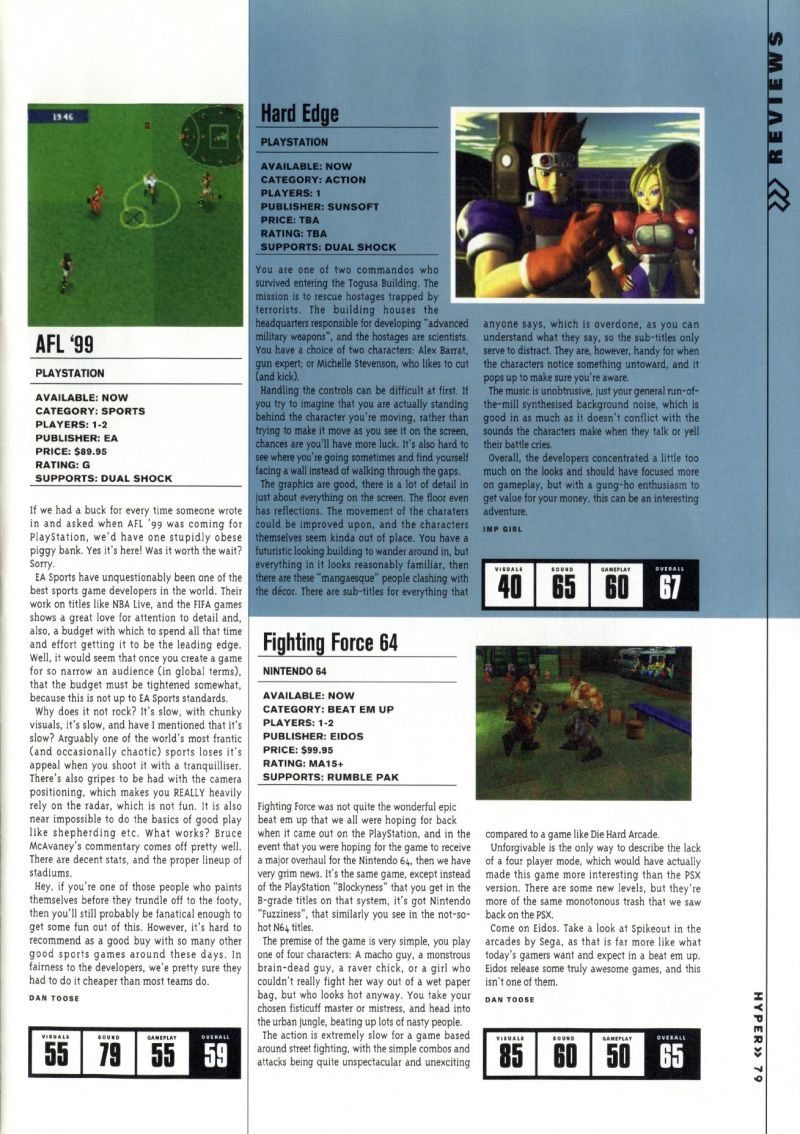
!["Fighting Force [64]"](http://www.nintendo64ever.com/scans/mags/Scan-Magazine-512-83.jpg)
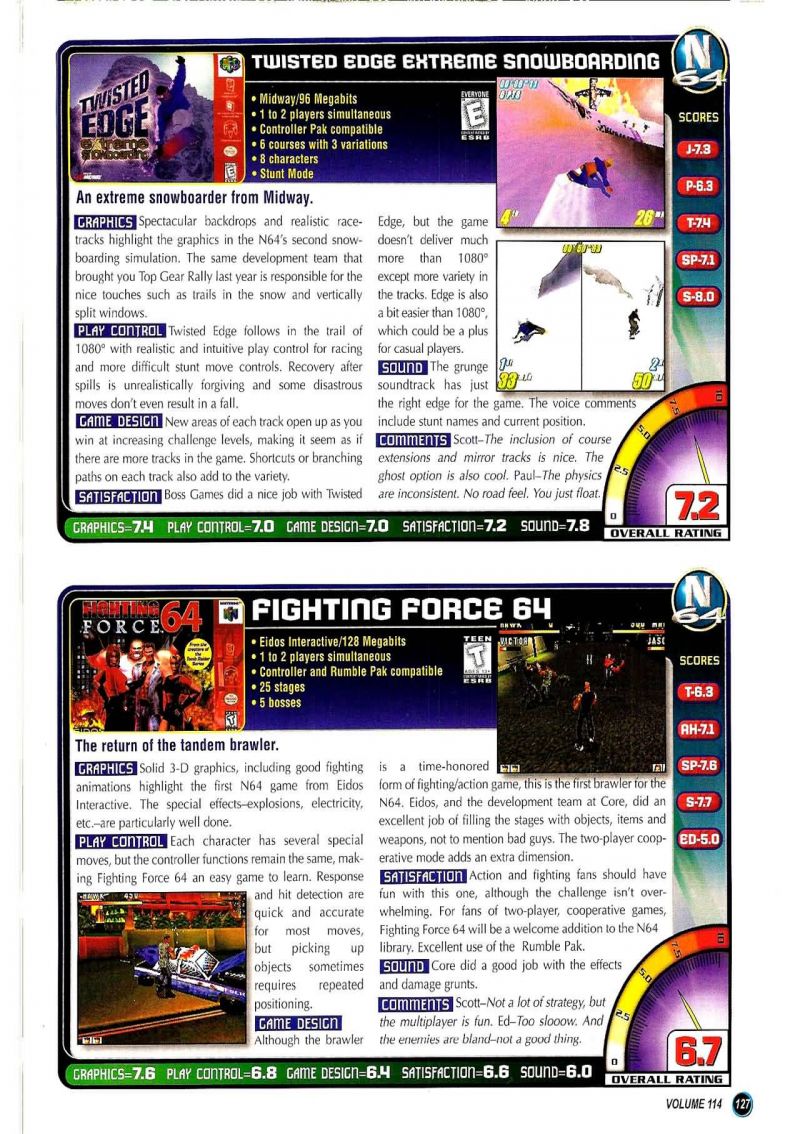
!["Fighting Force [64]"](http://www.nintendo64ever.com/scans/mags/Scan-Magazine-786-112.jpg)
::callout[type=info title="Wikipedia Source"] This article was imported from Wikipedia and is available under the Creative Commons Attribution-ShareAlike 4.0 License. Content has been adapted to SurfDoc format. Original contributors can be found on the article history page. ::