Exon junction complex
Protein complex assembled on mRNA
title: "Exon junction complex" type: doc version: 1 created: 2026-02-28 author: "Wikipedia contributors" status: active scope: public tags: ["rna", "spliceosome"] description: "Protein complex assembled on mRNA" topic_path: "politics" source: "https://en.wikipedia.org/wiki/Exon_junction_complex" license: "CC BY-SA 4.0" wikipedia_page_id: 0 wikipedia_revision_id: 0
::summary Protein complex assembled on mRNA ::
An exon junction complex (EJC) is a protein complex which forms on a pre-messenger RNA strand at the junction of two exons which have been joined together during RNA splicing. The EJC has major influences on translation, surveillance, localization of the spliced mRNA, and m6A methylation. It is first deposited onto mRNA during splicing and is then transported into the cytoplasm. There it plays a major role in post-transcriptional regulation of mRNA. It is believed that exon junction complexes provide a position-specific memory of the splicing event. The EJC consists of a stable heterotetramer core, which serves as a binding platform for other factors necessary for the mRNA pathway. The binding of these proteins to nuclear speckled domains has been measured recently and it may be regulated by PI3K/AKT/mTOR signaling pathways. In order for the binding of the complex to the mRNA to occur, the eIF4AIII factor is inhibited, stopping the hydrolysis of ATP. These interactions are suggested to be important for mRNA compaction. The role of EJC in mRNA export is controversial.
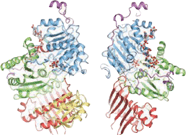
::figure[src="https://upload.wikimedia.org/wikipedia/commons/d/de/exon_junction_complex.gif" caption="2.3 angstrom resolution structure of a core EJC complex bound to an RNA transcript"] ::
Protein components
The EJC is made up of several key protein components: RNPS1, Y14, SRm160, Aly/REF and Magoh, among others. RNPS1 can function as a coactivator of splicing, but along with Y14, it also takes part in the process of nonsense-mediated decay in eukaryotes. SRm160 is another coactivator that has been proposed to enhance mRNA 3’ end processing. The protein component Magoh is thought to facilitate the subcytoplasmic localization of mRNAs while Aly is engaged in nuclear mRNA export. Aly is believed to be recruited to the exon junction complex by the protein UAP56. UAP56 is recognized as an RNA helicase but acts as a splicing factor required for early spliceosome assembly. Another factor involved in the EJC pathway is DEK. This component is known to take part in a variety of functions ranging from splicing to transcriptional regulation and chromatin structure.
Structure
The crystallization of the exon junction complex has revealed the structural organization of its protein components. The core of the complex is elongated with an overall dimension of 99Å by 67Å by 54Å. It is organized around the eIF4AIII factor. The factor itself consists of two different types of conformations around the mRNA: closed and open. In a closed state, the two domains of eIF4AIII form composite binding sites for the 5'-adenylyl-β,γ-imidodiphosphate (ADPNP) and mRNA. Magoh binds to an eIF4AIII domain through interactions between residues from its two C-terminal helices and one end of a large β-sheet.
Mechanism
During the second step of splicing in eukaryotic cells, the EJC is deposited approximately 20-24 nucleotides from the 5’ end upstream of the splice junction (where two exons are joined), when the lariat has formed and the exons are ligated together. The binding of the EJC to the mRNA occurs in a sequence independent manner, to form the mature messenger ribonucleoprotein (mRNP). The EJC remains stably bound to this mRNP as it is exported out of the nucleus and into the cytoplasm. Protein components are either bound to or released by the EJC as it is transported. In order for the translocation of mRNAs through the nuclear pore complex to occur, a heterodimer consisting of NXF1/TAP and NXT1/p15 must bind to the transcripts. NXF1/TAP is a major receptor for the export of mRNAs to the cytoplasm. This is because it interacts with both RNA-binding adapter proteins and components of the nuclear pore complex.
Recognition of a premature termination codon occurs during translation in the cytoplasm. The image shown below implies that this event is nuclear, contrary to the general view in this field. Readers should be aware that translation in the nucleus is a highly controversial subject that is not well-supported by data. ::figure[src="https://upload.wikimedia.org/wikipedia/commons/0/08/NMD_pathway.jpg" caption="PTC causes mRNA transcript to undergo NMD"] ::
In nonsense mediated decay
Exon junction complexes play a major role in mRNA surveillance. More specifically, they are found in the nonsense mediated decay pathway (NMD), wherein mRNA transcripts with premature stop codons are degraded. In normal mRNA translation, the ribosome binds to the transcript and begins amino acid chain elongation. It continues on until it reaches the location of the exon junction complex, which it then displaces. Next, translation is complete when the ribosome reaches a termination codon. In NMD, the mRNA transcript contains a premature termination codon (PTC) due to a nonsense mutation. If this codon occurs prior to the EJC site, the EJC will remain bound, triggering mRNA decay. The EJC and its position serve as a type of regulator, determining whether the transcript is defective or not.
EJCs are also known to take part in NMD in another way; the recruitment of the surveillance factors UPF1, UPF2 and UPF3. These proteins are the most important components of the NMD mechanism. The EJC protein MAGOH, Y14 and eIF4AIII provide a binding for UPF3, which acts as a bridge between UPF2 and UPF1 forming a trimeric complex. Within this complex, UPF2 and UPF3 act cooperatively to promote ATPase and RNA helicase of UPF1. The EJC core stably anchors the UPF complex to the mRNA, and aids in regulation of essential UPF1 protein. Ribosomes which are stalled on a PTC recruit UPF1 through interactions with the release factor eRF1 and eRF3. Along with the protein SMG1, eRF1, eRF3 and UPF1 form the complex SURF. This complex forms a bridge between the ribosome and the downstream EJC which is associated with UPF3 and UPF2. This interaction triggers the phosphorylation of UPF1 by SMG1, causing the dissociation of eRF1 and eRF3. The complex produced consists of EJC, UPF3, UPF2, phosphorylated UPF1 and SMG1 and in turn triggers degradation of the mRNA.
References
References
- (February 2023). "Exon architecture controls mRNA m6A suppression and gene expression". Science.
- (June 2004). "The ever-increasing complexities of the exon junction complex.". Current Opinion in Cell Biology.
- (2005). "The exon junction core complex is locked onto RNA by inhibition of eIF4AIII ATPase activity". Nat. Struct. Mol. Biol..
- (2013). "Regulation of mRNA export by the PI3 kinase/AKT signal transduction pathway". Mol Biol Cell.
- (2012). "The cellular EJC interactome reveals higher-order mRNP structure and an EJC-SR protein nexus". Cell.
- (2000). "Pre-mRNA Splicing Imprints mRNA in the Nucleus with a Novel RNA-Binding Protein that Persists in the Cytoplasm". Mol Cell.
- (2001). "The exon-exon junction complex provides a binding platform for factors involved in mRNA export and nonsense-mediated mRNA decay". EMBO J..
- (2000). "The spliceosome deposits multiple proteins 20-24 nucleotides upstream of mRNA exon-exon junctions". EMBO J..
- (2001). "Communication of the Position of Exon-Exon Junctions to the mRNA Surveillance Machinery by the Protein RNPS1". Science.
- (2002). "The exon junction complex is detected on CBP80-bound but not eIF4E-bound mRNA in mammalian cells: dynamics of mRNP remodeling". EMBO J..
- (1999). "Purification and characterization of human RNPS1: a general activator of pre-mRNA splicing". EMBO J..
- (2002). "SRm160 Splicing Coactivator Promotes Transcript 3'-End Cleavage". Mol. Cell. Biol..
- (2001). "The protein Mago provides a link between splicing and mRNA localization". EMBO Rep..
- (2000). "The protein Aly links pre-messenger-RNA splicing to nuclear export in metazoans". Nature.
- (2001). "REF proteins mediate the export of spliced and unspliced mRNAs from the nucleus". Proc. Natl. Acad. Sci. USA.
- (2003). "Nuclear RNA export". J. Cell Sci..
- (2002). "REF1/Aly and the additional exon junction complex proteins are dispensable for nuclear mRNA export". J. Cell Biol..
- (2000). "The protein encoded by the proto-oncogene DEK changes the topology of chromatin and reduces the efficiency of DNA replication in a chromatin-specific manner". Genes Dev..
- (2000). "The acute myeloid leukemia-associated protein, DEK, forms a splicing-dependent interaction with exon-product complexes". J. Cell Biol..
- (2001). "Protein phosphatase 2A activates the HIV-2 promoter through enhancer elements that include the pets site". J. Biol. Chem..
- (2006). "Structure of the exon junction core complex with a trapped DEAD-box ATPase bound to RNA". Science.
- (2003). "Structure of the Y14-Magoh Core of the Exon Junction Complex". Curr. Biol..
- (2003). "A novel mode of RBD-protein recognition in the Y14–Mago complex". Nat. Struct. Biol..
- (2003). "Crystal structure of the Drosophila Mago nashi-Y14 complex". Genes Dev..
- (2002). "5' exon interactions within the spliceosome establish a framework for exon junction complex structure and assembly". Genes Dev.
- (2004). "eIF4AIII binds spliced mRNA in the exon junction complex and is essential for [[nonsense mediated decay]].". Nat. Struct. Mol. Biol..
- (2000). "The spliceosome deposits multiple proteins 20-24 nucleotides upstream of mRNA exon-exon junctions". EMBO J.
- (2002). "A conserved mRNA export machinery coupled to pre-mRNA splicing". Cell.
- (2002). "A novel family of nuclear transport receptors mediates the export of messenger RNA to the cytoplasm. Eur". J. Cell Biol..
- (2007). "The nonsense-mediated decay RNA surveillance pathway". Annu Rev Biochem.
- (2005). "Nonsense-mediated mRNA decay: molecular insights and mechanistic variations across species". Curr. Opin. Cell Biol..
- (2007). "NMD factors UPF2 and UPF3 bridge UPF1 to the exon junction complex and stimulate its RNA helicase activity". Nature Structural & Molecular Biology.
::callout[type=info title="Wikipedia Source"] This article was imported from Wikipedia and is available under the Creative Commons Attribution-ShareAlike 4.0 License. Content has been adapted to SurfDoc format. Original contributors can be found on the article history page. ::