Eta Pegasi
Binary star in the constellation Pegasus
title: "Eta Pegasi" type: doc version: 1 created: 2026-02-28 author: "Wikipedia contributors" status: active scope: public tags: ["g-type-bright-giants", "f-type-main-sequence-stars", "binary-stars", "pegasus-(constellation)", "bayer-objects", "durchmusterung-objects", "flamsteed-objects", "henry-draper-catalogue-objects", "hipparcos-objects", "bright-star-catalogue-objects", "stars-with-proper-names", "population-i-stars"] description: "Binary star in the constellation Pegasus" topic_path: "science/astronomy" source: "https://en.wikipedia.org/wiki/Eta_Pegasi" license: "CC BY-SA 4.0" wikipedia_page_id: 0 wikipedia_revision_id: 0
::summary Binary star in the constellation Pegasus ::
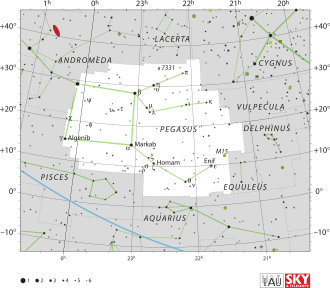
| image = | image=Pegasus IAU.svg | float=center | width=250 | position=right | mark=Red circle.svg | mark_width=10 | mark_link=η Peg | x%=46.9 | y%=29.8 | caption=Location of η Pegasi (circled) near the center | epoch = J2000.0 | ra = | dec = | appmag_v = +2.95 | constell = Pegasus | class = G2 II + F0 V | b-v = +0.86 | u-b = +0.57 | variable = | radial_v = +4.3 | prop_mo_ra = +13.16 | prop_mo_dec = -25.67 | parallax = 15.22 | p_error = 0.71 | parallax_footnote = | absmag_v = –1.18 | reference = | period_unitless = 813 days | eccentricity = 0.183 | periastron = 2452025 HJD | periarg = 344.7 | k1 = 14.37 | component1 = η Peg A | mass = | radius = | luminosity = | gravity = 2.40 | temperature = | metal_fe = +0.39 | rotational_velocity = 1.4 | rotation = 818 | age_gyr = | names = | Simbad = eta+Peg
Eta Pegasi or η Pegasi, formally named Matar ,{{cite book |last1=Kunitzsch |first1=Paul |last2=Smart |first2=Tim |date = 2006 |edition = 2nd rev. |title = A Dictionary of Modern star Names: A Short Guide to 254 Star Names and Their Derivations |publisher = Sky Pub |location = Cambridge, Massachusetts |isbn = 978-1-931559-44-7
Nomenclature
η Pegasi (Latinised to Eta Pegasi) is the star's Bayer designation.
It bore the traditional name Matar, derived from the Arabic سعد المطر Saʽd al Maṭar, meaning lucky star of rain. In 2016, the International Astronomical Union organized a Working Group on Star Names (WGSN){{citation | url=https://www.iau.org/science/scientific_bodies/working_groups/280/ | title=IAU Working Group on Star Names (WGSN) | publisher=International Astronomical Union | access-date=22 May 2016 | postscript=. }} to catalogue and standardize proper names for stars. The WGSN approved the name Matar for η Pegasi A on 21 August 2016 and it is now so entered in the IAU Catalog of Star Names.
In Chinese, 離宮 (Lì Gōng), meaning Resting Palace, refers to an asterism consisting η Pegasi, λ Pegasi, μ Pegasi, ο Pegasi, τ Pegasi and ν Pegasi. Consequently, η Pegasi itself is known as 離宮四 (Lì Gōng sì), "the Fourth Star of Resting Palace".
Namesake
USS Matar (AK-119) was a United States Navy Crater class cargo ship named after the star.
Properties
The Eta Pegasi system consists of a pair of stars in a binary orbit with a period of 813 days and an eccentricity of 0.183. The primary component is a bright giant star with a stellar classification of G2 II and about three and a half times the mass of the Sun. The interferometry-measured angular diameter of this star, after correcting for limb darkening, is 3.471 ± 0.027 mas, which, at its estimated distance, equates to a physical radius of more than 24 times the radius of the Sun. It is radiating 331 times the luminosity of the Sun from its expanded outer envelope at an effective temperature of 4,970 K. The rotation rate of the star slowed as it expanded, so it has a projected rotational velocity of 1.7 km s−1 with an estimated rotation period of 818 days.
The secondary component is an F-type main sequence star with a classification of F0 V. The secondary star is 3.56 magnitudes fainter that the primary star at 700 nm. There are also 2 class G stars further away that may or may not be physically related to the main pair.
References
References
- "IAU Catalog of Star Names".
- {{in lang. zh ''中國星座神話'', written by 陳久金. Published by 台灣書房出版有限公司, 2005, {{ISBN. 978-986-7332-25-7.
- {{in lang. zh [http://www.lcsd.gov.hk/CE/Museum/Space/Research/StarName/c_research_chinengstars_ala_alz.htm 香港太空館 - 研究資源 - 亮星中英對照表] {{webarchive. link. (2008-10-25 , Hong Kong Space Museum. Accessed on line November 23, 2010.)
- van Leeuwen, F.. (November 2007). "Validation of the new Hipparcos reduction". Astronomy and Astrophysics.
- (November 1995). "Chemical Abundances for F and G Luminosity Class II Stars". Astronomical Journal.
- (September 2000). "Evolution of X-ray activity of 1-3 Msun late-type stars in early post-main-sequence phases". Astronomy and Astrophysics.
- (November 1998). "Ultraviolet and Optical Studies of Binaries with Luminous Cool Primaries and Hot Companions. V. The Entire IUE Sample". The Astrophysical Journal Supplement Series.
- Wilson, Ralph Elmer. (1953). "General Catalogue of Stellar Radial Velocities". [[Carnegie Institution of Washington]].
- (January 2008). "Rotational and Radial Velocities for a Sample of 761 HIPPARCOS Giants and the Role of Binarity". The Astronomical Journal.
- (1966). "UBVRIJKL photometry of the bright stars". Communications of the Lunar and Planetary Laboratory.
- "eta Peg".
- (1944). "The pronunciations, derivations, and meanings of a selected list of star names". Popular Astronomy.
- (2018). "Fundamental Parameters of 87 Stars from the Navy Precision Optical Interferometer". The Astronomical Journal.
- (9 November 2016). "Surveying the Bright Stars by Optical Interferometry. I. A Search for Multiplicity Among Stars of Spectral Types F-K". The Astrophysical Journal Supplement Series.
::callout[type=info title="Wikipedia Source"] This article was imported from Wikipedia and is available under the Creative Commons Attribution-ShareAlike 4.0 License. Content has been adapted to SurfDoc format. Original contributors can be found on the article history page. ::