Eddie Waitkus
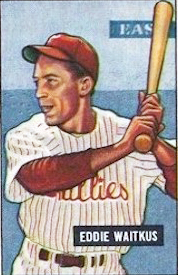
American baseball player (1919–1972)
title: "Eddie Waitkus" type: doc version: 1 created: 2026-02-28 author: "Wikipedia contributors" status: active scope: public tags: ["1919-births", "1972-deaths", "american-people-of-lithuanian-descent", "baltimore-orioles-players", "chicago-cubs-players", "deaths-from-esophageal-cancer-in-the-united-states", "deaths-from-cancer-in-massachusetts", "major-league-baseball-first-basemen", "national-league-all-stars", "philadelphia-phillies-players", "baseball-players-from-cambridge,-massachusetts", "moline-plowboys-players", "tulsa-oilers-(baseball)-players", "los-angeles-angels-(minor-league)-players", "united-states-army-personnel-of-world-war-ii"] description: "American baseball player (1919–1972)" topic_path: "science/astronomy" source: "https://en.wikipedia.org/wiki/Eddie_Waitkus" license: "CC BY-SA 4.0" wikipedia_page_id: 0 wikipedia_revision_id: 0
::summary American baseball player (1919–1972) ::
::data[format=table title="Infobox baseball biography"]
| Field | Value |
|---|---|
| image | Eddie Waitkus.jpg |
| name | Eddie Waitkus |
| position | First baseman |
| bats | Left |
| throws | Left |
| birth_date | |
| birth_place | Cambridge, Massachusetts, U.S. |
| death_date | |
| death_place | Jamaica Plain, Massachusetts, U.S. |
| debutleague | MLB |
| debutdate | April 15 |
| debutyear | 1941 |
| debutteam | Chicago Cubs |
| finalleague | MLB |
| finaldate | September 20 |
| finalyear | 1955 |
| finalteam | Philadelphia Phillies |
| statleague | MLB |
| stat1label | Batting average |
| stat1value | .285 |
| stat2label | Home runs |
| stat2value | 24 |
| stat3label | Runs batted in |
| stat3value | 373 |
| :: |
| image = Eddie Waitkus.jpg | name = Eddie Waitkus | position = First baseman | bats = Left | throws = Left | birth_date = | birth_place = Cambridge, Massachusetts, U.S. | death_date = | death_place = Jamaica Plain, Massachusetts, U.S. | debutleague = MLB | debutdate = April 15 | debutyear = 1941 | debutteam = Chicago Cubs | finalleague = MLB | finaldate = September 20 | finalyear = 1955 | finalteam = Philadelphia Phillies | statleague = MLB | stat1label = Batting average | stat1value = .285 | stat2label = Home runs | stat2value = 24 | stat3label = Runs batted in | stat3value = 373 | teams =
- Chicago Cubs (, –)
- Philadelphia Phillies (–)
- Baltimore Orioles (–)
- Philadelphia Phillies () | highlights =
- 2× All-Star (1948, 1949) Edward Stephen Waitkus (September 4, 1919 – September 16, 1972) was an American professional baseball player who played as a first baseman. He played a total of 11 seasons in Major League Baseball (MLB), before and after serving in World War II (1941 and 1946–1955). He played for the Chicago Cubs and Philadelphia Phillies in the National League and for the Baltimore Orioles of the American League. He was elected to the National League All-Star team twice (1948 and 1949).
Early career, WWII
Waitkus, the son of Lithuanian immigrants, grew up in Boston and attended the Cambridge High and Latin School and Boston College. He began his professional career in 1938 playing for the Worumbo Indians, a semi-professional team sponsored by Worumbo Woolen Mill in Lisbon Falls, Maine. As a rookie, he was known as "the natural," which gave the title to the book loosely based on his life.
Waitkus saw some of the bloodiest fighting of World War II with the U.S. Army in the Philippines, and was awarded four Bronze Stars. During Operation Cartwheel, Waitkus saved the life of a badly bleeding fellow soldier, leaving his foxhole during an attack on his position, and finding some safety pins to stop the bleeding.
Upon his return to baseball, he quickly became a star for the Chicago Cubs. He also became a popular media figure, as he was well-educated and was fluent in Lithuanian, Polish, German, and French. Following the 1948 season, the Cubs traded Waitkus with Hank Borowy to the Philadelphia Phillies for Monk Dubiel and Dutch Leonard.
Shooting
Just a few years into his career, Waitkus was shot by Ruth Ann Steinhagen, an obsessed fan, at Chicago's Edgewater Beach Hotel on June 14, 1949, | title = Silly Honey | date = June 27, 1949 | magazine = Time | url = http://www.time.com/time/magazine/article/0,9171,800440,00.html | archive-url = https://web.archive.org/web/20090903114056/http://www.time.com/time/magazine/article/0,9171,800440,00.html | url-status = dead | archive-date = September 3, 2009 | access-date = July 22, 2012
Steinhagen had become infatuated with him when he was a Cub, but seeing him every day in-season may have kept her obsession in check. Once he was traded to the Phillies, Steinhagen's obsession grew to dangerous proportions. She checked into the hotel using the alias "Ruth Ann Burns" and left a note at the desk, asking him to come to her hotel room on an urgent matter.
When he arrived in her room, she shot him with a .22 caliber rifle, a bolt-action Remington model 510. The bullet entered his lung, barely missing his heart. She immediately called the desk to report the shooting and was found cradling his head in her lap. Waitkus was taken to the Illinois Masonic Hospital, where he nearly died several times on the operating table before the bullet was successfully removed. Steinhagen never stood trial but instead was confined to a mental institution for a few years.{{cite news | last = Heller | first = Dick | title = Waitkus was a Natural. | url = https://www.questia.com/read/1G1-201798378 | newspaper = The Washington Times | access-date = July 23, 2012 | date = June 14, 2009
Return to action
After being shot in Chicago, Waitkus did not play again in the 1949 season, in which he compiled a .306 batting average with 27 RBI and 41 runs scored in 54 games played. However Waitkus did return in uniform, although not to action, on August 19, 1949, for "Eddie Waitkus Night" at Shibe Park, at which he was feted by the Phillies and showered with gifts.
Waitkus returned to play in the 1950 season as the leadoff hitter for the Whiz Kids team that won the 1950 National League pennant. Waitkus led the team in scoring with 102 runs. Waitkus made his only post-season appearance in the 1950 World Series. After the 1950 season, Waitkus was named the Associated Press Comeback Player of the Year. | title = Waitkus, Who Beat Death Rap, 'Comeback King' | newspaper = Ellensburg Daily Record | date = November 10, 1950 | page = 3 | url = https://news.google.com/newspapers?id=pQcKAAAAIBAJ&pg=6308%2C681011 | access-date = July 22, 2012
Later life
Prior to the 1954 season, the Baltimore Orioles purchased Waitkus from the Philadelphia Phillies for $40,000 (). Released by the Orioles in 1955, he returned to the Phillies for the remainder of the season. After the 1955 baseball season was complete, the Phillies released Waitkus.
Following his baseball career, Waitkus worked in trucking in Buffalo, New York, and later as a manager at a department store in Waltham, Massachusetts. A resident of Cambridge, Massachusetts, at the time of his death, he was survived by a son and a daughter.
''The Natural''
Author Bernard Malamud may have woven the basic elements of the Waitkus story – including that some called Waitkus "The Natural" because of his natural swing – and other baseball legends (notably that of Joe Jackson) into The Natural.{{cite web | title = This Day in Philly Sports History: A Demented Fan and the Natural | publisher = PhillySportsHistory.com | date = June 14, 2011 | url = http://phillysportshistory.com/2011/06/14/this-day-in-philly-sports-history-a-demented-fan-and-the-natural/ | access-date = July 22, 2012 | archive-date = February 21, 2013 | archive-url = https://web.archive.org/web/20130221082248/http://phillysportshistory.com/2011/06/14/this-day-in-philly-sports-history-a-demented-fan-and-the-natural/ | url-status = dead
However, it is unclear if Malamud was solely inspired by the shooting of Waitkus, or if he also borrowed from the life of Cubs shortstop Billy Jurges, who was shot by his ex-girlfriend in 1932 at the Chicago hotel in which they lived. An episode from the 10th and last season of Beverly Hills, 90210 was called "Eddie Waitkus" and used the story of Waitkus' history, near death and inspiration for THE NATURAL in relation to a character who was though to be dead but turned out to be living in Federal witness protection under a new identity.
References
References
- Theodore, John. (2002). "Baseball's Natural: The Story of Eddie Waitkus". Southern Illinois University Press.
- Marshall, William. (1999). "Baseball's Pivotal Era, 1945–1951". University Press of Kentucky.
- (June 16, 1949). "Waitkus Rallies, Girl Tells Why She 'Had To'". [[New York Daily News.
- (June 15, 1949). "Phils' First Baseman Shot and Wounded". The Evening Herald.
- "Model 510 Targetmaster".
- Andrews, Dale. (March 26, 2013). "Stalker". SleuthSayers.
- Associated Press, “Eddie Waitkus, Major League Player, Shot,” ''The San Bernardino Daily Sun'', San Bernardino, California, Wednesday 15 June 1949, Volume LV, Number 247, page 1.
- Pennington, Bill. (June 14, 1992). "The Real Roy Hobbs — The Natural Facts". The Record.
- "Eddie Waitkus 1949 Batting Game Logs".
- Edelman, Rob. "Eddie Waitkus and "The Natural": What is Assumption? What is Fact?".
- "1950 Philadelphia Phillies Statistics".
- [https://news.google.com/newspapers?nid=860&dat=19550730&id=NXgKAAAAIBAJ&sjid=hUsDAAAAIBAJ&pg=2052,1483088 Phillies sign Eddie Waitkus]
- [https://news.google.com/newspapers?nid=348&dat=19551006&id=UZtMAAAAIBAJ&sjid=kjEDAAAAIBAJ&pg=5017,3316747 Phillies release Waitkus, Lowrey; Sell Bob Kuzava]
- Berkow, Ira. (October 3, 1972). "Writer recalls shooting of Eddie Waitkus in '49". [[The Cincinnati Post]].
- (September 17, 1972). "Eddie Waitkus dies, ex-baseball star". [[The Boston Globe]].
- Bales, Jack. "Show Girl and the Shortstop: The Strange Saga of Violet Popovich and Her Shooting of Cub Billy Jurges".
::callout[type=info title="Wikipedia Source"] This article was imported from Wikipedia and is available under the Creative Commons Attribution-ShareAlike 4.0 License. Content has been adapted to SurfDoc format. Original contributors can be found on the article history page. ::