Delta Cassiopeiae
Star in constellation of Cassiopeia
title: "Delta Cassiopeiae" type: doc version: 1 created: 2026-02-28 author: "Wikipedia contributors" status: active scope: public tags: ["eclipsing-binaries", "a-type-subgiants", "cassiopeia-(constellation)", "bayer-objects", "bright-star-catalogue-objects", "durchmusterung-objects", "flamsteed-objects", "henry-draper-catalogue-objects", "hipparcos-objects", "stars-with-proper-names"] description: "Star in constellation of Cassiopeia" topic_path: "science/astronomy" source: "https://en.wikipedia.org/wiki/Delta_Cassiopeiae" license: "CC BY-SA 4.0" wikipedia_page_id: 0 wikipedia_revision_id: 0
::summary Star in constellation of Cassiopeia ::
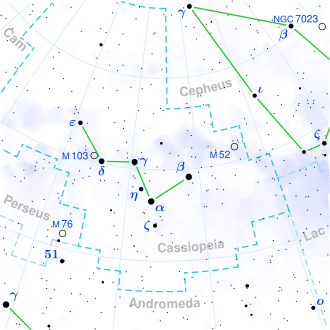
| name = δ Cassiopeiae | image= |image=Cassiopeia constellation map.svg|alt=|float=center|width=260 |label=|position=right |mark=Red circle.svg|mark_width=12|mark_link=δ Cas |x=306|y=490 | caption = Location of δ Cassiopeiae (circled) | epoch = J2000 | ra = | dec = | appmag_v = 2.68 | constell = Cassiopeia | class = A5 IV | b-v = +0.13 | u-b = +0.13 | variable = Algol? | radial_v = −6.7 | prop_mo_ra = +296.57 | prop_mo_dec = −49.22 | pm_footnote = | parallax = 32.81 | p_error = 0.14 | parallax_footnote = | absmag_v = +0.28 | mass = 2.49 | radius = 3.90 | luminosity = 72.88 | temperature = 7,980 | gravity = 3.1 | metal_fe = −0.4 | rotational_velocity = 123 | age_myr = 600 | names = | Simbad=HR403
Delta Cassiopeiae is an eclipsing binary star system in the northern circumpolar constellation of Cassiopeia. Its name is a Bayer designation that is Latinized from δ Cassiopeiae, and abbreviated Delta Cas or δ Cas. Based on parallax measurements taken during the Hipparcos mission, it is approximately 99.4 ly from the Earth.
Delta Cassiopeiae is the primary or 'A' component of a multiple star system designated WDS J01258+6014. Delta Cassiopeiae's two components are therefore designated WDS J01258+6014 Aa and Ab. Aa is officially named Ruchbah , the traditional name for the system.
Nomenclature
δ Cassiopeiae (Latinised to Delta Cassiopeiae) is the star's Bayer designation. WDS J01258+6014A is its designation in the Washington Double Star Catalog.
It also bore the traditional names Ruchbah and Ksora; the former deriving from the Arabic word ركبة rukbah meaning "knee", and the latter appeared in a 1951 publication, Atlas Coeli (Skalnate Pleso Atlas of the Heavens) by Czech astronomer Antonín Bečvář. Professor Paul Kunitzch has been unable to find any clues as to the origin of the name. The star Alpha Sagittarii also bore the traditional name Ruchbah (as well as Rukbat). In 2016, the International Astronomical Union organized a Working Group on Star Names (WGSN) to catalogue and standardize proper names for stars. The WGSN approved the name Ruchbah for the component WDS J01258+6014 Aa on 21 August 2016 and it is now so included in the List of IAU-approved Star Names (Alpha Sagittarii's primary was given the name Rukbat).
In Chinese, 閣道 (Gé Dào), meaning Flying Corridor, refers to an asterism consisting of Delta Cassiopeiae, Iota Cassiopeiae, Epsilon Cassiopeiae, Theta Cassiopeiae, Nu Cassiopeiae and Omicron Cassiopeiae. Consequently, the Chinese name for Delta Cassiopeiae itself is 閣道三 (Gé Dào sān, ).
Properties
Delta Cassiopeiae is a possible eclipsing binary star system consisting of a pair of stars that orbit about each other over a period of 759 days. The combined apparent visual magnitude of the two stars is 2.68, making it readily observable with the naked eye. Eclipses have been reported with a period of 759 days, when the brightness drops by 0.07 magnitudes. Modern studies have shown no brightness variations greater than 0.01 magnitudes.
The primary member of the system (WDS J01258+6014 Aa) has a stellar classification of A5 IV, with the luminosity class of IV indicating that it has exhausted the hydrogen at its core and has begun to evolve through the subgiant phase into a giant star. It is calculated that it is 4% beyond the end of its main sequence lifetime, with an age of about 600 million years. It has expanded to about 3.9 times the Sun's radius.
An excess infrared emission has been observed at a wavelength of 60 μm, which suggests the presence of a circumstellar debris disk. This emission can be characterized by heat radiated from dust at a temperature of 85 K, which corresponds to an orbital radius of 88 Astronomical Units, or 88 times the distance of the Earth from the Sun. For comparison, the region of the remote Kuiper belt in the Solar System extends from 30–50 AU.
The Washington Double Star Catalog lists a 12th magnitude companion away. It is an unrelated background object.
References
| access-date=2010-02-21 | postscript=. | mode = cs2 }}
| title=The Age Range of Hyades Stars | last=Eggen | first=Olin J. | journal=The Astronomical Journal | volume=116 | issue=1 | pages=284–292 | date=July 1998 | doi=10.1086/300413 | bibcode=1998AJ....116..284E | doi-access=free | postscript=. }}
| display-authors=1 | last1=Mason | first1=B. D. | last2=Wycoff | first2=G. L. | last3=Hartkopf | first3=W. I. | last4=Douglass | first4=G. G. | last5=Worley | first5=C. E. | title=The Washington Visual Double Star Catalog | journal=The Astronomical Journal | volume=122 | issue=6 | pages=3466 | year=2014 | bibcode=2001AJ....122.3466M | url=http://vizier.u-strasbg.fr/viz-bin/VizieR?-source=B/wds | access-date=2015-07-22 |doi = 10.1086/323920 | doi-access=free | postscript=. }}
|title=Star Name Pronunciation |last=Rumrill |first=H. B. |journal=Publications of the Astronomical Society of the Pacific |volume=48 |pages=139 |number=283 |date=June 1936 |location = San Francisco, California |bibcode=1936PASP...48..139R |doi=10.1086/124681 |s2cid=120743052 |doi-access=free | postscript=.}}
| url=https://www.iau.org/science/scientific_bodies/working_groups/280/ | title=IAU Working Group on Star Names (WGSN) | publisher=International Astronomical Union | access-date=22 May 2016 | postscript=. }}
| mode=cs2 | postscript=. | access-date=2025-09-22 }}
| title=A new method for the inversion of atmospheric parameters of A/Am stars | journal=Astronomy & Astrophysics | last1=Gebran|first1=M. | last2=Farah | first2=W. | last3=Paletou | first3=F. | last4=Monier | first4=R. | last5=Watson | first5=V. | display-authors=1 | volume=589 | pages=A83 | year=2016 | bibcode=2016A&A...589A..83G | arxiv=1603.01146 | doi=10.1051/0004-6361/201528052 | s2cid=118549566 | postscript=. }}
References
- (November 2007). "Validation of the new Hipparcos reduction". Astronomy and Astrophysics.
- (1966). "UBVRIJKL photometry of the bright stars". Communications of the Lunar and Planetary Laboratory.
- Wilson, Ralph Elmer. (1953). "General catalogue of stellar radial velocities". [[Carnegie Institution of Washington]].
- (2012). "Rotational velocities of A-type stars. IV. Evolution of rotational velocities". Astronomy & Astrophysics.
- (February 2006). "A catalogue of eclipsing variables". Astronomy and Astrophysics.
- Burnham, Robert. (1978). "Burnham's celestial handbook: an observer's guide to the Universe beyond the solar system". [[Courier Dover Publications]].
- (1971). "General Catalogue of Variable Stars". General Catalogue of Variable Stars.
- Bakich, Michael E.. (1995). "The Cambridge guide to the constellations". [[Cambridge University Press]].
- Allen, Richard Hinckley. (1899). "Star-names and their meanings". G.E. Stechert.
- (May 2007). "Characterization of Dusty Debris Disks: The IRAS and Hipparcos Catalogs". The Astrophysical Journal.
- (1989). "The late A-type stars - Refined MK classification, confrontation with Stromgren photometry, and the effects of rotation". Astrophysical Journal Supplement Series.
- Adelman, S. J.. (2001). "Research Note Hipparcos photometry: The least variable stars". Astronomy and Astrophysics.
- "Naming Stars". IAU.org.
- (2006). "A Dictionary of Modern Star Names: A Short Guide to 254 Star Names and Their Derivations". Sky Publishing Corporation.
- {{in lang. zh ''中國星座神話'', written by 陳久金. Published by 台灣書房出版有限公司, 2005, {{ISBN. 978-986-7332-25-7.
- {{in lang. zh [http://www.lcsd.gov.hk/CE/Museum/Space/Research/StarName/c_research_chinengstars_n_r.htm 香港太空館 - 研究資源 - 亮星中英對照表] {{webarchive. link. (January 30, 2011 , Hong Kong Space Museum. Accessed on line November 23, 2010.)
::callout[type=info title="Wikipedia Source"] This article was imported from Wikipedia and is available under the Creative Commons Attribution-ShareAlike 4.0 License. Content has been adapted to SurfDoc format. Original contributors can be found on the article history page. ::