Daopao
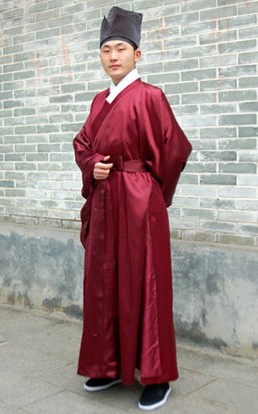
Traditional Chinese attire for men
title: "Daopao" type: doc version: 1 created: 2026-02-28 author: "Wikipedia contributors" status: active scope: public tags: ["chinese-traditional-clothing", "religious-clothing", "robes-and-cloaks"] description: "Traditional Chinese attire for men" topic_path: "geography/china" source: "https://en.wikipedia.org/wiki/Daopao" license: "CC BY-SA 4.0" wikipedia_page_id: 0 wikipedia_revision_id: 0
::summary Traditional Chinese attire for men ::
::data[format=table title="Infobox Chinese"]
| Field | Value |
|---|---|
| c | 道袍 |
| p | dàopáo |
| l | Taoist robe |
| pic | Hanfu daopao.jpg |
| piccap | Daopao (道袍)/ Xingyi (行衣) - formal wear for men |
| lang1 | English |
| lang1_content | Taoist robe |
| hangul | 도포 |
| hanja | 道袍 |
| rr | dopo |
| lk | Taoist robe |
| :: |
| c = 道袍 | p = dàopáo | l = Taoist robe | pic = Hanfu daopao.jpg | piccap = Daopao (道袍)/ Xingyi (行衣) - formal wear for men | lang1 = English | lang1_content = Taoist robe | hangul = 도포 | hanja = 道袍 | rr = dopo | lk = Taoist robe
zh (), also known as zh () when used as a zh during Chinese opera performances, and zh () when it is blue in colour, is a traditional form of zh in zh and is also one of the most distinctive form of traditional clothing for the Han Chinese. The zh was one of the most common traditional form of outer robe worn by men. zh literally means "Taoist robe"; however, despite its name, the zh were and is worn by men, and did not imply that its wearer had some affiliation to taoism. The zh can be dated back to at least the Ming dynasty but had actually been worn since the Song dynasty. Initially the daopao was a form of casual clothing which was worn by the middle or lower class in the Ming dynasty. In the middle and late Ming, it was one of the most common form of robes worn by men as casual clothing. The zh was also a popular formal wear by the Ming dynasty scholars in their daily lives. It was also the daily clothing for the literati scholars in the Ming dynasty. In the late Ming, it was also a popular form of clothing among the external officials and eunuchs sometimes wore it. The zh was also introduced in Korea during the Joseon period, where it became known as ko and was eventually localized in its current form.
The zh can also refer to a type of zh, which were worn by practitioners of taoism, when the term is used in its literal form. This form of zh worn taoist practitioners and taoist monks continued to be worn in the Qing dynasty as they were exempted from the zh policy. The zh of the Taoist also continue to be worn by modern taoist priests, although it may come in different names.
{{Transliteration|zh|Daopao}} in {{Transliteration|zh|Hanfu}}
History and origins
Main article: Zhiduo (clothing)
Some sources posit that a form of zh without a cord had evolved from the zh, which refers to the military-style garments which had supposedly been influenced by the northern nomad warriors from the north in the past. According to Antonia Finnane who noted the of Wang Shizhen (1526-1590), the three robes which evolved from the zh-style was the zh, the chengziyi (程子衣) worn with a chord around the waist, and the zh worn without chord. The zh of this period was a type of new garment which only appeared in the Ming dynasty and was likely localized from and developed under the influence of the jisün the Yuan dynasty. The zh was developed in the late Ming and bore some similarities with the zh. In the same ancient text, Wang Shizhen also noted that the zh was also called zh. However, the zh was another kind of zh which had predated the Yuan dynasty and can be traced back to the Tang dynasty.
Other Chinese sources also indicate that the zh had been worn since the Song dynasty (960–1279). After the year 960 AD, the belted zh was worn by the Taoist priests in order to distinguish themselves from others. The broad and elegant robes which were initially worn by Taoist priests were known as the ; sometimes translated as "Taoist priest robe").
Song dynasty
In the Northern Song dynasty, Taoism was highly revered. During this period, the zh also became very popular and was greatly appreciated by some hermits and scholars during the Song dynasty and was mentioned in some poems written by Wang Yucheng and Fan Zhongyan. Some scholars, such Shi Manqing (994 –1041), who was a celebrated scholar in the Northern Song dynasty, would often wore a zh with a scarf worn in a free style. The Shi Manqin-style zh was liked by some officials who were in their retirement; and therefore, they dressed in this form of zh.
In the Southern Song dynasty, it was Neo-Confucianism which arose and flourished; a new form of zh became fashionable; this form of zh was the garment worn by the scholars which followed the Confucianism. In the book Rules of Moral Teaching study by Zhu Xi, Zhu Xi stressed on the importance of dress code as being the first step for a person to be a "decent person". Since Zhu Xi put so much emphasis on the dress code, the literati eventually gradually developed their own dressing style as an accepted custom, which included the zh which was worn as a form of leisure clothing. Contemporary observers living in the Southern Song dynasty, such as Shi Shengzu (1192-1274), also noted that the return of the classic-style apparel in the Song dynasty had made the zh popular. In Volume 2 of the chapter in the , Shi Shengzu reported that the zh had been made popular by the use of zh and the shoes called zh; he associated the reason behind the popularity of zh with the attire style of the Taoist priests, which he observed, had remained unchanged for centuries. He also concluded that the apparel system of the three ancient Chinese dynasties, referred collectively as the , could still be found among the attire-style of the Taoist priests.
| total_width = 300 | image1 = Two men in daopao from liu songnian painting.jpg | image2 = 儒巾 五百罗汉像轴之一 南宋 周季常日本大德寺藏.png | align = center | footer = Men wearing zhiduo or daopao, from paintings of the Southern Song dynasty. | footer_align = center
Ming dynasty
During the Ming dynasty, the traditional clothing system of the Han Chinese, the zh, was restored following the fall of the Mongol-led Yuan dynasty. The zh and the zh continued to be worn in the Ming dynasty; the zh was similar to the zh in the Ming dynasty, with the presence of decorative border trims on the zh as an exception. However, despite the restoration of the zh-system by the Ming dynasty court, the shape of some garment, including the zh, had some differences from the ones worn in the Tang and Song dynasties as the clothing in the Ming dynasty had undergone a series of adjustments to their shapes. The shape of the Ming dynasty zh, and its colours, was strictly regulated by the political systems, rules and regulations of the time. Daopao4.jpg|A man wearing daopao with dadai-belt. Daopao2.jpg| Man wearing daofu with dadai-belt. 許樂善.jpg|Xu Yueshan wearing daopao, without a belt. 楊豫孫.jpg|Yang Yusun wearing daopao, without a belt. Lu Shusheng.jpg|Lu Shusheng wearing daopao with dragon patterns.
Construction and design
Ming dynasty {{Transliteration|zh|daopao}}
::figure[src="https://upload.wikimedia.org/wikipedia/commons/8/8e/Daopao_(Ming_dynasty_style).jpg" caption="daopao}}"] ::
The Ming dynasty zh is a full-length. It has a large frontal outer placket and smaller frontal inner placket. There is a pair of ties at the small placket and two pairs of ties on the large placket which is used for closing the garment. The sleeves are large but are narrower around the wrists. It characterized by a cross collar, which closes at the right side in the front, in a style called zh.[[File:Shenyi-daopao diff.jpg|left|thumb|Differences between zh and zh.]]It is also not completely stitched at the two sides and allows for side slits to begin below the waist level. At the sides of the robes, there are side panels in the form of concealed swing or pendulum structure (i.e. a front and back swings at each sides of the robe). These side panels at these slits, are called , and they were designed to conceal undergarments. ::figure[src="https://upload.wikimedia.org/wikipedia/commons/1/1d/Imperial_Encyclopaedia_-Ceremonial_Usages-pic351-_大帶.png" caption="dadai}}."] ::
The neckline of the robe is often decorated with white or plain collars. The collar can be either the same or a different colour to the main pieces of fabric. However, the collar is generally the same colour as the hems. An optional additional protective collar called could also be sewn to the first collar. The zh either be white or dark in colour.
A belt called was also fastened around the waist. In total, the structure of the Ming dynasty zh was made up of 10 parts. ::figure[src="https://upload.wikimedia.org/wikipedia/commons/4/4c/Daopao.jpg" caption="A man wearing a daofu with a dadai belt worn around the waist; it is edged with light blue decorative trims, Ming dynasty portrait."] ::
Ming dynasty {{Transliteration|zh|daofu}}
In the Ming dynasty, the zh was a wide-sleeved, crossed-collar robe which closes to the right in a style called zh; it also had dark edging at the edges of the collar, sleeves, and placket. In the collar edge, the zh was sometimes inserted. The Ming dynasty zh was similar to the zh, except for the addition of edges decoration on the robe. Belts, like the and the was also used around the waist when wearing the zh.
Derivatives and influences
China
{{Transliteration|zh|Xuezi}}
Main article: Xifu (Costume)
::figure[src="https://upload.wikimedia.org/wikipedia/commons/6/6e/20150803203805_IMG_0659_(19668286223).jpg" caption="[[Kunqu]]}}"] ::
The which is a costume in zh, is a derivative of the Ming dynasty zh which was worn by the Ming dynasty scholars as an every day formal attire.It is also a derivative of the zh which dates back from the Zhou dynasty.
In the Qing dynasty, actors who performed in Chinese opera performance were allowed to wear zh and zh-style zh as they were exempted from the zh policy. Therefore, the zh was therefore allowed to be worn and continues to be worn even in present days, where it is now one of the most common form of costumes worn on stage.
When used in Chinese opera, the zh is a form of informal dress worn by performers who hold the zh role types, which include the zh and the zh. Performers playing female roles could also wear a zh called zh*,* which was also used as an informal robe.
Construction and design
The zh is structurally different from the zh: the zh has a trapezoid body, narrower sleeves which is tubular in shape, the sleeves are longer than the wrists, and water sleeves are also added; there is an asymmetrical closure where the right side is right below the shoulder and neck intersection while the left crossing over is tied right under the right arm in a style called zh. There are also differences in the shapes and forms of the zh depending on the role types:
Actors performing the role of men wear a full-length zh while actors performing the role of women wear a knee-length zh; the male zh has a zh closure while there are two types of closure for the zh, one which has a zh closure and one which has front central closure, a style which can be referred as zh.
The zh often wears zh of pastel colours, which is embroidered with flowers and has water sleeves.
Korea
Main article: Dopo (clothing)
The zh was imported from the Ming dynasty to Korea during the Joseon period, where it became known as ko and was eventually localized in Korea gaining its current form. In this period, the intellectual current which had been popularized in Joseon was the Zhuzi studies (viz. 程朱理學: 程子理學 and 朱子理學) which was of Chinese origins. According to the Joseon literati, Sŏng Tae-chung, who visited Japan in the 1764 at a time when the Ming dynasty had already fallen, when asked what he wore as a robe and headwear by Ryūzan, Sŏng Tae-chung answered that he was wearing the ko and the ko which were the attire of the ancient sages; the ko and ko were both Confucian attire and dressing style which had been adopted in Joseon.
{{Transliteration|zh|Daojiao Fushi}}
Main article: Taoism, Daojiao fushi
::figure[src="https://upload.wikimedia.org/wikipedia/commons/c/ca/亜細亜大観_12_149_"道士の生活(三)_(北平郊外)".jpg" caption="Three Taoist priests at [[White Cloud Temple]], Beijing, 1931."] ::
::figure[src="https://upload.wikimedia.org/wikipedia/commons/9/9e/万寿八仙宫.jpg" caption="八仙宫}}, [[Xi'an]], 1910-1911."] ::
The traditional clothing worn by the Taoist community is connected to pre-modern Chinese clothing and styles. Tradition-based taoists will often wear the traditional robes and liturgical clothing for formal religious and ritual occasions while Zhengyi priests and taoists priests outside mainland China tend to wear Western clothing in their daily lives. The traditional taoist robes can also be worn as a daily lives clothing by the Quanzhen monastics in mainland China. There were many forms of daojiao fushi in the ancient China.
Daopao/ hechang
Some forms of taoist robes are also referred as crane robes (). The Taoist priests' daopao which date back to at least the 1800s is not cross collared and instead looks like a beizi in terms of construction and design; a clothing artefact showing this style of daopao is now stored in museums such as the Rhode Island School of Design Museum. The Taoist's priest daopao are commonly worn by the Taoism priests. It is worn by middle-ranks Taoist priests; it is red in colour and has motifs at the back and front, on the sleeves. Theses motifs decorations can include, the bagua and cranes. File:西塞2017·神舟前的道士.jpg|A taoist priest wearing a modern-day taoist's daopao (depicted as a red overcoat), 2017. File:WangChangyue.jpg|Wang Changyue, Qing dynasty. File:Taopriest.jpg|Taoist Priest in Macau, 2006.
Jiangyi
, also known as "robe of descent" which refers to either the descent of a priest from the altar or of the spirits to the altar, is a common form of Taoist priest's clothing. The jiangyi is a sign of the higher priestly rank and is worn by grandmasters. It was worn at least since the Ming and Qing dynasties.
It looks similar to a poncho in structure; when worn, the robe sits squarely on the shoulders of the Taoist' priest; it is usually fastened across the front with two silk ties which are sewn just above the waist level. It is made of embroidered silks and is composed of a large square of satin fabric folded into two to form the shoulder line; the shoulder lines continues to the hem of the sleeves. The robe is slashed in the middle to form the collar of the robe. It is typically trimmed with border decorations. File:邵元節.jpg|Zhengyi taoist priest wearing jiangyi, Ming dynasty. File:Daoist priest's robe (jiangyi), China, Qing dynasty, late 18th to early 19th century AD, silk, metal-wrapped silk, view 1 - Textile Museum, George Washington University - DSC09658.JPG|Daoist priest's robe (jiangyi), China, Qing dynasty, late 18th to early 19th century AD/ File:Daoist Priest's Robe (China), 19th century (CH 18464275-2).jpg|Daoist Priest's Robe (jiangyi), 19th century File:MET TP478.jpg|Daoist Priest's Robe (jiangyi), late 18th–early 19th century File:Daoist priest's robe, China, Honolulu Museum of Art 1678.1.JPG|Daoist priest's robe (jiangyi), China, 20th century. [[File:MET_30_76_28_F_sf.jpg|thumb|A priest's robe, China, 20th century]] ::figure[src="https://upload.wikimedia.org/wikipedia/commons/3/33/Imperial_Encyclopaedia_-Ceremonial_Usages-pic481-_道衣.png" caption="c=道衣}} from ''[[Gujin Tushu Jicheng]]'', between 1700 and 1725."] ::
Daoyi
The Quanzhen monastic taoist priests and nuns wear a wide-sleeved, cross-collared gown called which closes to the right; it is a standard type of clothing. The sleeves of the daoyi is referred as "cloud sleeves"; they are wide, open at the ends, and their sleeves are so long that it is past the fingers when extended but can be even longer. In the Quanzhen order, the dagua is worn as one of the ordinary clothing while the deluo is a formal clothing.
Deluo
::figure[src="https://upload.wikimedia.org/wikipedia/commons/d/d3/道家_-Taoist(8003104242).jpg" caption="Quanzhen school]], [[Donghua dijun]]. In large temples (e.g. Baiyunguan in Beijing), the deluo would be worn by monastics on festival days; the deluo would have wide sleeves which could reach 45 cm."] ::
Daogua
In the Wengong temple in Hanzhong, the cross-collar daopao is the standard form of attire and is referred to as . Their daopao is cross-collared at the front, and the sleeves are so long that only the fingers can escape from the sleeves. It is made of thick garments and is blue or black in colour. The daogua can be found in 3 types: , a long cross-collar robe which reaches the ankles and has a 42 cm wide sleeves; ; a cross-collar robe which reaches the mid-calf and has slightly narrower sleeves than the dagua; and , a cross-collar robe which reaches the hip and has sleeves which could either be the same size or narrower than a zhongua; the xiaogua is more similar to a jacket than a robe.
Similar garments
-
- Long Buddhist abbot robes.
-
- Buddhist ritual garment.
- Zhiduo, also known as - a style similar to the daopao except that it was decorated with outside pendulums.
- Dopo (clothing) - A Korean equivalent
References
References
- Ye, Tan. (2020). "Historical dictionary of Chinese theater".
- Wang, Guojun. (2020). "Staging personhood: costuming in early Qing drama".
- (1998). "Pi lu si bi hua". Hebei mei shu chu ban she.
- (2021-07-01). "Research on the Ming Dynasty Dao Robe Modeling Method Based on 3D Simulation Technology". Journal of Physics: Conference Series.
- Gwynne, Paul. (2017). "World religions in practice: a comparative introduction".
- Herrou, Adeline. (2016). "A World of Their Own: Daoist Monks and Their Community in Contemporary China.". Three Pines Press.
- Yuan, Zujie. (2007). "Dressing for power: Rite, costume, and state authority in Ming Dynasty China". Frontiers of History in China.
- (1998). "A Study on the Origin and Structural Development of Do-po". Journal of the Korean Society of Costume.
- Wang, Richard G.. (2012). "The Ming prince and Daoism: institutional patronage of an elite". Oxford University Press.
- Antonia Finnane. (2007). "Changing clothes in China: fashion, history, nation". [[Columbia University Press]].
- Wang, Zhishen. "Gubu Gulu".
- Wei, Luo. (2018-01-02). "A Preliminary Study of Mongol Costumes in the Ming Dynasty". Social Sciences in China.
- Wang, Chen. (2014-09-01). "Conservation study of Ming dynasty silk costumes excavated in Jiangsu region, China". Studies in Conservation.
- Li, Laiyu. (2017). "Mingdai nanzi fushi——yunxiang yishang xilie".
- Cheng, Fung Kei. (2020-07-28). "Intertwined Immersion: The Development of Chinese Buddhist Master Costumes as an Example". Religious Studies.
- Yifa. (2002). "The origins of Buddhist monastic codes in China: an annotated translation and study of the Chanyuan qinggui". University of Hawaii Press.
- Snodgrass, Mary Ellen. (2015). "World Clothing and Fashion: an Encyclopedia of History, Culture, and Social Influence.". Taylor and Francis.
- (2016). "A social history of middle-period China: the Song, Liao, Western Xia and Jin dynasties".
- Chengyu, Fang, Alex. (2016). "The Language and Iconography of Chinese Charms Deciphering a Past Belief System". Springer Singapore, Imprint: Springer.
- (22 October 2020). "Chinese Traditional Costume - Ming Style Daofu for Male".
- Bonds, Alexandra B.. (2008). "Beijing opera costumes: the visual communication of character and culture". University of Hawaiʻi Press.
- Su, Wenhao. (2019). "Proceedings of the 3rd International Conference on Art Studies: Science, Experience, Education (ICASSEE 2019)". Atlantis Press.
- Li., David C. S.. (2022). "Brush Conversation in the Sinographic Cosmopolis Interactional Cross-border Communication Using Literary Sinitic in Early Modern East Asia". Taylor & Francis.
- {{lang. ko. 冠幅巾衣道袍, 乃古聖賢所着
- Komjathy, Louis. (2013). "The Daoist tradition: an introduction".
- Zhuo, Xinping. (2018). "Religious faith of the Chinese".
- "From the Land of the Immortals {{!}} RISD Museum".
- "Daopao (Taoist priest's robe) {{!}} RISD Museum".
- (2002). "The encyclopedia of taoism". Curzon.
- "Daoist Robe, 17th century, China".
- "Daoist Robe".
- (2020). "What is Taoist Clothing? - 2021".
::callout[type=info title="Wikipedia Source"] This article was imported from Wikipedia and is available under the Creative Commons Attribution-ShareAlike 4.0 License. Content has been adapted to SurfDoc format. Original contributors can be found on the article history page. ::