Cinnoline
Chemical compound
title: "Cinnoline" type: doc version: 1 created: 2026-02-28 author: "Wikipedia contributors" status: active scope: public tags: ["aromatic-bases", "cinnolines"] description: "Chemical compound" topic_path: "general/aromatic-bases" source: "https://en.wikipedia.org/wiki/Cinnoline" license: "CC BY-SA 4.0" wikipedia_page_id: 0 wikipedia_revision_id: 0
::summary Chemical compound ::
| Watchedfields = changed | verifiedrevid = 443525481 | ImageFile_Ref = | ImageFile=Cinnoline numbering.png | ImageSize=160px | ImageFileL1 = Cinnoline-3D-balls.png | ImageAltL1 = Cinnoline molecule | ImageNameL1 = C=black, H=white, N=blue | ImageFileR1 = Cinnoline-3D-spacefill.png | ImageNameR1 = C=black, H=white, N=blue | ImageAltR1 = Cinnoline molecule | PIN = Cinnoline | OtherNames = Benzopyridazine |Section1={{Chembox Identifiers | ChemSpiderID_Ref = | ChemSpiderID = 8853 | ChEMBL_Ref = | ChEMBL = 479792 | EC_number = 205-964-8 | Gmelin = 1126565 | InChI = 1/C8H6N2/c1-2-4-8-7(3-1)5-6-9-10-8/h1-6H | InChIKey = WCZVZNOTHYJIEI-UHFFFAOYAA | StdInChI_Ref = | StdInChI = 1S/C8H6N2/c1-2-4-8-7(3-1)5-6-9-10-8/h1-6H | StdInChIKey_Ref = | StdInChIKey = WCZVZNOTHYJIEI-UHFFFAOYSA-N | CASNo_Ref = | CASNo=253-66-7 | PubChem=9208 | UNII_Ref = | UNII = N5KD6I506O | ChEBI_Ref = | ChEBI = 36617 | SMILES = n1nccc2ccccc12 |Section2={{Chembox Properties | C=8 | H=6 | N=2 | Appearance= | Density= | MeltingPtC=39 | BoilingPt= | pKa=2.64 | Solubility= |Section3={{Chembox Hazards | MainHazards= | FlashPt= | AutoignitionPt =
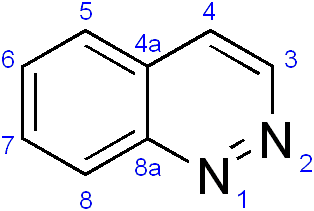
Cinnoline is an aromatic heterocyclic compound with the formula C8H6N2. It is isomeric with other naphthyridines including quinoxaline, phthalazine and quinazoline. Neither the unsubstituted heterocycle nor any derivatives is known to occur naturally.
Properties
The free base can be obtained as an oil by treatment of the hydrochloride with base. It co-crystallizes with one molecule of ether as white silky needles, (m.p. 24 –) upon cooling ethereal solutions. The free base melts at 39 °C. It has a taste resembling that of chloral hydrate and leaves a sharp irritation for some time.
Discovery and synthesis
The compound was first obtained in impure form by cyclization of the alkyne o-C6H4(N2Cl)C≡CCO2H in water to give 4-hydroxycinnoline-3-carboxylic acid. This material could be decarboxylated and the hydroxyl group reductively removed to give the parent heterocycle. This reaction is called the Richter cinnoline synthesis.
Improved methods exist for its synthesis. It can be prepared by dehydrogenation of dihydrocinnoline with freshly precipitated mercuric oxide. It can be isolated as the hydrochloride.
Cinnolines are cinnoline derivatives. A classic organic reaction for synthesizing cinnolines is the Widman–Stoermer synthesis, a ring-closing reaction of an α-vinyl- aniline with hydrochloric acid and sodium nitrite: ::figure[src="https://upload.wikimedia.org/wikipedia/commons/b/b2/Widman-stoermer-reaction.png" caption="Widman–Stoermer reaction" alt="The sodium nitrite is first converted to nitrous acid and then dinitrogen trioxide. The latter electrophilically attacks the amine nitrogen to form a nitrosamine and then diazonium salt. Finally the diazonium closes a ring into the vinyl group."] ::
A conceptually related reaction is the Bamberger triazine synthesis towards triazines.
Another cinnoline method is the Borsche cinnoline synthesis.
Safety
Cinnoline is toxic.
References
References
- [[International Union of Pure and Applied Chemistry]]. (2014). "Nomenclature of Organic Chemistry: IUPAC Recommendations and Preferred Names 2013". [[Royal Society of Chemistry.
- Brown, H.C.. (1955). "Determination of Organic Structures by Physical Methods". Academic Press.
- (January 2020). "A Concise Review on Cinnolines". Innovative Journal of Medical and Health Science.
- Victor von Richter. (1883). "Über Cinnolinderivate". Chemische Berichte.
- (2000). "Rodd's Chemistry of Carbon Compounds".
- (2005). "Name Reactions and Reagents in Organic Synthesis".
::callout[type=info title="Wikipedia Source"] This article was imported from Wikipedia and is available under the Creative Commons Attribution-ShareAlike 4.0 License. Content has been adapted to SurfDoc format. Original contributors can be found on the article history page. ::