Chesapeake Colonies
Historic region of British North America
title: "Chesapeake Colonies" type: doc version: 1 created: 2026-02-28 author: "Wikipedia contributors" status: active scope: public tags: ["colonial-united-states-(british)", "chesapeake-bay", "province-of-maryland", "colony-of-virginia", "english-colonization-of-the-americas", "history-of-slavery-in-virginia", "history-of-the-thirteen-colonies", "history-of-the-southern-united-states", "former-british-colonies-and-protectorates-in-the-americas"] description: "Historic region of British North America" topic_path: "history" source: "https://en.wikipedia.org/wiki/Chesapeake_Colonies" license: "CC BY-SA 4.0" wikipedia_page_id: 0 wikipedia_revision_id: 0
::summary Historic region of British North America ::
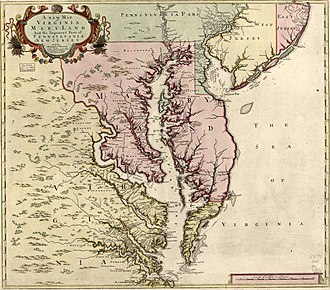
::figure[src="https://upload.wikimedia.org/wikipedia/commons/0/01/A_new_map_of_Virginia,_Maryland,and_the_improved_parts_of_Pennsylvania&_New_Jersey.LOC_2005630923(cropped).jpg" caption="''A new map of Virginia, Maryland, and the improved parts of Pennsylvania & New Jersey'', 1685 map of the Chesapeake region by Christopher Browne"] ::
The Chesapeake Colonies were the Colony and Dominion of Virginia, later the Commonwealth of Virginia, and Province of Maryland, later Maryland, both colonies located in British America and centered on the Chesapeake Bay.
History
Settlements of the Chesapeake region grew slowly due to diseases such as malaria. Most of these settlers were male immigrants from England who died soon after their arrival. Due to the majority being men, eligible women did not remain single for long. The native-born population eventually became immune to the Chesapeake diseases and these colonies were able to continue through all the hardships.
The Chesapeake region had a one-crop economy, based on tobacco. This contributed to the demand for slave labor in the Southern colonies. Tobacco also depleted nutrients in the soil, and new land was continually needed for its cultivation. White indentured servants were also common in this region early in its settlement, gradually being replaced by African slaves by the latter half of the seventeenth century due to improved economic conditions in Europe and the resulting decrease in emigration to the Chesapeake region. Indentured servants were people who signed a contract of indenture requiring them to work for their Chesapeake masters for an average of five to seven years, in return for the cost of the Atlantic crossing. When finished, they might be given land, or goods consisting of a suit of clothes, some farm tools, seed, and perhaps a gun.
References
- Mark C. Carnes & John A. Garraty, The American Nation: A History of the United States, Pearson Education, 2006.
References
- (February 1998). "Tobacco: Colonial Cultivation Methods - Historic Jamestowne Part of Colonial National Historical Park (U.S. National Park Service)".
- Carolyn Merchant. (2007). "American Environmental History: An Introduction". Columbia University Press.
- Kenneth Morgan. (August 2001). "Slavery and Servitude in Colonial North America: A Short History". NYU Press.
::callout[type=info title="Wikipedia Source"] This article was imported from Wikipedia and is available under the Creative Commons Attribution-ShareAlike 4.0 License. Content has been adapted to SurfDoc format. Original contributors can be found on the article history page. ::