Catenoid
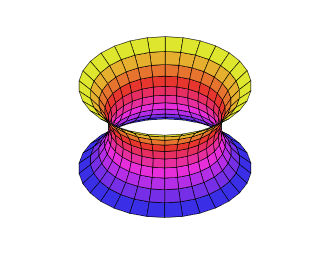
Surface of revolution of a catenary
title: "Catenoid" type: doc version: 1 created: 2026-02-28 author: "Wikipedia contributors" status: active scope: public tags: ["minimal-surfaces"] description: "Surface of revolution of a catenary" topic_path: "general/minimal-surfaces" source: "https://en.wikipedia.org/wiki/Catenoid" license: "CC BY-SA 4.0" wikipedia_page_id: 0 wikipedia_revision_id: 0
::summary Surface of revolution of a catenary ::
::figure[src="https://upload.wikimedia.org/wikipedia/commons/5/5d/Catenoid.svg" caption="A catenoid" alt="three-dimensional diagram of a catenoid"] ::
::figure[src="https://upload.wikimedia.org/wikipedia/commons/e/e3/Catenoid.gif" caption="A catenoid obtained from the rotation of a catenary" alt="animation of a catenary sweeping out the shape of a catenoid as it rotates about a central point"] ::
In geometry, a catenoid is a type of surface, arising by rotating a catenary curve about an axis (a surface of revolution). It is a minimal surface, meaning that it occupies the least area when bounded by a closed space. It was formally described in 1744 by the mathematician Leonhard Euler.
Soap film attached to twin circular rings will take the shape of a catenoid. Because they are members of the same associate family of surfaces, a catenoid can be bent into a portion of a helicoid, and vice versa.
Geometry
The catenoid was the first non-trivial minimal surface in 3-dimensional Euclidean space to be discovered apart from the plane. The catenoid is obtained by rotating a catenary about its directrix.
Early work on the subject was published also by Jean Baptiste Meusnier.
The catenoid may be defined by the following parametric equations: x &= c \cosh \frac{v}{c} \cos u \ y &= c \cosh \frac{v}{c} \sin u \ z &= v \end{align}|}} where u \in [-\pi, \pi) and v \in \mathbb{R} and c is a non-zero real constant.
In cylindrical coordinates: \rho =c \cosh \frac{z}{c}, where c is a real constant.
A physical model of a catenoid can be formed by dipping two circular rings into a soap solution and slowly drawing the circles apart.
The catenoid may be also defined approximately by the stretched grid method as a facet 3D model.
Helicoid transformation
::figure[src="https://upload.wikimedia.org/wikipedia/commons/0/0a/helicatenoid.gif" caption="Deformation of a right-handed [[helicoid]] into a left-handed one and back again via a catenoid" alt="Continuous animation showing a right-handed helicoid deforming into a catenoid, a left-handed helicoid, and back again"] ::
Because they are members of the same associate family of surfaces, one can bend a catenoid into a portion of a helicoid without stretching. In other words, one can make a (mostly) continuous and isometric deformation of a catenoid to a portion of the helicoid such that every member of the deformation family is minimal (having a mean curvature of zero). A parametrization of such a deformation is given by the system \begin{align} x(u,v) &= \sin \theta ,\cosh v ,\cos u + \cos \theta ,\sinh v ,\sin u \ y(u,v) &= \sin \theta ,\cosh v ,\sin u - \cos \theta ,\sinh v ,\cos u \ z(u,v) &= v \sin \theta + u \cos \theta \end{align} for (u,v) \in (-\pi, \pi] \times (-\infty, \infty), with deformation parameter -\pi , where:
- \theta = \pi corresponds to a right-handed helicoid,
- \theta = \pm \pi / 2 corresponds to a catenoid, and
- \theta = 0 corresponds to a left-handed helicoid.
The critical catenoid conjecture
A critical catenoid is a catenoid in the unit ball that meets the boundary sphere orthogonally. Up to rotation about the origin, it is given by rescaling with c=1 by a factor (\rho_0\cosh\rho_0)^{-1} , where \rho_0\tanh\rho_0=1 . It is an embedded annular solution of the free boundary problem for the area functional in the unit ball and the critical catenoid conjecture states that it is the unique such annulus.
The similarity of the critical catenoid conjecture to Hsiang-Lawson's conjecture on the Clifford torus in the 3-sphere, which was proven by Simon Brendle in 2012, has driven interest in the conjecture, as has its relationship to the Steklov eigenvalue problem.
Nitsche proved in 1985 that the only immersed minimal disk in the unit ball with free boundary is an equatorial totally geodesic disk. Nitsche also claimed without proof in the same paper that any free boundary constant mean curvature annulus in the unit ball is rotationally symmetric, and hence a catenoid or a parallel surface. Non-embedded counterexamples to Nitsche’s claim have since been constructed.
The critical catenoid conjecture is stated in the embedded case by Fraser and Li and has been proven by McGrath with the extra assumption that the annulus is reflection invariant through coordinate planes, and by Kusner and McGrath when the annulus has antipodal symmetry.
As of 2025 the full conjecture remains open.
References
References
- (2010). "Minimal Surfaces". [[Springer Science & Business Media]].
- (1997). "Mathematics: From the Birth of Numbers". [[W. W. Norton & Company]].
- (1952). "Methodus inveniendi lineas curvas: maximi minimive proprietate gaudentes sive solutio problematis isoperimetrici latissimo sensu accepti". Springer Science & Business Media.
- (17 July 2006). "Shapes of embedded minimal surfaces". Proceedings of the National Academy of Sciences.
- (1881). "Mémoire sur la courbure des surfaces". F. Hayez, Printer of the Royal Academy of Belgium.
- "Catenoid".
- Brendle, Simon. (2013). "Embedded minimal tori in S3 and the Lawson conjecture". Acta Mathematica.
- Devyver, B.. (2019). "Index of the critical catenoid". Geometriae Dedicata.
- (2011). "The first Steklov eigenvalue, conformal geometry, and minimal surfaces". [[Advances in Mathematics]].
- Nitsche, J. C. C.. (1985). "Stationary partitioning of convex bodies". Archive for Rational Mechanics and Analysis.
- Wente, H. C.. (1993). "Tubular capillary surfaces in a convex body". International Press.
- (2023). "Free boundary minimal annuli immersed in the unit ball". Archive for Rational Mechanics and Analysis.
- (2014). "Compactness of the space of embedded minimal surfaces with free boundary in three-manifolds with nonnegative Ricci curvature and convex boundary". Journal of Differential Geometry.
- McGrath, P.. (2018). "A characterization of the critical catenoid". Indiana University Mathematics Journal.
- (2024). "On Steklov eigenspaces for free boundary minimal surfaces in the unit ball". American Journal of Mathematics.
::callout[type=info title="Wikipedia Source"] This article was imported from Wikipedia and is available under the Creative Commons Attribution-ShareAlike 4.0 License. Content has been adapted to SurfDoc format. Original contributors can be found on the article history page. ::