CallAir Model A
title: "CallAir Model A" type: doc version: 1 created: 2026-02-28 author: "Wikipedia contributors" status: active scope: public tags: ["1940s-united-states-civil-utility-aircraft", "low-wing-aircraft", "single-engined-tractor-aircraft", "aircraft-first-flown-in-1940"] topic_path: "geography/united-states" source: "https://en.wikipedia.org/wiki/CallAir_Model_A" license: "CC BY-SA 4.0" wikipedia_page_id: 0 wikipedia_revision_id: 0
::data[format=table title="Infobox aircraft"]
| Field | Value |
|---|---|
| name | Model A |
| image | CallAir A-2 (N2916V).jpg |
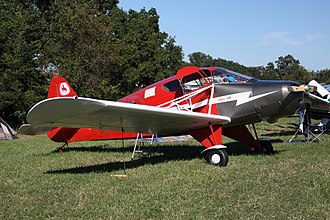
| caption | CallAir A-2 |
| type | Cabin monoplane and agricultural aircraft |
| manufacturer | Call Aircraft Company |
| first_flight | 1940 |
| number_built | 218 |
| variants | CallAir A-9 |
| :: |
|name = Model A |image = CallAir A-2 (N2916V).jpg |caption = CallAir A-2 |type = Cabin monoplane and agricultural aircraft |manufacturer = Call Aircraft Company |designer = |first_flight = 1940 |introduction = |retired = |status = |primary_user = |more_users = |produced = |number_built = 218 |unit cost = |developed_from = |variants = CallAir A-9 The Call-Air Model A is an American two- to three-seat utility aircraft designed by the Call brothers and built by the Call Aircraft Company, later developed into a successful line of agricultural aircraft.
Design and development
The Model A was designed by the Call family, who were Wyoming ranchers. The aircraft was ready to be produced in 1940 but the start of World War II delayed the start of production to 1946. The family had formed the Call Aircraft Company (known as Call-Air) to produce the aircraft. The prototype Model A was powered by a Continental A-80 engine but was redesignated the Model A-1 when re-engined with an Avco Lycoming O-235-A engine. A United States type certificate was awarded in July 1944 and the production model was designated the Model A-2. The Model A-2 was a two-seat braced low-wing monoplane with fabric-covered wooden wings and fabric-covered welded steel tube. It had a fixed tailwheel landing gear. Further models were introduced with different engines. Examples of the three-seat A-4 were converted for agricultural use followed by a new-build agricultural version the A-5. In 1962 the assets of the company were acquired at auction by the Intermountain Manufacturing Company (IMCO) who developed their own version the IMCO CallAir A-9. IMCO was later taken over by the Aero Commander division of the Rockwell Standard Corporation and later became part of North American Rockwell, the design was further developed and redesignated.
Variants
:;A :Continental A-80-engined prototype, one built converted to A-1 :;A-1 :Re-engined with an Avco Lycoming O-235-a engine, four built and prototype converted. :;A-2 :Two-seat cabin monoplane production version powered by an Avco Lycoming O-290-a engine, 16 built. :;A-3 :125 hp (93 kw) Continental C-125-2-powered version, 15 built. :;A-4 :Two/three-seat cabin monoplane version powered by a 135 hp (101 kw) Avco Lycoming O-290-D2 engine, 65 built. :;A-5 :Open-cockpit two-seat agricultural version of the A-4, 74 built. ::;A-5T Texan ::A-5 with revised fuselage structure, nine built. :;A-6 :Improved version of A-5 with Avco Lycoming O-360-A1A engine, 34 built. :;A-7 :Similar to A-5 powered by West Coast Dusting-built Continental W-670-240 engine. One converted from an A-6 ::;A-7T ::Proposed development of A-7 with higher gross weight
Specifications (A-2)
|ref=Jane's all the World's Aircraft 1947 |prime units?=imp General characteristics
|crew=1 |capacity=1 pax |length m=7.15 |span m=10.91 |height m=1.83 |height note=tailup |wing area sqft=181.6 |aspect ratio= |empty weight lb=975 |gross weight lb=1550 |fuel capacity=30 USgal |more general= Powerplant
|eng1 number=1 |eng1 name=Lycoming O-290B or C |eng1 type=4-cyl. horizontally-opposed air-cooled piston engine |eng1 hp=125 |eng1 note=at2,600 rpm
|prop blade number=2 |prop name=Sensenich fixed pitch wooden propeller |prop dia m= |prop dia ft= |prop dia in= |prop dia note= Performance
|max speed mph=112 |cruise speed mph=102 |cruise speed note=
- Landing speed: 42 mph |range miles=332 |endurance= |ceiling ft=17500 |g limits= |roll rate= |climb rate ftmin=1000 |wing loading lb/sqft=8.53 |fuel consumption lb/mi=0.458 |power/mass=12.4 lb/hp (7.51 kg/kW) |more performance=
- Take-off run: 142 yd
- Landing run: 100 yd
References
References
- (1958). "Jane's All the World's Aircraft 1958-59". Jane's All the World's Aircraft Publishing Co. Ltd..
- (1947). "Jane's all the World's Aircraft 1947". Sampson Low, Marston & Co.
::callout[type=info title="Wikipedia Source"] This article was imported from Wikipedia and is available under the Creative Commons Attribution-ShareAlike 4.0 License. Content has been adapted to SurfDoc format. Original contributors can be found on the article history page. ::