Bolas
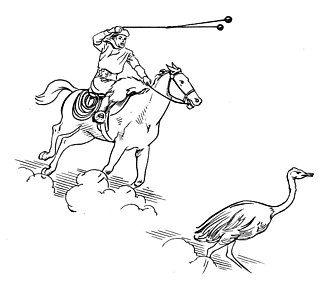
Type of weighted throwing weapon used in South America
title: "Bolas" type: doc version: 1 created: 2026-02-28 author: "Wikipedia contributors" status: active scope: public tags: ["ancient-weapons", "argentine-folklore", "throwing-weapons", "chain-and-rope-throwing-weapons", "chilean-folklore", "culture-in-rio-grande-do-sul", "indigenous-culture-of-the-southern-cone", "indigenous-weapons-of-the-americas", "lithics", "uruguayan-folklore", "hunting-equipment", "gaucho-culture"] description: "Type of weighted throwing weapon used in South America" topic_path: "general/ancient-weapons" source: "https://en.wikipedia.org/wiki/Bolas" license: "CC BY-SA 4.0" wikipedia_page_id: 0 wikipedia_revision_id: 0
::summary Type of weighted throwing weapon used in South America ::
::data[format=table title="Infobox weapon"]
| Field | Value |
|---|---|
| name | Bolas |
| image | Bola (PSF).jpg |
| caption | A hunter using bolas while mounted on a horse. |
| origin | The Americas |
| type | Throwing weapon |
| :: |
| name = Bolas | image = Bola (PSF).jpg | caption = A hunter using bolas while mounted on a horse. | origin = The Americas | type = Throwing weapon | is_ranged = | is_bladed = | is_explosive = | is_artillery = | is_vehicle = | is_missile = | is_UK = | service = | used_by = | wars = | designer = | design_date = | manufacturer = | unit_cost = | production_date = | number = | variants = | spec_label = | weight = | length = | part_length = | width = | height = | d = | crew = | passengers = | cartridge = | cartridge_weight = | caliber = | barrels = | action = | rate = | velocity = | range = | max_range = | feed = | sights = | breech = | recoil = | carriage = | elevation = | traverse = | blade_type = | hilt_type = | sheath_type = | head_type = | haft_type = | filling = | filling_weight = | detonation = | yield = | armour = | primary_armament = | secondary_armament = | engine = | engine_power = | pw_ratio = | transmission = | payload_capacity = | suspension = | clearance = | fuel_capacity = | vehicle_range = | speed = | guidance = | steering = | wingspan = | propellant = | ceiling = | altitude = | depth = | boost = | accuracy = | launch_platform = | transport =
Bolas or bolases (: bola; from Spanish and Portuguese bola, "ball", also known as a boleadora or boleadeira) is a type of throwing weapon made of weights on the ends of interconnected cords, used to capture animals by entangling their legs. Bolas were most famously used by the gauchos, but have been found in excavations of Pre-Columbian settlements, especially in Patagonia, where indigenous peoples (particularly the Tehuelche) used them to catch 200-pound guanacos and rheas. The Mapuche and the Inca army used them in battle. Mapuche warriors used bolas in their confrontations with the Chilean Army during the Occupation of Araucanía (1861–1883).
Use
::figure[src="https://upload.wikimedia.org/wikipedia/commons/e/ec/Toortse_Rio_de_la_Plata.png" caption="Indians]] with ''Bolas'' (Hendrick Ottsen, 1603)"] ::
Gauchos used boleadoras to capture running cattle or game. Depending on the exact design, the thrower grasps the boleadora by one of the weights or by the nexus of the cords. The thrower gives the balls momentum by swinging them and then releases the boleadora. The weapon is usually used to entangle the animal's legs, but when thrown with enough force might even inflict damage (e.g. breaking a bone).
Traditionally, Inuit have used bolas to hunt birds, fouling the birds in air with the lines of the bola. People of a Feather showed Belcher Island Inuit using bolas to hunt eider ducks on the wing.
Design
::figure[src="https://upload.wikimedia.org/wikipedia/commons/5/55/Boleadoras.png" caption="''Boleadoras''"] ::
There is no uniform design; most bolas have two or three balls, but there are versions of up to eight or nine. Some bolas have balls of equal weight; others vary the knot and cord. Gauchos use bolas made of braided leather cords with wooden balls or small leather sacks full of stones at the ends of the cords.
Bolas can be named depending on the number of weights used:
- Perdida (one weight)
- Avestrucera or ñanducera (two weights, for rheas)
- Somai (two weights)
- Achico (three weights)
- Boleadora (three weights)
- Kiipooyaq (Inuit name for bolas with three or more weights)
Bolas of three weights are usually designed with two shorter cords with heavier weights, and one longer cord with a light weight. The heavier weights fly at the front parallel to each other, hit either side of the legs, and the lighter weight goes around, wrapping up the legs. ::figure[src="https://upload.wikimedia.org/wikipedia/commons/3/36/Le_Tour_du_monde-04-p248.jpg" caption="Puelche]] warriors using bolas in the 19th century"] ::
::figure[src="https://upload.wikimedia.org/wikipedia/commons/c/c6/Boleando_nandues_la_pampa_1905.jpg" caption="website=aulex.org}}"] ::
References
References
- Bengoa, José. (2000). "Historia del pueblo mapuche: Siglos XIX y XX". [[LOM Ediciones]].
- Cayuqueo, Pedro. (2020). "Historia secreta mapuche 2". [[Catalonia (publisher).
- Tracy Allard. (8 November 2013). "People of a Feather (2011)". IMDb.
- Blair, Claude and Tarassuk, Leonid, eds. (1982). ''The Complete Encyclopedia of Arms and Weapons''. p. 92. [[Simon & Schuster]]. {{ISBN. 0-671-42257-X.
- "Inuit Bola". Gamesmuseum.uwaterloo.ca.
- [http://www.westferrisscouting.com/Winter%20Camp%202006%203%20.htm] {{webarchive. link. (July 9, 2008)
- "AULEX - Diccionario Quechua - Español; en línea".
::callout[type=info title="Wikipedia Source"] This article was imported from Wikipedia and is available under the Creative Commons Attribution-ShareAlike 4.0 License. Content has been adapted to SurfDoc format. Original contributors can be found on the article history page. ::