Betulin
title: "Betulin" type: doc version: 1 created: 2026-02-28 author: "Wikipedia contributors" status: active scope: public tags: ["triterpenes", "isopropenyl-compounds", "pentacyclic-compounds", "diols", "primary-alcohols", "secondary-alcohols", "birch-bark", "tree-derived-bioactive-compounds"] topic_path: "general/triterpenes" source: "https://en.wikipedia.org/wiki/Betulin" license: "CC BY-SA 4.0" wikipedia_page_id: 0 wikipedia_revision_id: 0
| Watchedfields = changed | verifiedrevid = 441829253 | Name = Betulin | ImageFile = Betulin.svg | ImageName = Betulin | IUPACName = Lup-20(29)-ene-3β,28-diol | SystematicName = (1R,3aS,5aR,5bR,7aR,9S,11aR,11bR,13aR,13bR)-3a-(Hydroxymethyl)-5a,5b,8,8,11a-pentamethyl-1-(prop-1-en-2-yl)icosahydro-1H-cyclopenta[a]chrysen-9-ol | OtherNames = Betulinol, betuline, betulol, betulinic alcohol, trochol | Section1 = {{Chembox Identifiers | InChI = 1/C30H50O2/c1-19(2)20-10-15-30(18-31)17-16-28(6)21(25(20)30)8-9-23-27(5)13-12-24(32)26(3,4)22(27)11-14-29(23,28)7/h20-25,31-32H,1,8-18H2,2-7H3/t20-,21+,22-,23+,24-,25+,27-,28+,29+,30+/m0/s1 | PubChem = 72326 | ChEMBL_Ref = | ChEMBL = 23236 | SMILES = O[C@H]5CC[C@@]4([C@@H]3C@@(C)CC[C@H]4C5(C)C)C | InChIKey = FVWJYYTZTCVBKE-ROUWMTJPBQ | SMILES1 = CC(=C)[C@@H]1CC[C@]2([C@H]1[C@H]3CC[C@@H]4[C@]5(CCC@@HO)C)CO | StdInChI_Ref = | StdInChI = 1S/C30H50O2/c1-19(2)20-10-15-30(18-31)17-16-28(6)21(25(20)30)8-9-23-27(5)13-12-24(32)26(3,4)22(27)11-14-29(23,28)7/h20-25,31-32H,1,8-18H2,2-7H3/t20-,21+,22-,23+,24-,25+,27-,28+,29+,30+/m0/s1 | StdInChIKey_Ref = | StdInChIKey = FVWJYYTZTCVBKE-ROUWMTJPSA-N | CASNo = 473-98-3 | CASNo_Ref = | UNII_Ref = | UNII = 6W70HN7X7O | EC_number = 207-475-5 | ChemSpiderID_Ref = | ChemSpiderID = 65272 | KEGG_Ref = | KEGG = C08618 | Section2 = {{Chembox Properties | Appearance = solid with needle-like crystals | C=30 | H=50 | O=2 | MeltingPtC = 256 to 257 | Solubility = insoluble | SolubleOther = slightly soluble in ethanol and benzene; soluble in diethyl ether, ethyl acetate and ligroin | Section3 = | Section4 = | Section5 = | Section6 =
Betulin is an abundant, naturally occurring triterpene. It is commonly isolated from the bark of birch trees, hence its name, from betula. It forms up to 30% of the dry weight of silver birch bark. It is also found in birch sap. Inonotus obliquus contains betulin.
The compound in the bark gives the tree its white color which appears to protect the tree from mid-winter overheating by the sun. As a result, birches are some of the northernmost occurring deciduous trees.
History
Betulin was discovered in 1788 by German-Russian chemist Johann Tobias Lowitz.
Chemistry
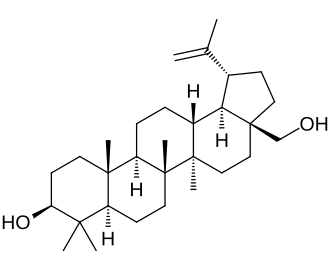
Chemically, betulin is a triterpenoid of lupane structure. It has a pentacyclic ring structure, and hydroxyl groups in positions C3 and C28.
References
References
- (2014). "CRC Handbook of Chemistry and Physics". CRC Press.
- (2007-12-01). "Isolation of Betulin and Rearrangement to Allobetulin. A Biomimetic Natural Product Synthesis". Journal of Chemical Education.
- (2006-09-01). "Pharmacological properties of the ubiquitous natural product betulin". European Journal of Pharmaceutical Sciences.
- (November 2009). "Quantitative determination of steroids in the fruiting bodies and submerged-cultured mycelia of ''Inonotus obliquus''". Se Pu.
- Lowitz, J. T.. (1788). "Űber eine neue, fast benzoeartige substanz der briken". Crell's Chem. Ann..
- (2015). "Comprehensive Review on Betulin as a Potent Anticancer Agent". BioMed Research International.
::callout[type=info title="Wikipedia Source"] This article was imported from Wikipedia and is available under the Creative Commons Attribution-ShareAlike 4.0 License. Content has been adapted to SurfDoc format. Original contributors can be found on the article history page. ::