Bede BD-1
title: "Bede BD-1" type: doc version: 1 created: 2026-02-28 author: "Wikipedia contributors" status: active scope: public tags: ["bede-aircraft", "1960s-united-states-sport-aircraft", "single-engined-tractor-aircraft", "low-wing-aircraft", "homebuilt-aircraft", "aircraft-first-flown-in-1963"] topic_path: "sports" source: "https://en.wikipedia.org/wiki/Bede_BD-1" license: "CC BY-SA 4.0" wikipedia_page_id: 0 wikipedia_revision_id: 0
::data[format=table title="Infobox aircraft"]
| Field | Value |
|---|---|
| name | BD-1 |
| type | Light aircraft |
| national_origin | United States of America |
| manufacturer | Bede Aviation Corporation |
| designer | Jim Bede |
| first_flight | July 11, 1963 |
| variants | Grumman American AA-1 |
| :: |
|name=BD-1 |image= |caption= |type = Light aircraft |national_origin = United States of America |manufacturer = Bede Aviation Corporation |designer = Jim Bede |first_flight = July 11, 1963 |introduction = |retired = |status = |primary_user = |more_users = |produced = |number_built = |program cost = |unit cost = |developed_from = |variants = Grumman American AA-1 The Bede BD-1 was a two-seat, single-engine, low-wing monoplane, the first design of American aeronautical engineer Jim Bede. The BD-1 was designed in 1960 as a kit-built aircraft intended for home assembly by amateur builders. Design goals included a kit price of $US 2500, including a rebuilt 100 hp (75 kW) engine and a cruise speed of 130 knots (240 km/h). The prototype N624BD first flew in 1962.
No kits were sold however, and it was not until Bede had been removed from the company and the design was reworked - including the removal of the folding wing feature - that it entered production as the American Aviation AA-1 Yankee, forerunner of the Grumman-American line of light aircraft.
Design
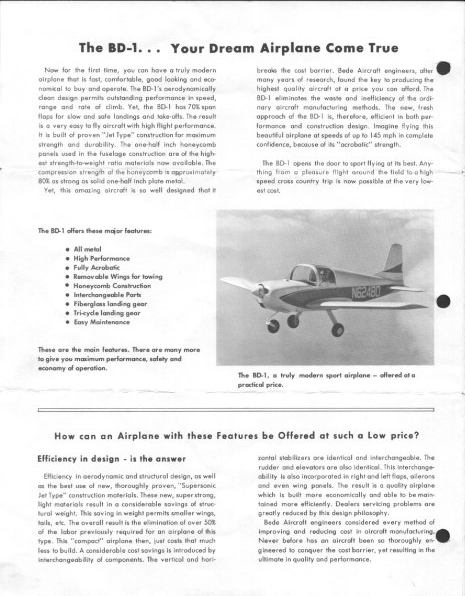
The BD-1 was a low-wing monoplane of all-metal construction, utilizing aluminium honeycomb construction and a laminar flow wing. The aircraft was predominantly of bonded, rather than riveted, construction. It featured a sliding canopy and two seats. The aircraft was designed to be towed behind a car to allow it to be stored at home in a garage and thus reduce hangarage costs. To facilitate this goal the aircraft had folding wings and a horizontal stabilizer of less than 8 foot (2.4 m) width. It was designed to be fully aerobatic as well and was stressed for 9g (90 m/s²).
Many parts of the BD-1 were interchangeable to simplify production. For example, the wings were interchangeable as were the fin and horizontal tail. The ailerons and flaps were interchangeable and the rudder and elevators were also. Many aerodynamic and handling compromises were made to achieve this commonality of parts and trailer-ability.
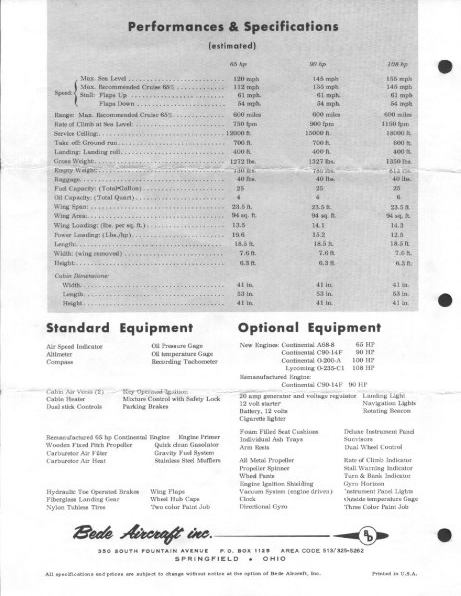
The aircraft was intended to be offered with a variety of new or rebuilt engines. Rebuilt engines were to be available to reduce the purchase price. Design powerplants included the Continental A65-8 of 65 hp, Continental C90-14F of 90 hp, Continental O-200A of 100 hp and a Lycoming O-235C1 of 108 hp.
Development
The BD-1 was never developed beyond prototype stage and no kits were produced. The company Bede founded to produce the BD-1 kits, Bede Aviation Corporation, eventually became American Aviation and they pursued FAA certification under FAR 23 for the design so that completed aircraft could be sold. Due to financial problems Bede was forced out of the company and the BD-1 was redesigned.
During the redesign process the aircraft was modified so that the wings did not fold, making it easier to achieve certification. Other changes included a longer wing to improve rate of climb, an anti-servo tab on the elevator along with an elevator centering spring system to increase longitudinal stability and stall strips to improve the stall performance. The resulting aircraft entered production in the fall of 1968 as the 1969 model American Aviation AA-1 Yankee Clipper.
While the BD-1 never did enter production itself, it has had a lasting impact on light aircraft production and spawned a whole series of offspring designs including the Grumman American AA-1, AA-5, and Gulfstream American GA-7 Cougar. The ultimate derivative design, the Tiger Aircraft AG-5B Tiger, was produced until 2006 by Tiger Aircraft.
Specifications (BD-1)
|ref=Jane's All The World's Aircraft 1965-66 |prime units?=imp
|crew=one |capacity=one passenger |length m= |length ft=18 |length in=6 |length note= |span m= |span ft=23 |span in=0 |span note= |height m= |height ft=6 |height in=3.5 |height note= |wing area sqm= |wing area sqft=93.3 |wing area note= |aspect ratio= |airfoil=NACA 642415 |empty weight kg= |empty weight lb=832 |empty weight note= |gross weight kg= |gross weight lb= |gross weight note= |max takeoff weight kg= |max takeoff weight lb=1375 |max takeoff weight note= |fuel capacity=25 US Gallons (94.5 L) |more general=
|eng1 number=1 |eng1 name=Lycoming O-235-C1 |eng1 type=air-cooled flat-four |eng1 kw= |eng1 hp=108 |eng1 note= |power original= |more power=
|prop blade number= |prop name= |prop dia m= |prop dia ft= |prop dia in= |prop note=
|max speed kmh= |max speed mph=155 |max speed kts= |max speed note=at sea level |cruise speed kmh= |cruise speed mph=135 |cruise speed kts= |cruise speed note=(econ cruise) |stall speed kmh= |stall speed mph=52 |stall speed kts= |stall speed note=(flaps down) |never exceed speed kmh= |never exceed speed mph=251 |never exceed speed kts= |never exceed speed note= |range km= |range miles=600 |range nmi= |range note= |ferry range km= |ferry range miles= |ferry range nmi= |ferry range note= |endurance= |ceiling m= |ceiling ft=18000 |ceiling note= |g limits= |roll rate= |glide ratio= |climb rate ms= |climb rate ftmin=1150 |climb rate note= |time to altitude= |lift to drag= |wing loading kg/m2= |wing loading lb/sqft= |wing loading note= |fuel consumption kg/km= |fuel consumption lb/mi= |power/mass= |more performance=
|avionics=
References
References
- BD Corp. (2004). "History of BedeCorp".
- Skip Stagg. (1997). "Grumman, Where It All Began".
- Davisson, Budd: [http://www.airbum.com/pireps/PirepBD4.html "Bede's BD-4,"] March, 1991, ''Air Progress,'' (as [[optical character recognition. OCR-scanned]] and posted on the author's website as "Jim Bede's High-speed Packing Crate: the BD-4: A classic, fast mover"), retrieved June 24, 2023
- Flying Annual & Pilots' Guide, 1965 Edition. (1965). "BEDE BD-1".
- BD Corp. (1965). "The BD-1...Your Dream Airplane Come true pg 2".
- BD Corp. (1965). "The BD-1 Performances and Specifications pg 4".
- Aviation Consumer. (1989). "Gulfstream Yankee/Trainer AA-1".
- Aviation Consumer. (n.d.). "AGAC AA-1".
- Bill Cox. (1997). "Trusty Trainer".
- Scott Smith. (n.d.). "The Grumman Yankee Fighter Fun - Trainer Price!".
- Taylor 1965, p.179.
::callout[type=info title="Wikipedia Source"] This article was imported from Wikipedia and is available under the Creative Commons Attribution-ShareAlike 4.0 License. Content has been adapted to SurfDoc format. Original contributors can be found on the article history page. ::