ATS-1
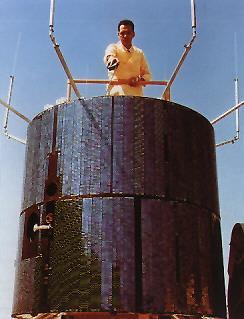
Early geostationary communications and weather satellite, launched in 1966
title: "ATS-1" type: doc version: 1 created: 2026-02-28 author: "Wikipedia contributors" status: active scope: public tags: ["spacecraft-launched-in-1966", "weather-satellites-of-the-united-states", "communications-satellites-of-the-united-states", "applications-technology-satellites"] description: "Early geostationary communications and weather satellite, launched in 1966" topic_path: "geography/united-states" source: "https://en.wikipedia.org/wiki/ATS-1" license: "CC BY-SA 4.0" wikipedia_page_id: 0 wikipedia_revision_id: 0
::summary Early geostationary communications and weather satellite, launched in 1966 ::
::data[format=table title="Infobox spaceflight"]
| Field | Value |
|---|---|
| name | ATS-1, Advanced Tech. Sat. 1, ATS-B, 02608 |
| image | Applications Technology Satellite 1 (ATS 1).jpg |
| image_size | 200px |
| image_caption | Applications Technology Satellite 1 (ATS 1) |
| mission_type | Weather Satellite |
| operator | NASA |
| COSPAR_ID | 1966-110A |
| SATCAT | 02608 |
| mission_duration | |
| spacecraft_bus | HS-306 |
| manufacturer | Hughes Aircraft |
| launch_mass | 352 kg |
| power | |
| launch_date | UTC |
| launch_rocket | Atlas SLV-3 Agena-D |
| launch_site | Cape Canaveral LC-12 |
| last_contact | April 1985 |
| orbit_reference | Geocentric |
| orbit_regime | GEO |
| orbit_periapsis | 35,782.0 km |
| orbit_apoapsis | 35,793.0 km |
| orbit_inclination | 3.6º |
| orbit_semimajor | 42152.0 km |
| orbit_eccentricity | 0.00013 |
| orbit_period | 1,435.5 minutes |
| apsis | gee |
| programme | Applications Technology Satellites |
| next_mission | ATS-2 |
| :: |
| name = ATS-1, Advanced Tech. Sat. 1, ATS-B, 02608 | image = Applications Technology Satellite 1 (ATS 1).jpg | image_size = 200px | image_caption = Applications Technology Satellite 1 (ATS 1) | mission_type = Weather Satellite | operator = NASA | website = | COSPAR_ID = 1966-110A | SATCAT = 02608 | mission_duration = | spacecraft_bus = HS-306 | manufacturer = Hughes Aircraft | dry_mass = | launch_mass = 352 kg | dimensions = | power = | launch_date = UTC | launch_rocket = Atlas SLV-3 Agena-D | launch_site = Cape Canaveral LC-12 | launch_contractor = | disposal_type = | deactivated = | last_contact = April 1985 | decay_date = | orbit_epoch = | orbit_reference = Geocentric | orbit_regime = GEO | orbit_periapsis = 35,782.0 km | orbit_apoapsis = 35,793.0 km | orbit_inclination = 3.6º | orbit_semimajor = 42152.0 km | orbit_eccentricity = 0.00013 | orbit_period = 1,435.5 minutes | apsis = gee | programme = Applications Technology Satellites | next_mission = ATS-2
ATS-1 (Applications Technology Satellite 1), also designated ATS-B or Advanced Tech. Sat. 1, was an experimental geostationary satellite, launched in 1966, and part of the Applications Technology Satellites Program. Though intended as a communications satellite rather than as a weather satellite, it carried the Spin Scan Cloud Camera developed by Verner E. Suomi and Robert Parent at the University of Wisconsin.
After entering an orbit at 23000 mi above Earth, initially in orbit over Ecuador, it transmitted weather images from the Western Hemisphere, as well as other data, to ground stations, including well as video feeds for television broadcasting.
It took one of the first pictures of the Earth's full-disk (the first from a geostationary orbit), on December 11, 1966. ::quote
"For the first time," historians would note later, "rapid-imaging of nearly an entire hemisphere was possible. We could watch, fascinated, as storm systems developed and moved and were captured in a time series of images. Today such images are an indispensable part of weather analysis and forecasting." ::
It was the first satellite to use frequency-division multiple access which accepted multiple independent signals and downlinked them in a single carrier.
The ATS-1 satellite was used during the 1967 international television broadcast Our World, providing a link between the United States and Australia during the program.
The ATS-1 would remain operational for more than 18 years, until April 1985.
Features
This satellite was cylindrical, with a diameter of 142 cm and a height of 135 cm; an additional 270 cm in height was the engine cover. The surface was covered with solar panels, and the whole satellite was stabilized by rotation. It measured 56 in in diameter, 57 in high and weighed 750 lb.
Instruments
A total of fifteen experiments were conducted during the mission:
- Suprathermal Ion Detector
- Biaxial Fluxgate Magnetometer
- Omnidirectional Spectrometer
- Electron Spectrometer
- Particle Telescope
- Solar Cell Radiation Damage
- Thermal Coating Degradation
- Rate Range Beacon
- Spin Scan Cloud Camera
- Microwave communication transponder
- Communication VHF transponder
- Nutation sensor
- Resist-Jet Thruster
- Faraday Rotation
- Meteorological Data Relay System
Gallery
File:ATS-B scheme-02.png|ATS-1 exterior scheme File:ATS-B scheme-01.png| ATS-1 interior scheme File:Concept artwork of the ATS-1 satellite (G-66-3651).jpg|Concept artwork of the ATS-1 satellite File:ATS-1 (Earth full disk), 1966.jpg|First full disk image of Earth from geostationary orbit (December 11, 1966) File:ATS-1 Moon.webp|ATS-1 captured the first image of Earth and the moon together (December 11, 1966) File:Monica1971sep20008z.gif|Section of an ATS-1 satellite image showing Hurricane Monica,(September 2, 1971)
References
References
- [https://nssdc.gsfc.nasa.gov/nmc/spacecraft/display.action?id=1966-110A NASA – NSSDC – Spacecraft – Details]
- "NASA - NSSDCA - Spacecraft - Details".
- (22 May 2016). "ATS". [[NASA]].
- (2016-12-06). "The 50th Anniversary of ATS-1".
- (12 September 1995). "Satellite Meteorology: An Introduction". Elsevier.
- (12 May 2014). "Handbook of Satellite Orbits: From Kepler to GPS". Springer.
- NSSDC Master Catalog]]. Retrieved 2016-22-05.
::callout[type=info title="Wikipedia Source"] This article was imported from Wikipedia and is available under the Creative Commons Attribution-ShareAlike 4.0 License. Content has been adapted to SurfDoc format. Original contributors can be found on the article history page. ::