Atil
Capital of Khazaria from 750 CE
title: "Atil" type: doc version: 1 created: 2026-02-28 author: "Wikipedia contributors" status: active scope: public tags: ["geography-of-astrakhan-oblast", "former-cities-in-russia", "khazar-towns", "populated-places-on-the-volga", "underwater-ruins", "saltovo-mayaki-culture"] description: "Capital of Khazaria from 750 CE" topic_path: "geography" source: "https://en.wikipedia.org/wiki/Atil" license: "CC BY-SA 4.0" wikipedia_page_id: 0 wikipedia_revision_id: 0
::summary Capital of Khazaria from 750 CE ::
::callout[type=note] the Khazar capital ::
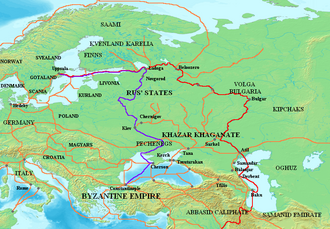
Atil, also Itil, was the capital of the Khazar Khaganate from the mid-8th century to the late 10th century. It is known historically to have been situated along the Silk Road, on the northern coast of the Caspian Sea, in the Volga Delta region of what is now southern Russia. Its precise location has long been unknown.
::figure[src="https://upload.wikimedia.org/wikipedia/commons/d/dd/Varangian_routes.png" caption="Varangian-Greek route]] is in purple."] ::
In 2008, a Russian archaeologist claimed to have discovered the remains of Atil in Samosdelka, a village in the Volga Delta approximately 30 km southwest of the city of Astrakhan. This claim has since been disproven.
Name
The name Atil (or Itil) is often interpreted as deriving from a Finno-Ugric word meaning “river”. A related form appears in the term Atelkuzu (Ἀτελκούζου), recorded by the Byzantine emperor Constantine VII in reference to the region between rivers inhabited by the early Hungarians. Although the word does not survive in modern Hungarian, comparable hydronyms are attested elsewhere, such as the name of the White River (Ak Adil) in Bashkiria, and the ancestors of the Bashkirs spoke a Ugric language that was understandable to Hungarians as early as the 13th century.
A number of Islamic sources from the 9th century, in particular Ibn Khordadbeh, Ibn Rustah and later compilers who used they're information, record that the Khazar capital was called Hamlikh or Hamlij (the name Hamlikh may represent a slightly distorted form of the Hebrew expression ha-melekh (“the king”), possibly referring to the royal residence of the Khazar rulers following their conversion to Judaism). This information suggests that the name Atil became widespread only in the 10th century, when foreign authors began to refer to the Khazar capital as Atil. It is not known exactly what the Khazars themselves called it.
Ibn Rustah's version has led researchers to associate it with Mongolian word used to refer to Beijing in the 13th and 14th centuries, 'khan''baliqh''' ("city of the khan"). But this seems unlikely, due to the differences between the Khazar and Mongolian languages.{{cite book |last=Novoseltsev |first=Anatoly P. |title=The Khazar State and Its Role in the History of Eastern Europe and the Caucasus |language=ru |location=Moscow |year=1990
Modern Turkic languages have retained the historical name for the Volga. The Volga is known as * İdel *( Идел) in Tatar, as * Atăl * (Атӑл) in Chuvash, as * Iźelin * in Bashkir, as * Edıl * in Kazakh, and as * İdil * in Turkish.
History and description
Atil was located along the Volga delta at the northwestern corner of the Caspian Sea. Following the defeat of the Khazars in the Second Arab-Khazar War, Atil became the capital of Khazaria.
At its height, the city was a major center of trade. It consisted of three parts separated by the Volga. The western part contained the administrative center of the city, with a court house and a large military garrison. The eastern part of the city was built later and acted as the commercial center of Atil, and had many public baths and shops. Between them was an island on which stood the palaces of the Khazar Khagan and Bek. The island was connected to one of the other parts of the city by a pontoon bridge. According to Arab sources of the 10th century, one half of the city was referred to as Atil, while the other was named Khazaran.
Atil was a multi-ethnic and religiously diverse city, inhabited by Jews, Christians, Muslims, Shamanists, and Pagans, many of them traders from foreign countries. All of the religious groups had their own places of worship in the city, and there were seven judges appointed to settle disputes (two Christian, two Jewish, and two Muslim judges, with a single judge for all of the Shamanists and other Pagans). The numerous Christians of Atil were under the jurisdiction of their own bishop; the minaret of the Friday mosque of the Muslims of Atil is said to have been higher than the castle.
::figure[src="https://upload.wikimedia.org/wikipedia/commons/7/72/RadzivillChronicleFol8rb.jpg" caption="Miniature depicting payment of tribute to the Varangians and the Khazars, [[Radziwiłł Chronicle"] ::
The city was a major trade center, and managed the Khazar slave trade, in which slaves bought for export were transported from the Khazar Khaganate to either the Black Sea slave trade in the West via the Black Sea port of Kerch, or East from the capital of Atil via the Caspian Sea to Central Asia and from there to slavery in the Abbasid Caliphate.
::figure[src="https://upload.wikimedia.org/wikipedia/commons/3/36/S._V._Ivanov._Trade_negotiations_in_the_country_of_Eastern_Slavs.Pictures_of_Russian_history.(1909).jpg" caption="Sergei Ivanov]] (1913)"] ::
Svyatoslav I of Kiev sacked Atil in 968 or 969 CE. Ibn Hawqal and al-Muqaddasi refer to Atil after 969, indicating that it may have been rebuilt. Al-Biruni (mid-11th century) reported that Atil was again in ruins, and did not mention the later city of Saqsin which was built nearby, so it is possible that this new Atil was only destroyed in the middle of the 11th century.
::figure[src="https://upload.wikimedia.org/wikipedia/commons/8/89/Поход_Святослава_на_хазар.png" caption="The eastern campaign of Prince Svtoslav in 965, in which he captured the White Tower and defeated the Khazar Khaganate, [[Radziwiłł Chronicle"] ::
The search for archaeological remains
As of 2024, the archaeological remains of Atil have not been positively identified. An accepted hypothesis is that they were washed away by the rising level of the Caspian Sea.
Samosdelka site
Semibugry site
The archaeological remains of a settlement from the Khazar period near the village of Semibugry (Russian: Семибугры) in the central part of the Volga Delta were discovered after Samosdelka and as of 2020 were being excavated in the hopes that the settlement was Atil. According to historian Alex Feldman, "it remains impossible to archaeologically prove" the location of Atil.
Gallery
File:В поисках Итиля.jpg File:Brick field Atil 2014.jpg File:Brick wall Atil 2014.jpg File:Potsherds (close up) Atil 2014.jpg File:Potsherds (wide) Atil 2014.jpg
References
Sources
References
- Akhmetyanov R. G. Brief Historical and etymological dictionary of the Tatar language. - Kazan: Tat. publishing house, 2001. p. 76. {{ISBN. 5-298-01004-0 (In tatar: Әхмәтьянов Р. Г. Татар теленең кыскача тарихи-этимологик сүзлеге. — Казан: Тат. кит. нәшр., 2001. б. 76. )
- Golden, Peter B.. (1980). "Khazar Studies: An Historico-Philological Inquiry into the Origins of the Khazars". Akadémiai Kiadó.
- Brook, Kevin A.. (2018). "The Jews of Khazaria". Rowman & Littlefield.
- "Atil or Itil{{!}} Jewish Virtual Library".
- The World of the Khazars: New Perspectives. Selected Papers from the Jerusalem 1999 International Khazar Colloquium. (2007). Nederländerna: Brill. p. 233
- Dunlop, Douglas M.. (1954). "The History of the Jewish Khazars". Princeton University Press.
- Dunlop, Douglas M.. (1954). "The History of the Jewish Khazars". Princeton University Press.
- Vasilyev, D.. "Итиль-мечта (The Itil Dream)".
- (2008-09-21). "Scholar claims to find medieval Jewish capital".
- (2020-06-15). "On the Threshold of the Great Discovery: Archaeologists Begin Excavations of the Legendary Capital of the Khazar Khaganate".
- Feldman, Alex Mesibov. (2023). "How Medieval Europe was Ruled". Routledge.
::callout[type=info title="Wikipedia Source"] This article was imported from Wikipedia and is available under the Creative Commons Attribution-ShareAlike 4.0 License. Content has been adapted to SurfDoc format. Original contributors can be found on the article history page. ::