Ashoke Kumar Sen
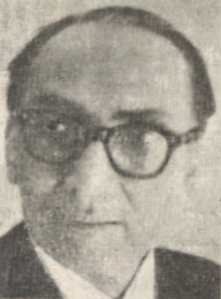
Indian politician and lawyer
title: "Ashoke Kumar Sen" type: doc version: 1 created: 2026-02-28 author: "Wikipedia contributors" status: active scope: public tags: ["presidency-university,-kolkata-alumni", "alumni-of-the-london-school-of-economics", "university-of-calcutta-alumni", "academic-staff-of-the-university-of-calcutta", "bengali-people", "brahmos", "das-family-(telirbagh)", "indian-barristers", "members-of-the-cabinet-of-india", "rajya-sabha-members-from-west-bengal", "1913-births", "1996-deaths", "law-ministers-of-india", "lok-sabha-members-from-west-bengal", "india-mps-1957–1962", "india-mps-1962–1967", "india-mps-1967–1970", "india-mps-1971–1977", "india-mps-1980–1984", "india-mps-1984–1989", "academic-staff-of-city-college,-kolkata", "20th-century-indian-lawyers", "politicians-from-kolkata", "steel-ministers-of-india", "indian-national-congress-politicians-from-west-bengal", "janata-dal-politicians"] description: "Indian politician and lawyer" topic_path: "economics" source: "https://en.wikipedia.org/wiki/Ashoke_Kumar_Sen" license: "CC BY-SA 4.0" wikipedia_page_id: 0 wikipedia_revision_id: 0
::summary Indian politician and lawyer ::
::data[format=table title="Infobox officeholder"]
| name = Ashoke Kumar Sen | office = Member of Parliament, Rajya Sabha | term_start = 3 April 1990 | term_end = 2 April 1996 | constituency = West Bengal | successor =
| order1 = Minister of Law and Justice | term1 = 1957–1966 | predecessor1 = Charu Chandra Biswas | successor1 = Gopal Swarup Pathak | primeminister1 = Jawaharlal Nehru | term2 = 1984–1987 | primeminister2 = Rajiv Gandhi | predecessor2 = Jagannath Kaushal | successor2 = P. Shiv Shankar
| order4 = Minister of Electronics & Communications Technology | predecessor4 = Jagjivan Ram | successor4 = Satya Narayan Sinha | term4 = 1 September 1963 – 13 June 1964
| order5 = Minister of Steel and Mines | order6 = President of Supreme Court Bar Association of India | order7 = President of Indian Football Association | office8 = Member of Parliament, Lok Sabha | term8 = 1957–1977 | term9 = 1980–1989 | constituency8 = Calcutta North West | predecessor8 = Meghnad Saha | successor8 = Bijoy Singh Nahar | constituency9 = Calcutta North West | predecessor9 = Bijoy Singh Nahar | successor9 = Debi Prasad Pal
| image = File:Ashoke Sen official portrait.gif | imagesize = | caption = Lok Sabha portrait | party = Indian National Congress Janata Dal, Independent | birth_date = | birth_place = Faridpur, Bengal Presidency, British Raj | death_date = | death_place = New Delhi, India | spouse = Anjana Sen | children = 2 daughters 2 sons | alma_mater = Presidency College, Kolkata London School of Economics | profession = Lawyer | relatives = Sukumar Sen (brother) Amartya Sen (nephew)
Ashoke Kumar Sen (10 October 1913 – 31 August 1996) was an Indian barrister, a former Cabinet minister of India, and an Indian parliamentarian.
He also holds the record for winning a Lok Sabha seat the most times and also the record for being not only an MP for the most years, but also a cabinet minister – serving more than 7 prime ministers. For decades, he was the inevitable Union Law Minister.
Background
Ashoke Kumar Sen was born in 1913 during the British Raj in a well-known Baidya family. His father was a district magistrate. Both Ashoke Kumar Sen and Sukumar Sen were students of Sambalpur high School, Odisha wherein Late Mr. Suryamani Jena of village Kusupur was the Principal. His elder brother, Sukumar Sen ICS (b. 1899), who went on to become India, Sudan and Nepal's first Chief Election Commissioner, funded his education in England, at the London School of Economics. Ashoke Sen went on to study for the Bar at Gray's Inn.
Upon his return, he started teaching law at the City College, Kolkata a constituent college of the University of CalcuttaMemorial references by the Speaker Eleventh Lok Sabha Debates, Session II (Budget) Monday, 2 September 1996. Retrieved 13 January 2008. He then began practising in the Calcutta High Court. At the age of 26, he had already written a book about Commercial Law, which was endorsed by Mr. Sen's then senior Sudhi Ranjan Das, the future Chief Justice of India.
Some years later, in February 1943, Ashoke Kumar Sen married Anjana Das, his senior's only daughter. They had two sons and two daughters.
Legal career
Within five years of practice, Sen became regarded as one of the top lawyers in the Calcutta High Court and gained wide acclaim. He published many books and articles, and was the Editor of Calcutta Law Journal.
Sen was a Senior Advocate of the Supreme Court, and President of the Supreme Court Bar Association several times.
Parliamentary career
::figure[src="https://upload.wikimedia.org/wikipedia/commons/2/20/Ashokesen.JPG" caption="Ashoke Kumar Sen with President [[Sarvepalli Radhakrishnan]], [[Nehru]] and [[Bidhan Chandra Roy]]"] ::
Because of his legal acumen, Bidhan Chandra Roy, Chief Minister of West Bengal, recommended him to the Prime Minister Jawaharlal Nehru. Nehru wanted Sen in his cabinet, and asked him to contest elections for the Lok Sabha.
In 1957, the Calcutta North West seat for the Lok Sabha was a communist stronghold. Sen had tried in 1956 to win the election, but fell short by only a few votes. However, in the following year, he triumphed and won by over 100,000 votes. He retained that seat from 1957 to 1977, and again held the Calcutta North West seat from 1980 to 1989, being defeated in 1989 by Debi Prosad Pal.
Sen was a Member of the Second, Third, Fourth, Fifth and Eighth Lok Sabhas.
He was later made a Rajya Sabha member and remained in the Upper House until April 1996, a few months before his death.
Ministerial career
Ashoke Sen became the Union Law Minister under Nehru. It is this post for which he became famous worldwide. He was Union Minister of Law, but he also held other portfolios such as Communications. He was Minister of Steel and Mines in Chandra Shekhar government from November 1990 to June 1991. ::figure[src="https://upload.wikimedia.org/wikipedia/commons/a/a1/senandmacmillan.JPG" caption="Ashoke Kumar Sen with Harold Macmillan, Prime Minister of the U.K"] ::
Over the next years, Sen was India's representative to foreign countries and the United Nations. According to Deve Gowda (1996), Sen led the Indian delegations to the United Nations Conference on Law, the United Nations Conference on Human Rights and several other conferences.
He was Law Minister lastly under Rajiv Gandhi and resigned in 1989 after his party's debacle in state elections in his home state West Bengal.
Other activities
During his lifetime, Sen started the Paschim Banga Seva Samiti – a charitable organisation. He also served as the president of the Indian Football Association. During his lifetime, Mr Sen also amassed a large law library with many rare collections. This library is considered to be among the largest private law libraries in the world.
Memorials
There is a block in the Supreme Court named after him. A portrait of him also hangs there. A town, Ashoknagar Kalyangarh in West Bengal is named after him. Several documentary films have also been produced on Sen.
Family
Ashoke Kumar Sen was survived by his widow, Anjana (whom he married in 1943), and by his four children, and seven grandchildren.
Besides his brother Sukumar Sen, Ashoke Kumar Sen had another brother Amiya Kumar Sen, an associate of Rabindranath Tagore. Amiya, author of a book about the Tagore family newspaper, was formerly a lecturer at Calcutta University and Principal of the City College, Kolkata. Mr Sen is also uncle to Nobel Laureate Economist Amartya Sen.
References
Sources
- Profile from India's Rajya Sabha (Upper House) website
- The Hindu 27 January 2002, magazine section. Later reprinted as "Democracys biggest gamble: Indias first free elections in 1952. (Reconsiderations)." (partly available online) World Policy Journal 22 March 2002.
References
- (2 September 1996). "Obituary References". Lok Sabha Debates.
- [https://web.archive.org/web/20021017184729/http://www.hinduonnet.com/thehindu/mag/2002/01/27/stories/2002012700550100.htm ''The biggest gamble in history''], ''[[The Hindu]]'' article (2002) – on India's first general election in 1952 has historian [[Ramachandra Guha]]'s take on the first CEC
- Two volume autobiography/memoirs of Sudhi Ranjan Das in Bengali, with family photographs, published 1993 by his daughter Anjana Sen. S.R. Das mentions his worries that his [[Brahmo]] daughter would not be accepted by her in-laws, and his refusal to approve the marriage until Sen's parents also accepted the match, and the Brahmo rites as religiously acceptable.
- [http://www.eci.gov.in/electionanalysis/GE/PartyCompWinner/S25/partycomp21.htm Calcutta North West] {{webarchive. link. (11 April 2005)
- (21 November 1990). "Chandrashekhar Cabinet".
- [https://www.nytimes.com/1987/03/29/world/minister-in-india-quits-in-election-aftermath.html " Minister in India Quits In Election Aftermath"] ''[[The New York Times]]'' 29 March 1987
::callout[type=info title="Wikipedia Source"] This article was imported from Wikipedia and is available under the Creative Commons Attribution-ShareAlike 4.0 License. Content has been adapted to SurfDoc format. Original contributors can be found on the article history page. ::