Ashley Library
title: "Ashley Library" type: doc version: 1 created: 2026-02-28 author: "Wikipedia contributors" status: active scope: public tags: ["british-library-collections"] topic_path: "geography/united-kingdom" source: "https://en.wikipedia.org/wiki/Ashley_Library" license: "CC BY-SA 4.0" wikipedia_page_id: 0 wikipedia_revision_id: 0
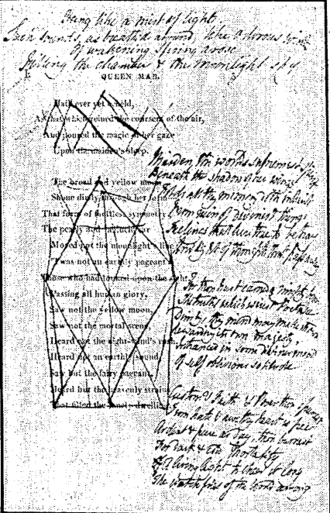
::figure[src="https://upload.wikimedia.org/wikipedia/commons/f/f5/Shelly_Queen_Mab.png" caption="newspaper=The Times}}"] ::
::figure[src="https://upload.wikimedia.org/wikipedia/commons/6/63/Autumn_Song,_Dante_Gabriel_Rossetti.jpg" caption="Original manuscript of "Autumn Song" by [[Dante Gabriel Rossetti]], 1848, in the Ashley Library."] ::
The Ashley Library is a collection of original editions of English poets from the 17th century onwards, including their prose works as well as those in verse, collected by the bibliographer, collector, forger, and thief Thomas James Wise. The library was sold to the British Museum by his widow, Frances Louise Greenhaigh Wise, in 1937 for £66,000. It was named after the street in which Wise lived when he started the collection (Ashley Road, Hornsey Rise).
Scope
The Ashley Library is recognized as one of the most important collections of 19th-century English literary manuscripts. The collection spans the period from Coleridge to Conrad, with the emphasis on poetical manuscripts and the correspondence of writers, critics, collectors, and bibliographers. The collection is strong in manuscripts of the Younger Romantics and of the Pre-Raphaelites, together with Swinburne. Wise's lack of scholarship and his practice of dispersing related manuscripts throughout the collection, made it a particularly difficult library to catalog .
History
The original collection consisted of 7,000 volumes with the bookcases used to hold them. When the British Museum library cataloged the collection it was discovered that 200 volumes were missing, it is thought that these were sold by Wise in the 1920s.
Part of the collection was pre-restoration drama which Wise had been collecting since 1900. These works were compared with the British Museum's former collection at which point it was discovered that over 200 book leaves were missing and 89 of these matching leaves were found in the Wise volumes. Henry Wrenn had built up a drama collection (housed in the University of Texas) and Wise had helped with supplying these volumes, when the Texas authorities sent relevant volumes for comparison, 60 of these books were also found to have been completed with thefts from the British Museum library.
Though allegations were published against Wise of theft and forgery in 1934, it was not until 1959 that a detailed scientific investigation was published by the Bibliographic Society. The conclusion supported the theory that Wise must have known that some of the books leaves added to his collection were stolen and that it was probable that he would have taken the leaves himself.
References
Notes
Citations
Sources
- ,
- ,
References
- (11 September 1937). "The Ashley Library". The Times.
- (14 May 1937). "Mr. T. J. Wise Bibliographer, Editor, And Collector". [[The Times]].
- (21 December 2010). "Forging a Collection; Thomas J. Wise and H. Buxton Forman, the Two Forgers". [[University of Delaware]] Library, Special Collections.
- (11 September 1937). ["The Ashley Library; Purchase For The Nation, The Late T. J. Wise And His Books"](http://archive.timesonline.co.uk/tol/keywordsearch.arc?queryKeywords=The+Ashley+Library}}{{dead link). [[The Times]].
- Marsden, W. A.. (January 1938). "The Ashley Library". British Museum.
- "Named Collections of Printed Materials". [[British Library]].
- "Harry Ransom Center, John Henry Wrenn Library". [[University of Texas at Austin]].
- (2012). "Wise, Thomas James". [[Columbia University Press]], [[Infoplease]].
::callout[type=info title="Wikipedia Source"] This article was imported from Wikipedia and is available under the Creative Commons Attribution-ShareAlike 4.0 License. Content has been adapted to SurfDoc format. Original contributors can be found on the article history page. ::