Anza (missile)
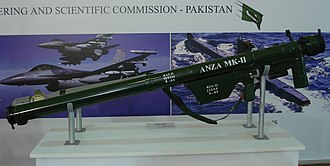
Pakistani man-portable air-defence system
title: "Anza (missile)" type: doc version: 1 created: 2026-02-28 author: "Wikipedia contributors" status: active scope: public tags: ["gids-products", "surface-to-air-missiles-of-pakistan", "guided-missiles-of-pakistan", "military-equipment-introduced-in-the-1980s", "china–pakistan-military-relations"] description: "Pakistani man-portable air-defence system" topic_path: "geography/pakistan" source: "https://en.wikipedia.org/wiki/Anza_(missile)" license: "CC BY-SA 4.0" wikipedia_page_id: 0 wikipedia_revision_id: 0
::summary Pakistani man-portable air-defence system ::
::data[format=table title="Infobox weapon"]
| Field | Value |
|---|---|
| is_missile | yes |
| name | Anza |
| image | ANZA MK 2.JPG |
| image_size | 300 |
| caption | Anza Mk-II |
| type | Man-portable air-defence system (MANPADS) |
| origin | Pakistan |
| service | 1989–present |
| used_by | See Operators |
| wars | Kargil War |
| Libyan civil war (2011) | |
| Syrian Civil War | |
| * GIDS{{Cite web | url |
| * KRL (1989–99)<ref name | "Global Security" |
| production_date | 1988 |
| variants | See Variants |
| spec_label | Anza Mk-II |
| weight | 16.5 kg |
| length | 1.44 m |
| diameter | 7.2 cm |
| filling | 1.42 kg shaped charge |
| engine | Rocket motor |
| propellant | Solid propellant |
| vehicle_range | 500–6000 m |
| altitude | 30–4000 m |
| speed | 600+ m/s |
| guidance | Infrared homing |
| launch_platform | Human, vehicle. |
| :: |
| is_missile = yes | name = Anza | image = ANZA MK 2.JPG | image_size = 300 | caption = Anza Mk-II | type = Man-portable air-defence system (MANPADS) | origin = Pakistan | service = 1989–present | used_by = See Operators | wars = Kargil War Libyan civil war (2011) Syrian Civil War | manufacturer =
- GIDS
- KRL (1989–99) | production_date = 1988 | variants = See Variants | spec_label = Anza Mk-II | weight = 16.5 kg | length = 1.44 m | diameter = 7.2 cm | height = | wingspan = | detonation = | filling = 1.42 kg shaped charge | engine = Rocket motor | engine_power = | propellant = Solid propellant | vehicle_range = 500–6000 m | altitude = 30–4000 m | ceiling = | speed = 600+ m/s | guidance = Infrared homing | launch_platform = Human, vehicle. | unit_cost =
The Anza (عنزہ Anza) is a series of shoulder-fired, man-portable surface-to-air missiles produced by Pakistan. Guided by an infrared homing seeker, the Anza is used for short range air defence.
The Anza is produced by Khan Research Laboratories (KRL), being one of the facility's main conventional weapons projects. Development was originally undertaken to eliminate dependence on importing expensive foreign systems. Various versions of the Anza are currently in service with the Pakistan Army, with the Mk-III version being the most recent.
GIDS currently manufactures the Anza.
Development
Some sources state that the Anza Mk-II was co-developed in a joint project by Pakistan and China.
The Anza Mk-I entered service with the Pakistan Army in January 1990, followed by the Anza Mk-II in September 1994. Serial production of Anza Mk-III for the Pakistan Army was announced in 2006.
Pakistan has also advertised the Anza series for export, displaying it at the International Defense Exhibition (IDEX) 2007 event in the United Arab Emirates and at the IDEAS 2008 defence exhibition in Pakistan.
Training aids
The Mk-II is known to have the ATS-II Training Simulator included, which consists of a set of four Mk-II training missiles, four firing units, simulated ground batteries, cable interconnectors, PC-based control, monitoring and scoring unit with a target simulator made up of an infrared electric bulb moving along an overhead wire.
The High Speed Aerial Target Drone, or HISAT-DK, is a high speed, low maintenance target drone that can be used in training operators to use the Anza. It is manned by a four-man crew using Optical Tracking Pod devices. The drones can be used for MANPAD training, though they are also used for other purposes, such as artillery fire support training.
Operational history
On 27 May 1999, the Anza Mk-II was used by the Pakistan Army's Air Defence Forces to shoot down an Indian MiG-21 and Mi-17 during the Kargil conflict.
In December 2002, The Indian media sources claimed that their soldiers found an Anza Mk-I in a militant hideout near the Line of Control in Kupwara, Kashmir. An Anza system had previously been found at a militant hideout by Indian Army soldiers in 2001. In 2002, Indian media sources again claimed that an Anza MANPAD was fired at an Indian Air Force Antonov An-32 over the Line of Control; the plane was able to land safely.
In 2004, Saudi Assistant Minister for Defense Prince Khaled ibn Sultan of Saudi Arabia and Defense Minister Rao Sikandar Iqbal of Pakistan had been in talks for joint production of the Anza.
In November 2008, the Pakistan Army conducted exercises with the Anza Mk-II in a semi-desert area near Muzaffargarh in response to covert attacks on targets in north-west Pakistan by American unmanned aerial vehicles (UAV). In the same month, the chief of the Pakistan Air Force told reporters that his forces are fully capable of shooting down the American drones, but it was the responsibility of the government to decide whether the drone attacks were stopped through diplomacy or military engagement. In the 2010 Azm-e-Nau 3 exercises, the air defence of Pakistan Army exhibited accurate targeting of enemy's aircraft while in its attacking position, with a pinpoint precision through shoulder operated system of Anza Missiles
In 2014, it was reported that the Saudi government sought to obtain Anzas in an effort to provide support for anti-Assad forces in Syria.
In June 2015, Small Arms Survey reported that Anzas were used by Libya in 2011.
Variants
- Anza Mk-I - The first MANPADS produced by Pakistan for use by the Pakistan Army. Development is based on the Chinese HN-5B MANPADS. A British source said the Anza is a copy of the SA-7 Grail. Approximately 1000 Anza Mk-I were produced between 1989 and 1998.
::figure[src="https://upload.wikimedia.org/wikipedia/commons/e/e6/Anza_Mk_II.JPG" caption="Anza Mk-II on display at the IDEAS 2008 defence exhibition, Pakistan."] ::
-
Anza Mk-II - A third generation MANPADS, believed to be based on the Chinese QW-1 MANPADS. Uses a dual-band, cross-scan infrared homing seeker to counter decoy flares. Also believed to use American missile technology. Approximately 2650 Anza Mk-II were produced between 1994 and 2022.
-
Anza Mk-III - Believed to be based on the Chinese QW-2 MANPADS, modifications made to meet Pakistan Army requirements include increased range up to 5 km, improved sensors and a new firing unit similar to the Russian 9K38 Igla MANPADS. All-aspect attack capability and improved ECCM capability. It also has a vehicle-mounted launcher variant.
Operators
::figure[src="https://upload.wikimedia.org/wikipedia/commons/5/5f/Anza_operators.png" caption="Map with Anza operators in blue"] ::
- Libya: Reported to be used in Libya from 2011.
- Pakistan: Large numbers of Mk.I, Mk.II and Mk.III are in service with the Pakistani Army.
- Malaysia: 100 Anza Mk-I systems, received in 2002. 500 Anza MK.II systems delivered as part of a RM446 million arms deal with Pakistan, used to arm the 10th Paratrooper Brigade.
- Syria: Anza Mk.-IIs captured from rebels.
- Ukraine: Anza Mk-IIs reported to be acquired by the Ukrainian military.
Specifications
References
References
- (8 May 2018). "DSA 2018: Pakistan Dips Its Toes In ASEAN".
- "Kahuta - Pakistan Special Weapons Facilities". GlobalSecurity.org.
- "Over-View Of Pakistani Weapon Systems". Pakistani Defence.
- "Transfers and licensed production of major conventional weapons".
- "PAF Weapons & Missiles". Pakistani Defence.
- Robin Hughes. (2002-12-02). "SAM attack on jet reignites old fears". [[Jane's Information Group]].
- (2007-09-11). "MBDA Spada 2000 Air Defence System for Pakistan Air Force". Defence Talk.
- B. Muralidhar Reddy. (2001-03-28). "Pak. testfires missiles". [[The Hindu]].
- (2008-02-21). "IICS Anza Mk II low-altitude surface-to-air missile system (Pakistan), Land systems - Air defence - Missiles". [[Jane's Information Group]].
- Malik Qasim Mustafa. "PAKISTAN DEFENCE PRODUCTION: PROSPECTS FOR DEFENCE EXPORT".
- "Anza-III missile to end Indian dominance". The Fact.
- "Defense Industry of Pakistan for the first time at SOFEX defense exhibition | SOFEX 2018 Official Online Show Daily News | Defence security military exhibition 2018 daily news category".
- (October 1995). "Pakistan Needs Foreign Help to Develop Missiles". The Risk Report.
- Pakistan Pushing Military Exports. (May 2005). "Pakistan Pushing Military Exports". National Defense.
- Xinhua. "Pakistani defense industry in "perpetual quest" for international alliances: report". People's Daily.
- "Special Supplement on IDEAS 2008 - Global Industrial and Defence Solutions (GIDS)". Financial Daily International.
- "Global Industrial & Defence Solutions(GIDS)". Asian Defence Journal.
- "Training Simulator for Anza MK-II (ATS-II)". Defence Export Promotion Organisation.
- "High Speed Aerial Target Drone, HISAT-DK". Defence Export Promotion Organization.
- (2002-01-15). "Missile found in Valley". [[The Telegraph (Kolkata).
- (2002-12-14). "Jawans recover surface-to-air missile near LoC". J&K News.
- Press Trust of India. (2002-12-15). "Pak-made missile found at militant hideout in J-K". Express India.
- (2002-12-14). "Missile found in Kashmir". BBC News.
- "WHAT'S HOT? –– ANALYSIS OF RECENT HAPPENINGS". INDIA DEFENCE CONSULTANTS.
- Mohammed Rasooldeen. (2004-10-17). "More Saudi Soldiers to Be Trained in Pakistan". Arab News.
- (21 March 2023). "Inter Services Public Relations Pakistan".
- (2008-11-21). "Pakistan army flexes muscles to shoot down drone aircraft". [[Khaleej Times]].
- (26 September 2022). "Pakistan's Army Practices Drone Shoot-Downs | WIRED".
- (2008-11-25). "'Pakistan capable of shooting down US drones'". Sindh Today.
- "Pakistan air defence demonstrates Anza-II in Azm-e-Nau 3".
- "Saudi Arabia in talks with Pakistan to provide anti-aircraft anti-tank weapons to Syrian rebels 2302 | February 2014 Global Defense Security news UK | Defense Security Global news Industry army 2014".
- (15 June 2015). "Missing Missiles: The Proliferation of Man-portable Air Defence Systems in North Africa (SANA Issue Brief 2)".
- Small Arms Survey. (2004). "Small Arms Survey 2004: Development Denied". [[Oxford University Press]].
- (2007-12-21). "HN-5 Man-Portable Surface-to-Air Missile".
- Cloughley, Brian. "Pak armour has edge over India". Jane's Information Group.
- James C. "Chris" Whitmire. "SHOULDER LAUNCHED MISSILES (A.K.A. MANPADS): The Ominous Threat to Commercial Aviation". USAF Counterproliferation Center.
- (2007-07-30). "QW-1 Man-Portable Surface-to-Air Missile". Sino Defence.
- Michael Puttré. (2001-04-01). "Facing the Shoulder-Fired Threat". eDefenseonline.com & Horizon House Publications.
- (2008-08-21). "Trends in Small Arms and Light Weapons Development: Non-Proliferation and Arms Control Dimensions". [[Department of Foreign Affairs and International Trade]].
- SIPRI Arms Transfers Database. "Transfers and licensed production of major conventional weapons".
- (2007-07-30). "QW-2 Man-Portable Surface-to-Air Missile". Sino Defence.
- "Pakistan builds on Chinese missile system". Punjab Kesari.
- (May 31, 2006). "China Hustles Stinger Tech to Pakistan". strategypage.com.
- "Pakistan Armée Pakistanaise forces terrestres équipements et véhicules".
- MAH. (2007-04-02). "MENGENAL AD MALAYSIA".
- (2003-10-15). "Anza Mk II anti-aircraft missile for elite Rapid Deployment Force". Worldsources Online.
- (March 18, 2016). "A New MANPADS Variant Appears in Syria". Bellingcat.
- "Pakistan to Supply Anza Mark-II MANPADS to Ukraine".
- John Pike. (1999-03-21). "SA-7 GRAIL". [[Federation of American Scientists.
- John Pike. (1999-08-10). "QW-1". [[Federation of American Scientists.
- (8 May 2018). "Anza Mk-I Mk-II Mk-III man-portable air defense missile system technical data sheet specifications | Pakistan Pakistani army missile systems vehicles U | Pakistan Pakistani army military equipment vehicle".
::callout[type=info title="Wikipedia Source"] This article was imported from Wikipedia and is available under the Creative Commons Attribution-ShareAlike 4.0 License. Content has been adapted to SurfDoc format. Original contributors can be found on the article history page. ::