Anvallus
title: "Anvallus" type: doc version: 1 created: 2026-02-28 author: "Wikipedia contributors" status: active scope: public tags: ["gaulish-gods", "culture-of-burgundy"] topic_path: "general/gaulish-gods" source: "https://en.wikipedia.org/wiki/Anvallus" license: "CC BY-SA 4.0" wikipedia_page_id: 0 wikipedia_revision_id: 0
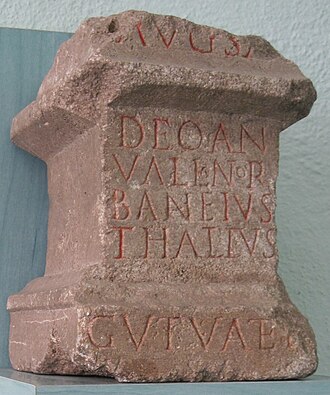
::figure[src="https://upload.wikimedia.org/wikipedia/commons/8/82/Anvallus_MuseeRolin_Autun_2600.jpg" caption="august]], to the god Anvallus, Norbaneius Thallus the ''gutuater'' [freely and deservedly fulfilled his vow]"."] ::
Anvallus was a Gaulish god, known from several public inscriptions at Augustodunum (Autun). Two Latin inscriptions on altars were dedicated by gutuatres in requital of vows; both such dedications began with the formula Aug(usto) sacr(um). The title gutuater is typically understood to mean 'priest'; the gutuatres have at times been taken to be Romanized continuations of the druids. These altars were both discovered in 1900 on the site of Autun's railway station, along with a Greek-style helmet of thin bronze that would have been left there as a votive offering.
The third text mentioning a name similar to Anvallus was a Gaulish text found on a limestone cartouche: :LICNOS · CON :TEXTOS · IEVRV :ANVALONNACV · :CANECOSEDLON · According to P.-Y. Lambert and J.-P. Savignac, this stone commemorated the dedication of a kind of seat or throne by a person named Licnos Contextos. The seat was dedicated to a sanctuary of Anvalos, in the interpretation of P.-Y. Lambert; Delmarre gives the translation "Licnos Contextus dedicated to Anvalonnacos the (golden?) seat".
The god's name has been analyzed as a composition an-ualos, of which the second root has been understood to mean 'sovereign' or 'prince', and the first 'without' or 'not'. The name might therefore be understood as 'without a sovereign', i.e. inferior to none.
References
References
- ''[[Corpus Inscriptionum Latinarum. CIL]]'' XIII:11225.
- ''[[Corpus Inscriptionum Latinarum. CIL]]'' XIII:11226.
- Xavier Delamarre (2003). ''Dictionnaire de la langue gauloise.'' Errance, Paris, p184.
- Monique Clavel-Lévêque (1989). ''Puzzle Gaulois: les Gaules en mémoire : images, textes, histoire, Volume 396.'' Presses universitaires de Franche-Comté, p423.
- J.-G. Bulliot (1901). "Découverte de deux inscriptions romaines et d'un casque votif à Autun." ''Bulletin monumental.'' Retrieved from [http://gallica.bnf.fr/ark:/12148/bpt6k310809/f44.r=zola.langfr Gallica] on 2011-06-03.
- "Inscriptions gauloises : Le cartouche d'Autun". Encyclopédie de l'Arbre Celtique.
- ''[[Corpus Inscriptionum Latinarum. CIL]]'' XIII:2733.
- P.-Y. Lambert (2003). ''La langue gauloise.'' Errance, Paris.
- J.-P. Savignac (2000). ''Merde à César.'' La différence.
- In the original, ''“Licnos Contextos a dédié à Anvalonnacos le siège (d’or ?)”.'' Xavier Delamarre (2003). ''Dictionnaire de la langue gauloise.'' Errance, Paris, p331.
- Xavier Delamarre (2003). ''Dictionnaire de la langue gauloise.'' Errance, Paris, pp43, 305.
::callout[type=info title="Wikipedia Source"] This article was imported from Wikipedia and is available under the Creative Commons Attribution-ShareAlike 4.0 License. Content has been adapted to SurfDoc format. Original contributors can be found on the article history page. ::