Andrew Geller
American architect
title: "Andrew Geller" type: doc version: 1 created: 2026-02-28 author: "Wikipedia contributors" status: active scope: public tags: ["1924-births", "2011-deaths", "modernist-architects-from-the-united-states", "20th-century-american-architects", "architects-from-brooklyn", "deaths-from-kidney-failure-in-new-york-(state)", "people-from-northport,-new-york", "the-high-school-of-music-&-art-alumni", "united-states-army-personnel-of-world-war-ii"] description: "American architect" topic_path: "arts" source: "https://en.wikipedia.org/wiki/Andrew_Geller" license: "CC BY-SA 4.0" wikipedia_page_id: 0 wikipedia_revision_id: 0
::summary American architect ::
::data[format=table title="Infobox architect"]
| Field | Value |
|---|---|
| name | Andrew Geller |
| image | Andrew Geller architect.jpg |
| parents | Olga Geller |
| Joseph Geller | |
| nationality | American |
| birth_name | Andrew Michael Geller |
| birth_date | |
| birth_place | Brooklyn, New York |
| death_date | |
| death_place | Syracuse, New York |
| significant_buildings | Elizabeth Reese House (1955) |
| Pearlroth House (1958) | |
| Esquire Weekend House | |
| Leisurama | |
| :: |
|name=Andrew Geller |image=Andrew Geller architect.jpg |parents =Olga Geller Joseph Geller |nationality= American |birth_name=Andrew Michael Geller |birth_date= |birth_place= Brooklyn, New York |death_date= |death_place= Syracuse, New York |significant_buildings=Elizabeth Reese House (1955) Pearlroth House (1958) Esquire Weekend House Leisurama |awards= |signature= |}}
Andrew Michael Geller (April 17, 1924 – December 25, 2011) was an American architect, painter, and graphic designer. He is widely known for his uninhibited, sculptural beach houses in the coastal regions of New York, New Jersey, and Connecticut during the 1950s and '60s, as well as for his indirect role in the 1959 Kitchen Debate between Richard Nixon (then Vice President) and Soviet Premier Nikita Khrushchev, which began at an exhibit Geller had helped design for the American National Exhibition in Moscow.
Geller worked with the prominent firm of American industrial and graphic designer Raymond Loewy where his projects ranged widely—from the design of shopping centers and department stores across the United States, to the Windows on the World restaurant atop the World Trade Center and the logo of New York-based department store Lord & Taylor.{{cite news | title = A Double Diamond May Not Be Forever | publisher = The New York Times, Bruce Lambert, May 6, 2005 | url = https://www.nytimes.com/2005/05/06/nyregion/06house.html?scp=75&sq=%22andrew%20geller%22&st=cse | date=May 6, 2005}}{{cite web |title = Keepin' It Casual, Informal Script Lettering in Mid-Century American Advertising and Design |publisher = Communication Arts, Ken Barber |quote = In spite of fluctuating typographic tastes and technological advances, much exemplary casual script lettering has endured, like Andrew Geller's energetic Lord & Taylor logo |url = http://www.commarts.com/Columns.aspx?pub=4396&pageid=1417 |access-date = 2011-12-28 |archive-url = https://web.archive.org/web/20101223194622/http://www.commarts.com/Columns.aspx?pub=4396&pageid=1417 |archive-date = 2010-12-23 |url-status = dead
After designing a beach house for Loewy's director of public relations, Geller was featured in The New York Times and began receiving notoriety for his own work. Between 1955 and 1974,{{cite web | title = Grandson Preserves Architect's Quirky Beach House Designs | date = 17 June 2011 | publisher = Southampton Patch, Jessica DiNapoli, June 17, 2011 | url = http://southampton.patch.com/articles/grandson-preserves-architects-quirky-beach-house-designs}} Geller produced a series of modest but distinctive vacation homes, many published in popular magazines including Life, Sports Illustrated, and Esquire.{{cite web | title = Andrew Geller, Architect of Happiness, 1924–2011 | date = 26 December 2011 | publisher = alastair-gordon-wall-to-all, December 26, 2011 | url = http://alastairgordonwalltowall.wordpress.com/2011/12/26/andrew-geller-architect-of-happiness-1924-2011}}
On his death in 2011, The New York Times said Geller "helped bring modernism to the masses."
Background
Geller was born in Brooklyn on April 17, 1924, to Olga and Joseph Geller, an artist and sign painter who had emigrated from Hungary in 1905. Architectural historian Alastair Gordon reported that as a sign painter Joseph Geller designed the logo for Boar's Head Provision Company, still in use today.
Geller studied drawing with his father, and the attended art classes at the Brooklyn Museum. A 1938 painted self-portrait won him a scholarship to the New York High School of Art and Music (1939), and he subsequently studied architecture at Cooper Union, where he took drawing class with Robert Gwathmey, father of architect Charles Gwathmey. Geller later worked as a naval architect for the United States Maritime Commission designing tanker hulls and interiors (1939–42).
During World War II, Geller served in the U.S. Army Corps of Engineers (1942–45) and was inadvertently exposed to a toxic chemical agent, suffering medical consequences for the remainder of his life. Geller married Shirley Morris (a painter) in 1944. The couple lived in Northport, New York, and together had a son, Gregg Geller (formerly catalog executive at RCA, CBS and Warner Bros.){{cite web |title = Gregg Geller To Exit As Rhino VP |publisher = allbusiness.com, Chris Morris |url = http://www.allbusiness.com/retail-trade/miscellaneous-retail-retail-stores-not/4364225-1.html | title = About Jamie Geller Dutra | publisher = Etsy.com | url = http://www.etsy.com/people/ToWearOrNotToWear}}
Prior to his death in December 2011 in Syracuse, Geller lived in Spencer, New York.{{cite news | title = Andrew Geller, Modernist Architect, Is Dead at 87 | publisher = The New York Times, December 26, 2011, Fred Burnstein | url = https://www.nytimes.com/2011/12/27/arts/design/andrew-geller-modernist-architect-is-dead-at-87.html?_r=2&ref=nyregion | first=Fred A. | last=Bernstein | date=December 26, 2011}}
Career with Loewy
::figure[src="https://upload.wikimedia.org/wikipedia/commons/5/59/Apex_Department_Store_Building,_Pawtucket_Rhode_Island.jpg" caption="Apex Department Store Building, [[Pawtucket, Rhode Island]] (1969)"] ::
After reading in Life magazine of Raymond Loewy's diverse and comprehensive career, Geller began what became a career (variously reported as 28 or 35{{cite web | title = Andrew Geller, 87, architect designed prefabricated modernist houses in N.Y. | publisher = The Boston Globe, December 2011, Fred Bernstein | url = https://www.bostonglobe.com/metro/obituaries/2011/12/29/andrew-geller-architect-designed-prefabricated-modernist-houses/2OCJ8gvaEQNMJVj8134iOI/story.html}} years) at Raymond Loewy Associates — later known as Raymond Loewy/William Snaith Inc. or simply Loewy/Snaith.
Geller went on to carry various titles at Loewy/Snaith, including 'head of the New York City architecture department', 'vice president' and 'director of design,' — working on notable projects including the interiors and garden (with Isamu Noguchi) for the glass-and-metal Lever House. At Loewy/Snaith, Geller also designed shopping centers and department stores across the United States, notably for Macy's, Lord & Taylor, Wanamaker's, Bloomingdales, Apex Department Stores{{cite web | title = Apex Department Store Current Rumor | date = 8 November 2022 | publisher = Art In Ruins, Rhode Island, Tim Lehnert, December 17, 2004 | url = http://artinruins.com/arch/?id=stillinuse&pr=apex#}} and Daytons — as well as work for Bell Telephone, and the Worlds Fair Beirut U.S. Pavilion (year unknown).
Geller left Loewy/Snaith in 1976. It has been reported that at some point in his career, Geller designed the Quiet House for a Dallas, Texas, consortium, the all-aluminum Easy Care Home for the Aluminum Association of America, and the Vacation House System.
In 2009, the city of Stamford, Connecticut, listed the 150,000 square foot Lord & Taylor at 110 High Ridge Road on the state's list of landmark buildings — after the building had been inadvertently made more prominent by the razing of adjacent trees.{{cite web | title = Threatened: Midcentury Modern Lord & Taylor | publisher = National Trust for Historic Preservation, Margaret Foster, Nov. 11, 2009 | url = http://www.preservationnation.org/magazine/2008/todays-news/threatened-midcentury-modern.html}} Geller had designed the three-story building in 1969 while with Loewy/Snaith.{{cite web | title = Andrew Geller's Lord & Taylor Building Landmarked but Still at Risk | publisher = Preservation Corner, Oct 15, 2009 | url = https://preservationcorner.blogspot.com/2009/10/andrew-gellers-lord-taylor-building.html}} Richard Longstreth, director of the Graduate Program in Historic Preservation at George Washington University, said the store's case for preservation was “quite straightforward, based on the significance of the company it has housed, the nature of its siting, the firm that designed the building, and as a now rare survivor of its type."{{cite web | title = Lord & Taylor Landmarked, Stamford department store listed on state register | publisher = The Architects Newspaper, 07.30.2008 | url = http://archpaper.com/news/articles.asp?id=2305}}
Kitchen Debate and Leisurama
Main article: Kitchen Debate, Leisurama
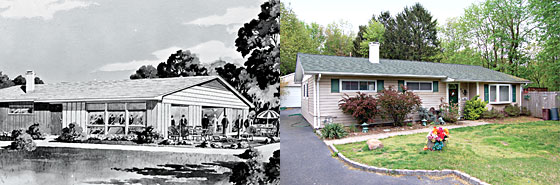
In 1959, as vice president of the Housing and Home Components department at Loewy/Snaith, Geller was the design supervisor for the exhibition, the "Typical American House," built at the American National Exhibition in Moscow. The exhibition home largely replicated a home previously built at 398 Townline Road{{cite web | title = The Kitchen Debate's Actual Kitchen | date = 5 May 2011 | publisher = New York Magazine, Justin Davidson, May 8, 2011 | url = http://nymag.com/realestate/features/commack-moscow-2011-5/}} in Commack, New York, which had been originally designed by Stanley H. Klein for a Long Island-based firm, All-State Properties (later known as Sadkin enterprises),{{cite news | title = When a Slice of Beach 'Utopia' Could Be Had for Under $17,000 | publisher = The New York Times, August 3, 2003, Julia Mead | url = https://www.nytimes.com/2003/08/03/nyregion/architecture-when-a-slice-of-beach-utopia-could-be-had-for-under-17000.html?scp=39&sq=%22andrew%20geller%22&st=cse | date=August 3, 2003}} headed by developer Herbert Sadkin.{{cite news | title = Macy's Montauk Houses, a Cold War Footnote | publisher = The New York Times, Carole Paquette, April 6, 2003 | url = https://www.nytimes.com/2003/04/06/realestate/in-the-region-long-island-macy-s-montauk-houses-a-cold-war-footnote.html?scp=81&sq=%22andrew%20geller%22&st=cse | date=April 6, 2003}}{{cite news | title = Herbert Sadkin, 72, Former L.I. Developer | publisher = The New York Times, February 18, 1989 | url = https://www.nytimes.com/1989/02/18/obituaries/herbert-sadkin-72-former-li-developer.html?scp=1&sq=Herbert%20Sadkin&st=cse | date=February 18, 1989}} To accommodate visitors to the exhibition, Sadkin hired Loewy's office to modify Klein's floor plan. Geller supervised the work, which "split" the house, creating a way for large numbers of visitors to tour the small house and giving rise to its nickname, Splitnik.See: Geller's "split" home at the American National Exhibition and 398 Townline Road, Commack, New York, designed by Stanley H. Klein

References
- "Andrew Geller, Architect". Glasswing Collective.
- See: [http://artinruins.com/arch/stillinuse/apex/images/rendering.jpg Rendering for Apex Department Stores, Pawtucket, Rhode Island, Andrew Geller]
- See: [https://www.flickr.com/photos/65359853@N00/4716005964/in/photostream/ Lord & Taylor, Stamford, CT, 1969, Andrew Geller] and [https://web.archive.org/web/20160304113355/http://3.bp.blogspot.com/-X0IcPTxHlog/TsdCGS8CPlI/AAAAAAAAV5A/2wezgyR9BJo/s1600/stamford.jpg Rendering, Lord & Taylor, Stamford, CT, Andrew Geller]
- See: [http://alastairgordonwalltowall.files.wordpress.com/2011/12/fireplace.jpeg Andrew Geller design sketch] and [http://alastairgordonwalltowall.files.wordpress.com/2011/12/sketch_interior.jpg Andrew Geller design sketch]
- See: [http://alastairgordonwalltowall.files.wordpress.com/2011/12/esquire_weekend_house.jpg The Esquire Weekend House, rendering by Andrew Geller]
- (10 December 2014). "Save Midcentury Modern Architect Andrew Geller's Archive".
::callout[type=info title="Wikipedia Source"] This article was imported from Wikipedia and is available under the Creative Commons Attribution-ShareAlike 4.0 License. Content has been adapted to SurfDoc format. Original contributors can be found on the article history page. ::