Alpha Gruis
Star in the constellation Grus
title: "Alpha Gruis" type: doc version: 1 created: 2026-02-28 author: "Wikipedia contributors" status: active scope: public tags: ["b-type-main-sequence-stars", "grus-(constellation)", "bayer-objects", "bright-star-catalogue-objects", "durchmusterung-objects", "gliese-and-gj-objects", "henry-draper-catalogue-objects", "hipparcos-objects", "stars-with-proper-names", "gould-objects", "lucidae"] description: "Star in the constellation Grus" topic_path: "science/astronomy" source: "https://en.wikipedia.org/wiki/Alpha_Gruis" license: "CC BY-SA 4.0" wikipedia_page_id: 0 wikipedia_revision_id: 0
::summary Star in the constellation Grus ::
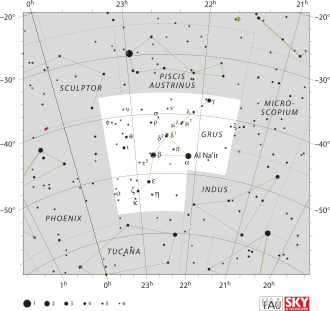
| image = | image=Grus IAU.svg | float=center | width=250 | position=right | mark=Red circle.svg | mark_width=10 | mark_link=α Gru | x%=57.0 | y%=50.0 | caption=Location of α Gruis (circled) | pronounce= | epoch = J2000 | ra = | dec = | appmag_v = +1.74 | constell = Grus | class = B6 V | b-v = −0.13 | u-b = −0.47 | variable = | radial_v = +11.8 | prop_mo_ra = +126.69 | prop_mo_dec = −147.47 | parallax = 32.29 | p_error = 0.21 | parallax_footnote = | absmag_v = | mass = 3.82 | radius = | luminosity = 520 | gravity = | temperature = | metal_fe = | rotational_velocity = 215 | age_myr = 100 | names = |Simbad=alf+Gru
Alpha Gruis is the brightest star in the southern constellation of Grus. It is officially named Alnair; Alpha Gruis is the star's Bayer designation, which is Latinized from α Gruis and abbreviated α Gru. With a magnitude of 1.74, it is one of the brightest stars in the sky and one of the fifty-eight stars selected for celestial navigation. Alpha Gruis is a single, B-type main-sequence star located at a distance of .
Nomenclature
α Gruis (Latinised to Alpha Gruis) is the star's Bayer designation. (Its first depiction in a celestial atlas was in Johann Bayer's Uranometria of 1603.)
It bore the traditional name Alnair or Al Nair (sometimes Al Na'ir in lists of stars used by navigators), from the Arabic al-nayyir "the bright one", itself derived from its Arabic name, al-nayyir min dhanab al-ḥūt (al-janūbiyy), "the bright one from the (southern) fish's tail" (see Aldhanab). Confusingly, Alnair was also given as the proper name for Zeta Centauri in an astronomical ephemerides in the middle of the 20th century. In 2016, the International Astronomical Union organized a Working Group on Star Names (WGSN) to catalog and standardize proper names for stars. The WGSN approved the name Alnair for this star on 21 August 2016 and it is now so entered in the IAU Catalog of Star Names.
Along with Beta Gruis, Delta Gruis, Theta Gruis, Iota Gruis, and Lambda Gruis, Alpha Gruis belonged to Piscis Austrinus in traditional Arabic astronomy.
In Chinese, 鶴 (Hè), meaning Crane, refers to an asterism consisting of Alpha Gruis, Beta Gruis, Delta2 Gruis, Epsilon Gruis, Zeta Gruis, Eta Gruis, Iota Gruis, Theta Gruis, Mu1 Gruis and Delta Tucanae. Consequently, Alpha Gruis itself is known as 鶴一 (Hè yī, ). The Chinese name gave rise to another English name, Ke.
Properties
Alpha Gruis has a stellar classification of B6 V, although some sources give it a classification of B7 IV. The first classification indicates that this is a B-type star on the main sequence of stars that are generating energy through the thermonuclear fusion of hydrogen at the core. However, a luminosity class of 'IV' would suggest that this is a subgiant star; meaning the supply of hydrogen at its core is becoming exhausted and the star has started the process of evolving away from the main sequence. It has no known companions.
The measured angular diameter of this star, after correcting for limb darkening, is 1.17 mas. At the Alnair's distance from Earth of 101 ly from Earth, this yields a physical size of times the radius of the Sun. It is rotating rapidly, with a projected rotational velocity of about 215 km/s providing a lower bound for the rate of azimuthal rotation along the equator. This star has around four times the Sun's mass and is radiating roughly 520 times the luminosity of the Sun.
The effective temperature of Alnair's outer envelope is 14,245 K, giving it the blue-white hue characteristic of B-type stars. The abundance of elements other than hydrogen and helium, what astronomers term the metallicity, is about 74% of the abundance in the Sun.
Based on the estimated age and motion, it is a member of the AB Doradus moving group that share a common motion through space. This group has an age of about 70 million years, which is consistent with α Gruis's 100-million-year estimated age (allowing for a margin of error). The space velocity components of this star in the Galactic coordinate system are [U, V, W] = [–7.0 ± 1.1, –25.6 ± 0.7, –15.5 ± 1.4] km/s.
Notes
References
References
- van Leeuwen, F.. (November 2007). "Validation of the new Hipparcos reduction". Astronomy and Astrophysics.
- (2015). "The Ages of Early-type Stars: Strömgren Photometric Methods Calibrated, Validated, Tested, and Applied to Hosts and Prospective Hosts of Directly Imaged Exoplanets". The Astrophysical Journal.
- (2015). "A self-consistent, absolute isochronal age scale for young moving groups in the solar neighbourhood". Monthly Notices of the Royal Astronomical Society.
- (July 2006). "Contributions to the Nearby Stars (NStars) Project: spectroscopy of stars earlier than M0 within 40 pc-The Southern Sample". [[The Astronomical Journal]].
- Wilson, Ralph Elmer. (1953). "General catalogue of stellar radial velocities". Washington.
- Hoffleit, D.. "HR 8425, database entry". [[Centre de Données astronomiques de Strasbourg.
- "LTT 8869 -- High proper-motion Star". Centre de Données astronomiques de Strasbourg.
- (May 2011). "The Tucana/Horologium, Columba, AB Doradus, and Argus Associations: New Members and Dusty Debris Disks". The Astrophysical Journal.
- (September 2008). "A catalogue of multiplicity among bright stellar systems". [[Monthly Notices of the Royal Astronomical Society]].
- (December 2006). "Debris Disk Evolution around A Stars". The Astrophysical Journal.
- (March 1981). "Photoelectric scanner measurements of Balmer emission line profiles for southern Be stars. II - A survey for variations". Astronomy and Astrophysics Supplement Series.
- (November 1999). "Determining the Physical Properties of the B Stars. I. Methodology and First Results". The Astrophysical Journal.
- (2006). "A Dictionary of Modern star Names: A Short Guide to 254 Star Names and Their Derivations". [[Sky Publishing Corporation.
- (1959). "Arabische Sternnamen in Europa". [[Otto Harrassowitz]].
- (1963). "Star Names: Their Lore and Meaning". [[Dover Publications]] Inc..
- (2008). "Rough Guide to the Universe". Penguin.
- (December 21, 2004). "The Colour of Stars". Commonwealth Scientific and Industrial Research Organisation.
- (November 1990). "Accurate absolute luminosities, effective temperatures, radii, masses and surface gravities for a selected sample of field stars". Astronomy and Astrophysics Supplement Series.
- "IAU Catalog of Star Names".
- 陳久金. (2005). "中國星座神話". 五南圖書出版股份有限公司.
- Richard Hinckley Allen. "Star Names — Their Lore and Meaning: Grus".
- "香港太空館 - 研究資源 - 亮星中英對照表". Hong Kong Space Museum.
::callout[type=info title="Wikipedia Source"] This article was imported from Wikipedia and is available under the Creative Commons Attribution-ShareAlike 4.0 License. Content has been adapted to SurfDoc format. Original contributors can be found on the article history page. ::