Aeshnidae
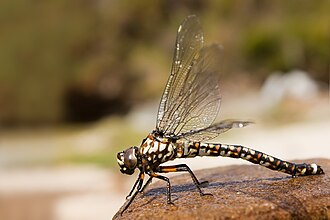
Family of dragonflies
title: "Aeshnidae" type: doc version: 1 created: 2026-02-28 author: "Wikipedia contributors" status: active scope: public tags: ["aeshnidae", "aeshnoidea", "odonata-of-asia", "odonata-of-africa", "odonata-of-australia", "odonata-of-europe", "odonata-of-oceania", "odonata-of-north-america", "odonata-of-south-america", "taxa-named-by-william-elford-leach", "insects-described-in-1815", "odonata-families", "dragonflies", "extant-berriasian-first-appearances"] description: "Family of dragonflies" topic_path: "geography/australia" source: "https://en.wikipedia.org/wiki/Aeshnidae" license: "CC BY-SA 4.0" wikipedia_page_id: 0 wikipedia_revision_id: 0
::summary Family of dragonflies ::
| taxon = Aeshnidae | fossil_range = | image = Lesser Tasmanian Darner Austroaeschna hardyi female.jpg | image_caption = Tasmanian darner (Austroaeschna tasmanica) | authority = Leach, 1815 | subdivision_ranks = Genera | subdivision = See text. | synonyms = * Allopetaliidae Cockerell, 1913
- Gomphaeschnidae Tillyard & Fraser, 1940
- Telephlebiidae Cockerell, 1913 Aeshnidae, also called aeshnids, hawkers, or darners, is a family of dragonflies, found nearly worldwide, with more than 50 genera and over 450 species.
The family includes some of the largest dragonflies, and can be over three inches long.
Description
Common worldwide or nearly worldwide genera are Aeshna and Anax. Anax includes some of the largest dragonflies, including the North American A. walsinghami, Hawaiian A. strenuus, European A. imperator and A. immaculifrons, and African A. tristis, but these are all exceeded by another member of the family, the Asian Tetracanthagyna plagiata, which, by both wingspan and weight, is the world's largest dragonfly.
There are 41 North American species in 11 genera in this family. Most European species belong to Aeshna. Their American name "darner" stems from the female abdomens looking like a sewing needle, as they cut into plant stems when they lay their eggs through the ovipositor.
These dragonflies mate in flight. The eggs are deposited in water or close by. The larvae (nymphs or naiads) are generally slender compared to those of other families, with a long and flat extensible lower lip (labium). The larvae are aquatic predators, feeding on other insects and even small fish.
The adults spend large amounts of time in the air and seem to fly tirelessly with their four large and powerful wings. They can fly forwards, backwards, or hover like a helicopter. The wings are always extended horizontally.
Their abdomens are long and thin. Most are colored blue and/or green, with black and occasionally yellow. Their large, hemispherical compound eyes touch in the midline and nearly cover their heads. They have extremely good vision and are voracious insect predators, using their sharp, biting mouthparts.
All are difficult to catch because of their flying ability and keen sight.
Taxonomy and genera
::figure[src="https://upload.wikimedia.org/wikipedia/commons/5/56/Mangrove_darner_(Coryphaeschna_viriditas).JPG" caption="[[Mangrove darner]] (''Coryphaeschna viriditas''), [[Grand Cayman"] ::
The name Aeshnidae was first proposed as a family by Elford Leach in 1815.
The spelling of Aeshnidae may have resulted from a printer's error in spelling the Greek Aechma, "a spear". The spelling Aeschnidae has been intermittently used over a period of time, but is now abandoned for the original name Aeshnidae. However, derived genus names (such as Rhionaeschna) retain the 'sch' spelling, as this is how they were first cited.
The oldest known members of the family are †Gomphaeschna inferna Pritykina, 1977 and †Baissaeschna Pritykina, 1977, both from the earliest Cretaceous (Berriasian) of Buryatia, Russia. Gomphaeschna displays a very ancient divergence from the rest of the genus, and many fossil dragonfly genera appear to be closely related to it. For this reason, some studies have placed it and its fossil relatives in their own family, Gomphaeschnidae. However, the World Odonata Checklist presently retains it in Aeshnidae.
- Acanthaeschna Selys, 1883
- Adversaeschna Watson, 1992
- Aeschnophlebia Selys, 1883
- Aeshna Fabricius, 1775
- Afroaeschna Peters & Theischinger, 2011
- Agyrtacantha Lieftinck, 1937
- Allopetalia Selys, 1873
- Amphiaeschna Selys, 1871
- Anaciaeschna Selys, 1878
- Anax Leach, 1815
- Andaeschna De Marmels, 1994
- Antipodophlebia Fraser, 1960
- Austroaeschna Selys, 1883
- Austrogynacantha Tillyard, 1908
- Austrophlebia Tillyard, 1916
- Basiaeschna Selys, 1883
- Boyeria McLachlan, 1895
- Brachytron Evans, 1845
- Caliaeschna Selys, 1883
- Castoraeschna Calvert, 1952
- Cephalaeschna Selys, 1883
- Coryphaeschna Williamson, 1903
- Dendroaeschna Tillyard, 1916
- Dromaeschna Förster, 1908
- Epiaeschna Hagen in Selys, 1883
- Gomphaeschna Selys, 1871
- Gynacantha Rambur, 1842
- Gynacanthaeschna Fraser, 1921
- Heliaeschna Selys, 1882
- Indaeschna Fraser, 1926
- Limnetron Förster, 1907
- Linaeschna Martin, 1908
- Nasiaeschna Selys in Förster, 1907
- Neuraeschna Hagen, 1867
- Notoaeschna Tillyard, 1916
- Oligoaeschna Selys, 1889
- Oplonaeschna Selys, 1883
- Oreaeschna Lieftinck, 1937
- Periaeschna Martin, 1908
- Petaliaeschna Fraser, 1927
- Pinheyschna Peters & Theischinger, 2011
- Planaeschna McLachlan, 1896
- Plattycantha Förster, 1908
- Polycanthagyna Fraser, 1933
- Racenaeschna Calvert, 1958
- Remartinia Navás, 1911
- Rhionaeschna Förster, 1909
- Sarasaeschna Karube & Yeh, 2001
- Spinaeschna Theischinger, 1982
- Staurophlebia Brauer, 1865
- Telephlebia Selys, 1883
- Tetracanthagyna Selys, 1883
- Triacanthagyna Selys, 1883
- Zosteraeschna Peter & Theischinger, 2011
Fossil genera
The following fossil aeshnid genera are known. They have been variously classified in the subfamilies Aeschninae, Allopetalinae or Gomphaeschninae, with the latter two sometimes treated as separate families.
- †Alloaeschna Wighton & Wilson, 1986 (mid-late Paleocene of Alberta, Canada)
- †Anglogomphaeschna Nel & Fleck, 2014 (Late Eocene of England)
- †Antiquiala Archibald & Cannings, 2019 (Early Eocene of Washington, US)
- †Anomalaeschna Bechly et al. 2001 (Aptian of Ceará, Brazil)
- †Baissaeshna Pritykina, 1977 (Berriasian or Aptian of Buryatia, Russia)
- †Cretagomphaeschnaoides Zheng, Jarzembowski, Chang & Wang, 2016 (Cenomanian of Myanmar)
- †Cretalloaeschna Jarzembowski & Nel, 1996 (Berriasian of England)
- †Elektrogomphaeschna Pinkert, Bechly & Nel, 2017 (Late Eocene of Kaliningrad, Russia)
- †Eoshna Archibald & Cannings, 2019 (Early Eocene of British Columbia, Canada)
- †Falsisophoaeschna Zhang, Ren & Pang, 2008 (Barremian of Inner Mongolia, China)
- †Gomphaeschnaoides Carle & Wighton, 1990 (Aptian of Ceará, Brazil)
- †Huncoaeshna Petrulevičius, Nel & Voisin, 2010 (Early Eocene of Argentina)
- †Idemlinea Archibald & Cannings, 2019 (Early Eocene of Washington, US)
- †Jingguaeshna Zheng & Zhang, 2021 (Middle Miocene of Yunnan, China)
- †Kachinaeshna Zheng et al., 2019 (Cenomanian of Myanmar)
- †Kishenehna Archibald & Cannings, 2022 (Lutetian of Montana, US)
- †Kvacekia Prokop & Nel, 2002 (Early Oligocene of the Czech Republic)
- †Merlax Prokop & Nel, 2000 (Early Miocene of the Czech Republic)
- †Necracantha Martynov, 1929 (Late Oligocene of Kazakhstan)
- †Oligaeschna Piton & Théobald, 1939 (Middle Eocene to Middle Miocene of Europe, Colorado (US) & China)
- †Palaeaeschna Meunier, 1914 (Barremian of Spain)
- †Parabaissaeshna Bechly & Rasmussen, 2019 (earliest Eocene of Denmark)
- †Paramorbaeschna Bechly et al. 2001 (Aptian of Ceará, Brazil)
- †Plesigomphaeschnaoides Bechly et al. 2001 (Hauterivian to Early Eocene of England, Mongolia, and Denmark)
- †Progomphaeschnaoides Bechly et al. 2001 (Aptian of Ceará, Brazil)
- †Sinojagoria Bechly et al. 2001 (Barremian of Liaoning, China)
- †Sophoaeschna Zhang, Ren & Pang, 2008 (Barremian of Inner Mongolia, China)
- †Ypshna Archibald & Cannings, 2019 (Early Eocene of British Columbia, Canada)
References
References
- (1815). "The Edinburgh Encyclopedia". William Blackburn.
- (2013). "The classification and diversity of dragonflies and damselflies (Odonata). In: Zhang, Z.-Q. (Ed.) Animal Biodiversity: An Outline of Higher-level Classification and Survey of Taxonomic Richness (Addenda 2013)". Zootaxa.
- {{World Odonata List
- (June 2017). "Dragonflies of the Family Aeshnidae in British Columbia".
- (March 2016). "How to date a dragonfly: Fossil calibrations for odonates". Palaeontologia Electronica.
- (2023-01-01). "New odonatans (Odonata: Gomphaeschnidae; Synlestidae) from the Paleocene Paskapoo Formation: systematic and biogeographical implications". Journal of Systematic Palaeontology.
- {{World Odonata List
- "Superfamily Aeshnoidea Leach 1815 (true dragonfly)". Paleobiology Database.
- "Family Gomphaeschnidae Tillyard and Fraser 1940 (true dragonfly)". Paleobiology Database.
- (2019). "Fossil dragonflies (Odonata: Anisoptera) from the early Eocene Okanagan Highlands, western North America". The Canadian Entomologist.
- (2016-11-01). "A new true dragonfly (Odonata, Anisoptera, Gomphaeschnaoidini) from mid-Cretaceous Burmese amber". Proceedings of the Geologists' Association.
- (2017). "First record of hawker dragonflies from Eocene Baltic amber (Odonata: Anisoptera: Gomphaeschnidae)". Zootaxa.
- (2008-01-10). "New dragonflies (Insecta: Odonata: Gomphaeschnidae) from the Yixian Formation in Inner Mongolia, China". Progress in Natural Science.
- (2010-01-01). "A new genus and species of darner dragonfl y (Aeshnidae: Odonata) from the lower Eocene of Laguna del Hunco, Patagonia, Argentina". Annales de la Société entomologique de France.
- (2019-08-01). "New gomphaeschnid dragonflies (Odonata: Anisoptera: Aeshnoptera) from mid-Cretaceous Burmese amber". Cretaceous Research.
::callout[type=info title="Wikipedia Source"] This article was imported from Wikipedia and is available under the Creative Commons Attribution-ShareAlike 4.0 License. Content has been adapted to SurfDoc format. Original contributors can be found on the article history page. ::