3C 48
Quasar discovered in 1960
title: "3C 48" type: doc version: 1 created: 2026-02-28 author: "Wikipedia contributors" status: active scope: public tags: ["quasars", "3c-objects", "astronomical-objects-discovered-in-1960", "triangulum", "principal-galaxies-catalogue-objects", "galaxy-mergers"] description: "Quasar discovered in 1960" topic_path: "science/astronomy" source: "https://en.wikipedia.org/wiki/3C_48" license: "CC BY-SA 4.0" wikipedia_page_id: 0 wikipedia_revision_id: 0
::summary Quasar discovered in 1960 ::
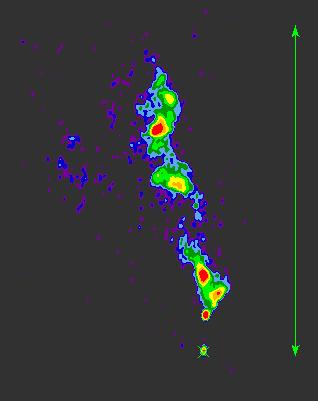
| name = 3C 48 | image = Radio map of quasar 3C48.jpg | epoch = J2000 | ra = {{cite web | title=NASA/IPAC Extragalactic Database | work=Results for 3C 48 | url=http://nedwww.ipac.caltech.edu/cgi-bin/nph-objsearch?objname=3C+48&extend=no | access-date=2006-10-26 }} | dec = | constellation name = Triangulum | z = 110,024 ± 0 km/s 0.367 | type = E | dist_ly = 3.9 billion light-years (Light travel time) 4.5 billion light-years (present) | appmag_v = 16.2 | size_v = 0.6 × 0.5 | notes = First quasar discovered | names = PG 0134+329, QSO B0134+329, PGC 73991
3C48 is a quasar discovered in 1960; it was the second source conclusively identified as such.
3C48 was the first source in the Third Cambridge Catalogue of Radio Sources for which an optical identification was found by Allan Sandage and Thomas A. Matthews in 1960 through interferometry.{{cite journal | author= Matthews, Thomas A. | author-link= Thomas A. Matthews | author2= Sandage, Allan R. | author2-link= Allan Sandage | title=Optical Identification of 3c 48, 3c 196, and 3c 286 with Stellar Objects | date=1963 | journal=The Astrophysical Journal | volume=138 | pages=30–56 | doi=10.1086/147615 | bibcode=1963ApJ...138...30M | doi-access=free In 1963 Jesse L. Greenstein and Thomas Matthews found that it had a redshift of 0.367, making it one of the highest redshift sources then known.{{cite journal | author=Greenstein, J. L. | author-link=Jesse L. Greenstein |author2=Matthews, Thomas A. |author2-link=Thomas A. Matthews | title=Red-Shift of the Unusual Radio Source 3C48 | date=1963 | journal=Nature | volume=197 | issue=4872 | pages=1041–1042 | bibcode=1963Natur.197.1041G | doi=10.1038/1971041a0 | s2cid=4193798 It was not until 1982 that the surrounding faint galactic "nebulosity" was confirmed to have the same redshift as 3C48, cementing its identification as an object in a distant galaxy.{{cite journal | author=Todd A. Boroson | author2=Oke, J. B. | name-list-style=amp | title=Detection of the underlying galaxy in the QSO 3C48 | journal=Nature | volume=296 | issue=5856 | pages=397–399 | bibcode=1982Natur.296..397B | doi=10.1038/296397a0 | date=1982| s2cid=4284238
3C 48 is one of four primary calibrators used by the Very Large Array (along with 3C 138 and 3C 147, and 3C 286). Visibilities of all other sources are calibrated using observed visibilities of one of these four calibrators.
Studies have confirmed 3C 48 is found currently in the process of an advanced galaxy merger stage, with the budge components only 2.5 kiloparsecs from each other. This merger resulted from the collision of two similar disk galaxies. A radio jet on one side, is found based on radio imaging, with signs of faint radio emission. This jet is also suggested as disrupted.
Nomenclature
The name of the object "3C 48" consists of two significant parts. The first part, "3C," means that the object belongs to the Third Cambridge Catalog of Radio Sources. The second part - "48" - is the serial number in the catalog ordered by right ascension.
History
3C 48 was the first source in the Third Cambridge Catalog of Radio Sources to be optically identified by Allan Sandage and Thomas Matthews in 1960 using interferometry.
Jesse Greenstein and Thomas Matthews found that it had a redshift of 0.367, one of the highest redshifts of any source known at the time. It was not until 1982 that a surrounding faint galactic "nebula" was measured to have the same redshift as 3C 48, confirming its identification as an object in a distant galaxy. This was also the first reliable identification of a quasar with a surrounding galaxy of the same redshift.
::quote[attribution="The color indices]] of 3C48 were also unusual: Sandage found that they were consistent with hot [[white dwarf"] emission lines]] that defied identification. [[Color Index ::
In December 1960, Sandage reported the results of the first optical observations of 3C48 at the 107th meeting of the American Astronomical Society. Testing the hypothesis that 3C48 is a stellar remnant of a nova or even a supernova ("the first true radio star"), H. Smith and D. Hoffleit looked through the Harvard Sky Survey's collection of plates for 1897-1958 and did not find any noticeable fluctuations in the object's brightness exceeding 0.3m, which are common in former novae. The most likely possibility seemed to be that it was a neutron star - a remnant of a supernova.|author=Yu. N. Efremov|title=Into the Universe|source=https://archive.org/details/isbn_535400392X_844}}
References
References
- "3C 48".
- Weaver, Kenneth F.. (May 1974). "The Incredible Universe". [[National Geographic (magazine).
- Witz, Stephan W.. (4 December 2015). "Calibration and Flux Density Scale". [[National Radio Astronomy Observatory]].
- Scharwächter, J.. (2004-02-01). "A multi-particle model of the 3C 48 host". Astronomy & Astrophysics.
- Kirhakos, Sofia. (1999-07-20). "The Host Galaxies of Three Radio‐loud Quasars: 3C 48, 3C 345, and B2 1425+267". The Astrophysical Journal.
- Wilkinson, P. N.. (July 1991). "A disrupted radio jet inside the host galaxy of the quasar 3C48". Nature.
- (1963). "Optical Identification of 3c 48, 3c 196, and 3c 286 with Stellar Objects". [[IOP Publishing]].
::callout[type=info title="Wikipedia Source"] This article was imported from Wikipedia and is available under the Creative Commons Attribution-ShareAlike 4.0 License. Content has been adapted to SurfDoc format. Original contributors can be found on the article history page. ::