31 Aquilae
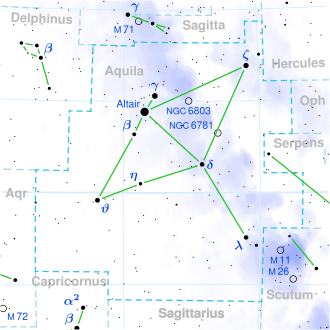
Star in the constellation Aquila
title: "31 Aquilae" type: doc version: 1 created: 2026-02-28 author: "Wikipedia contributors" status: active scope: public tags: ["bayer-objects", "flamsteed-objects", "henry-draper-catalogue-objects", "spectroscopic-binaries", "aquila-(constellation)", "g-type-subgiants", "hipparcos-objects", "bright-star-catalogue-objects", "durchmusterung-objects", "gliese-and-gj-objects"] description: "Star in the constellation Aquila" topic_path: "general/bayer-objects" source: "https://en.wikipedia.org/wiki/31_Aquilae" license: "CC BY-SA 4.0" wikipedia_page_id: 0 wikipedia_revision_id: 0
::summary Star in the constellation Aquila ::
| image= |image=Aquila constellation map.svg|alt=|float=center|width=260 |label=|position=right |mark=Red circle.svg|mark_width=10|mark_link=31 Aquilae |x=614|y=254 | caption=Location of 31 Aquilae (circled) | epoch = J2000 | constell = Aquila | ra = | dec = | appmag_v = 5.16 | type = subgiant | class = G8 IV | b-v = +0.77 | u-b = +0.42 | r-i = | v-r = | variable = | radial_v = −100.5 | prop_mo_ra = +721.292 | prop_mo_dec = +642.968 | parallax = 67.0153 | p_error = 0.0657 | parallax_footnote = | absmag_v = +4.26 | mass = | radius = | luminosity = | temperature = | metal_fe = +0.37 | rotational_velocity = | gravity = | age_gyr = | names= BD+11 3833, FK5 1503, HD 182572, GJ 759, NLTT 47763, HIP 95447, HR 7373, LFT 1477, LHS 3463, LTT 15668, NSV 11994, SAO 104807. |Simbad=31+Aql
31 Aquilae (abbreviated 31 Aql) is a star in the equatorial constellation of Aquila. 31 Aquilae is its Flamsteed designation though it also bears the Bayer designation b Aquilae. This star has an apparent visual magnitude of 5.16 and is 49.5 light years from Earth. It has no known companions.
Properties
31 Aquilae has an apparent visual magnitude of 5.16, making it bright enough to be seen with the naked eye in dark skies. The annual parallax shift of yields a distance estimate of 48.7 ly from Earth. It is a variable star with a magnitude change of less than 0.02.
With a stellar classification of G8 IV, the luminosity class of IV indicates this is a subgiant star. Compared to the Sun, it has 116% of the mass and 138% of the radius. It is radiating nearly double the luminosity of the Sun from its outer atmosphere at an effective temperature of 5,510 K, giving it the yellow hue of a G-type star. Its age is probably similar to NGC 188, the oldest open cluster known, which was calculated to be over 5 billion years. For its age, it is surprisingly rich in elements other than hydrogen or helium, contrary to common assumptions that the oldest stars should be metal-poor.
No certain substellar companion has been detected so far around 31 Aquilae. McDonald Observatory team has set limits to the presence of one or more planets around 31 Aquilae with masses between 0.22 and 1.9 Jupiter masses and average separations spanning between 0.05 and 5.2 Astronomical Units.
Optical companions
The following stars are optical companions that are coincidentally aligned near the line of sight to 31 Aquilae.
::data[format=table]
| Companion | Right ascension | Declination | Magnitude | Spectral type | Reference |
|---|---|---|---|---|---|
| HD 231345 | BD+11 3833C | ||||
| 8.56 | 10.6 | ||||
| G0 | |||||
| Simbad | Simbad | ||||
| :: |
References
References
- Detection Limits from the McDonald Observatory Planet Search Program
- (2012). "XHIP: An extended hipparcos compilation". Astronomy Letters.
- (November 1990). "Accurate absolute luminosities, effective temperatures, radii, masses and surface gravities for a selected sample of field stars". Astronomy and Astrophysics Supplement Series.
- (2008). "Vertical distribution of Galactic disk stars. IV. AMR and AVR from clump giants". Astronomy and Astrophysics.
- (1999). "Sixth Catalogue of Fundamental Stars (FK6). Part I. Basic fundamental stars with direct solutions". Astronomisches Rechen-Institut Heidelberg.
- (1966). "UBVRIJKL photometry of the bright stars". Communications of the Lunar and Planetary Laboratory.
- (November 2011). "Analysis of old very metal rich stars in the solar neighbourhood". Astronomy & Astrophysics.
- (February 2012). "Stellar Diameters and Temperatures. I. Main-sequence A, F, and G Stars". The Astrophysical Journal.
- (December 21, 2004). "The Colour of Stars". [[Commonwealth Scientific and Industrial Research Organisation]].
- "* b Aql".
- {{cite Gaia DR3. 4315804351350378496
::callout[type=info title="Wikipedia Source"] This article was imported from Wikipedia and is available under the Creative Commons Attribution-ShareAlike 4.0 License. Content has been adapted to SurfDoc format. Original contributors can be found on the article history page. ::